


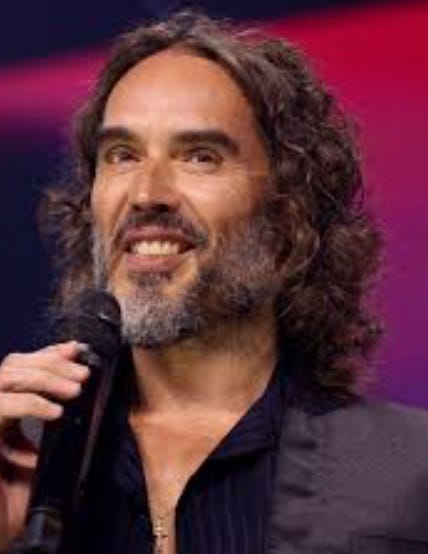
On November 5, 2026, a jury at Southwark Crown Court in London convicted British comedian, actor, and broadcaster Russell Brand of one count of rape and three counts of sexual assault, following a four-week criminal trial.
Brand was acquitted of two additional rape charges and one charge of attempted indecent assault. Sentencing is scheduled for November 9, and Brand faces a potentially lengthy prison sentence.
Brand denied all charges. He acknowledged having been promiscuous during the period in question, but he insisted that his sexual encounters were consensual.
The following are the offenses for which he was convicted and the circumstances in which they are alleged to have occurred.
Rape: The complainant stated that she met Brand backstage at a stand-up comedy show in early 2009 and then visited him in his townhouse in Hampstead, North London. She claimed the sexual encounter began as consensual but became nonconsensual when he forced anal sex.
Sexual Assault: The complainant claimed that, in the summer of 2004, at a bar in Soho, Central London, during her birthday celebration, Brand groped her breasts.
Sexual Assault: The complainant stated that in the summer of 2004 or 2005, at the Capital Radio building (Choice FM corridor) in London, Brand violently kissed and groped her (a Choice FM worker) in front of his entourage while she was at work.
Sexual Assault: The complainant stated that on a Channel 4 recording set, members of Brand’s entourage told her he would not film the production unless she massaged him. She claimed that she consented to giving the massage, but while performing it, he lunged at her groin.
Brand’s defense argued that the allegations had been reconstructed or reinterpreted many years after the events, following damaging media reporting in September 2023.
The task for the prosecution was to establish beyond a reasonable doubt that Brand had committed criminal sexual acts. This was no easy task, given the passage of up to two decades and the limited amount of physical and contemporaneous evidence that could be presented that could verify the claims of the accusers.
The accusers were granted anonymity and shielded from view from Brand and the jury by a large blue screen, though Brand and his attorneys were informed of their identities, and Brand’s attorneys were given the opportunity to cross examine them.
The prosecution portrayed the incidents as examples of a recurring pattern: Brand allegedly exploited his charm, professional standing, and increasingly powerful celebrity status to obtain sexual gratification without the women’s consent.
All six women came forward to police after a September 2023 television documentary and newspaper investigation publicized other allegations against Brand. The complainants in the criminal trial were not the same as the complainants whose stories were told in media reporting.
What Evidence Was Presented in Court?
The most significant question at trial was if evidence could be presented to prove Brand’s guilt.
The Metropolitan Police acknowledged that there was no available CCTV or forensic evidence, and that the passage of time had severely limited the availability of digital records. The prosecution therefore based its case on the following.
The detailed, graphic, and lurid nature of the alleged rape victim’s testimony. She told the jury that, although the encounter began with consensual sex, this ended when Brand flipped her over and anally raped her so violently that she struggled to breathe. She told the jury she begged him to stop but he refused, telling her, “I want you to feel my come.” She further testified that he chastised her for getting blood on his sheets and ordered her to clean up the mess before casually turning on the TV and instructing an assistant to escort her out.
To support her testimony, the woman claimed that she confronted Brand in a text exchange approximately six months later. According to the woman, the text exchange read as follows:
Brand: “Because you are dirty and I want to push you further.”
Complainant: “I think you pushed me far enough; you treated me like an animal.”
Brand: “I’m sorry.”
NOTE: It is not clear from conflicting reports as to whether this text exchange was presented to the jury as original messages or screenshots that were authenticated and admitted as exhibits, or whether the exchange is a reconstruction from the woman’s memory of the exchange.
Brand’s former flatmate, Mark Pinheiro, testified that Brand had told him he might have gone too far with a woman during the 1999 Labour Party conference. This concerned an allegation on which Brand was ultimately acquitted.
Other acquaintances testified about his extraordinary sexual appetite and methods of persuading women to have sex. Such testimony portrayed his attitudes and behavior—but did not independently establish that a particular assault occurred.
One complainant also testified that she reported the 2009 workplace incident to her manager. Such evidence could help establish circumstances and corroborate reporting, without necessarily proving the sexual misconduct itself.
Inconsistencies in Brand’s accounts. According to police, Brand initially maintained that he did not recognize several complainants, but his recollections changed as the trial approached. Prosecutors argued that these changes undermined his credibility. Brand claimed the accusations prompted him to meditate on the period in question, which prompted him to recall the women.
Prosecutors claimed that the women—who did not know one another—described broadly similar patterns of behavior, including abrupt sexual advances, disregard for objections, and apparently indifferent conduct afterward.
Defense Arguments
Brand’s barrister, Ian Winter KC, argued that sexual promiscuity, however distasteful, is not evidence of criminality. He challenged the complainants’ recollections, their failure to report the incidents for many years, and the possibility that the 2023 media investigation had influenced their subsequent interpretation of events.
The defense also questioned why some complainants had not physically resisted or immediately protested. The prosecution countered that victims respond to sexual assault in different ways and that the absence of resistance does not establish consent.
The jury’s verdict was mixed. It accepted four allegations beyond reasonable doubt but acquitted Brand of three others. It convicted him of sexually assaulting a woman at a birthday celebration in a London (Soho) bar in 2004 while acquitting him of raping the same woman during the same occasion.
Evaluating What Passed for Evidence
In my twenty years of investigating true crimes, I have consulted with many forensic scientists, prosecutors, and criminal defense attorneys. When trying to determine if an accused man is indeed guilty of grave crimes, it all comes down to the evidence. No matter how suspicious and unsympathetic we may find someone, me must remain focused on the proof of his guilt, and not our subjective perceptions and feelings about the accused.
My goal in writing this essay is not to proclaim Russell Brand’s innocence, but to point out what strikes me as grave deficiencies in the so-called evidence that was presented against him, the likelihood that the jury was prejudiced against him, and the likelihood that the jury felt considerable social and psychological pressure to find him guilty.
A central pillar of the Anglo-American criminal justice system is that accusations and denunciations are, by themselves, not sufficient to convict a man of grave crimes. The great English jurist, Sir William Blackstone (1723–1780) specifically addressed the danger of false accusations, malicious prosecutions, and wrongful convictions in his monumental Commentaries on the Laws of England, published in four volumes between 1765 and 1769.
Blackstone regarded the possibility of an innocent person being falsely accused and punished as a fundamental danger against which English criminal law must provide safeguards. He articulated the presumption of innocence and the principle that the state must establish guilt rather than require an accused person to prove innocence.
In Book IV, Chapter 27, “Of Trial, and Conviction,” Blackstone wrote:
For the law holds, that it is better that ten guilty persons escape, than that one innocent suffer.
This became known as Blackstone’s ratio, one of the most influential formulations of the principle that the criminal justice system should err on the side of protecting the innocent. Blackstone’s formulation expresses the conviction that the consequences of wrongful punishment are so serious that the law must impose a substantial burden of proof upon the prosecution.
At the time he wrote his monumental work, he reflected on the dark days of Europe’s religious wars and witch trials in the 16th and 17th centuries, when tens of thousands of people were persecuted for the crime of heresy on the basis of denunciations.
At the height of the witch hysteria, thousands of men and women were burned at the stake on the basis of lurid accusations with zero accompanying evidence that the accused were practicing witchcraft. Score settling, revenge, resentment, elimination of rivals, and scapegoating were common motives for denunciation.
I’m sure that Russell Brand was an aggressively promiscuous man during the period in question. He himself has admitted it. Thus, if he had been tried for being—at this earlier stage in his life—a selfish, sleazy, and arrogant jerk, it would probably be easy to adduce sufficient evidence to find him guilty as charged.
However, it strikes me as impossible to draw conclusions—beyond a reasonable doubt—about allegedly criminal sexual behavior that took place decades ago, with no supporting physical evidence such as medically documented injuries, no eyewitness testimony of the alleged acts, and only hearsay testimony from the victims’ friends and colleagues that is ambiguous and fragmentary.
Regarding the accusation of rape—by far the most serious charge for which Brand was convicted—the “reported” text message from his accuser in which she stated, “you treated me like an animal” may be plausibly evaluated as evidence that Brand made her feel like a cheap article of consumption and discarded as soon as his lust was sated. However, this is not evidence that he raped her. If he did rape her, she missed an opportunity to document it by not stating it in the text, not reporting it to the police, and not having a medical professional document her injury. No medical documentation of the alleged injury was presented at trial.
Brand’s “assistant” to whom she referred as escorting her out of the townhouse did not testify at the trial, and nor were any statements from him presented to the jury. One wonders why not, given that this assistant was—according to the woman—a witness of the immediate aftermath of the alleged crime and extreme trauma it inflicted on her.
The same can be said of Brand’s driver, whom the woman claimed drove her to a nearby Tube station and handed her tissue paper when he saw she was upset. Given that the driver could have served as a key witness of the woman’s mental state in the immediate aftermath of the alleged crime, one wonders why the jury heard no testimony or statements from him.
Were the police unable to find the assistant and the driver, or had they died in the intervening seventeen years? If so, it is an example of the difficulty of investigating and adjudicating an alleged crime after the passage of almost two decades.
One wonders why Brand was apparently so confident that he needn’t worry about the woman telling his assistant and his driver about the shocking crime that he had allegedly just committed against her. It’s a logical inference that, for all Brand knew, the woman would demand that his driver take her to the nearest police station.
The woman’s mother stated that the woman told her and her father about the rape and expressed fear that she may have contracted HIV from the incident, and therefore got tested for it. However, for some reason, the woman’s parents also chose not to report the incident to the police. That the woman’s father did not report the crime seems especially puzzling.
A former boyfriend of the woman stated in a 2025 police interview that the woman had told him about her anal intercourse with Brand, had been deeply upset by it, but that she had ultimately “come round,” suggesting that she had allowed herself to be talked into it. One of the woman’s female friends recalled the complainant saying she did not want anal sex but that Brand had assured her he would be gentle.
These witness statements added another element of ambiguity to what exactly happened in Brand’s bedroom seventeen years ago. The difficulty of evaluating the complainant’s testimony is further amplified by substantial scientific evidence that memory of events in the distant past tends to be reconstructive, heavily influenced by subsequent events and perceptions, and not a literal recording.
Another example of the extreme difficulty of evaluating the accusations made against Russell Brand is revealed in how the jury regarded the charge that he had sexually assaulted a woman in a Soho bar and subsequently “orally raped her” in the bar’s bathroom. The jury found Brand guilty of sexually assaulting her in the bar, but not guilty of “orally raping” her in the bathroom.
Given that the jury concluded that her claim that Brand “orally raped her” in the bathroom was insufficient to establish guilt, one wonders why it regarded her claim that he sexually assaulted her in the bar as sufficient to establish his guilt.
Brand claimed they went into the bathroom together to fool around; she claimed that he forced her into the bathroom. Brand’s defense attorney pointed out that she didn’t yell for help and that she got into Brand’s car after the alleged incident.
The woman acknowledged that she got into Brand’s car after the incident, but claimed she didn’t do so voluntarily, but was “shepherded along” and into the car without realizing it was Brand’s until she got into it. Nevertheless, she acknowledged that they went to another bar in Camden together. She claimed that, during the drive to the other bar, he again tried to force her to give him oral sex.
Brand’s defense attorney asked the jury how it was conceivable that a woman who had just been orally raped would get into her alleged assailant's car. The jury apparently concluded this was a good point, but still found Brand guilty of sexually assaulting her in the bar.
No eyewitnesses of the alleged sexual assault in the bar testified at the trial. The only testimony presented was that of hearsay witnesses whom the woman subsequently told about the incident. A man who attended the party testified that he recalled seeing Brand emerge from the bathroom, followed by a woman. He said Brand looked straight through him with a blank expression. He could not remember the woman's demeanor.
In the case of the alleged assault at the Capitol Radio Studio, none of the alleged eyewitnesses of the incident testified at the trial, and nor was any mention made at trial of any statements they may have made to the police.
The prosecutor’s claim—with respect to the sexual assault cases—that the absence of resistance or protest does not establish consent is perhaps true in the sense that some victims may be paralyzed by shock and fear. However, this raises the question of how precisely—in the absence of resistance or protest—a man can know that a woman does not consent to a sexual act.
By longstanding convention, men are usually expected to make the first move in sexual matters, but the conviction of Russell Brand suggests that any bold move to initiate sexual contact could be interpreted as a form of sexual assault if the advance is unwelcome.
This touches on our society’s schizophrenic attitude towards sex, vacillating between “hook-up culture” (in which celebrated men have access to innumerable eager partners) on the one hand, and outrage at male effrontery on the other.
The Timing of the Investigation and Accusations
According to the journalists who ultimately published the September 2023 report, they began their investigation in 2019 by seeking women who could and would relate their experiences of being sexually abused by Brand. This raises the following questions:
What motivated these journalists in 2019 to investigate a period in Brand’s distant past? It strikes me as notable that journalists began to investigate Brand two years after he married his current spouse, split from his agent, and was working as an independent broadcaster. Why didn’t the British press investigate him during the much earlier period in question, when Brand had a current reputation for being a promiscuous cad?
Upon finding women who claimed to have been abused by Brand, why didn’t the journalists encourage them to report the incidents to the police so that Brand would be officially investigated and judicially punished for his crimes? Reports indicate that the women they found did not want to endure the trouble of participating in a police investigation against a powerful man. While no one wants to participate in a police investigation, it’s extremely difficult to evaluate the veracity of accusations if they aren’t reported to criminal justice authorities.
Why didn’t the Metropolitan police consider the accusations made in the media as sufficiently credible to serve as grounds for prosecution? According to published accounts, the Crown Prosecution concluded that the accusations made in the media could not be proven beyond a reasonable doubt. In other words, the accusations wouldn’t pass muster in court, but were sufficient for conditioning the British public, including potential jury members, to regard him as guilty.
Before Brand’s trial, much of the British press had a field day with the lurid accusations against him, publishing little if any cautionary language about the presumption of innocence and the critical importance of supporting evidence. The marked slant of newspaper reporting conveyed the impression that the accusations are self-evidently true and that any questioning of their veracity is immoral and disrespectful of the alleged victims, as though expressing outrage for accusers is more important than observing due process for the accused. Reviewing these reports reminds me of Thomas Babington Macaulay’s famous remark in his 1830 review, “Moore’s Life of Lord Byron”—that is, “We know of no spectacle so ridiculous as the British public in one of its periodical fits of morality.”
Given the media blitz of accusations against Brand in September 2023, how did the Crown Prosecution service conclude it could assemble an impartial jury in Britain?
The probability that the jury was prejudiced against Brand was amplified by testimony about his generally promiscuous conduct that did not directly pertain to the crimes for which he was charged. The sexual assault charges such as breast groping with no eyewitness testimony also likely had a prejudicial effect on the minds of the jurors when it came to evaluating the testimony of the alleged rape victim.
The prosecution attributed significance to the fact that the complainants came forward independently from one another after viewing these media reports in 2023—as distinct from conspiring with each other to come forward.
Multiple media outlets reported the accusations in a coordinated fashion. One wonders if the accusers got the impression that someone with influence and resources—perhaps a senior media or public relations executive—welcomed their accusations.
A Concerning Timeline
January 16, 2018: Channel 4 News’s Cathy Newman interviews Jordan Peterson in which he challenges numerous British establishment pieties and orthodoxies. Cathy Newman comports herself in a way that is widely perceived as self-righteous, hostile, rude, and ineffectual. The video goes viral, thereby greatly elevating Peterson’s international profile and embarrassing Newman.
February 14, 2018: Russell Brand interviews Jordon Peterson. Their collegial, serious, and thoughtful conversation is published on Brand’s podcast Under the Skin. As an independent media personality, Brand increasingly espouses views that many in Britain regard as “right wing” and challenging of British establishment pieties.
2019: Investigative journalists purportedly begin digging into Brand’s past.
May, 13, 2020: Brand publicly questions Britain’s lockdown policies. In a YouTube video titled “Stay Alert! The Beginning of the End of Covid?” he asks whether the lockdown is justified and whether it should continue.
2021: Brand increasingly challenges vaccine mandates, government authority, and pharmaceutical-industry influence.
November 25, 2021: Brand publishes Vaccine Mandates: THIS Is What History WARNS Us, criticizing governments’ response to protests against mandates.
February 2022: In the lead-up to the delayed release of Disney’s Death on the Nile, in which Brand plays Dr. Windlesham, Brand intensifies his anti-establishment political activism on YouTube. He posts videos speaking out against vaccine mandates and questioning mainstream pandemic narratives. This clashes with Disney’s strict corporate stance and rigorous on-set safety mandates, creating substantial friction between the actor and the studio.
May 12, 2023: Brand publishes his interview with Robert F. Kennedy, Jr. titled RFK Jr. (Fauci, CIA Secrets & Running for President).
September 16, 2023: Channel 4's Dispatches documentary and accompanying Times and Sunday Times investigation are published—a coordinated media action that resembles what propagandists call “flooding the zone.”
September 25, 2023: The Metropolitan Police announces its criminal investigation of Russell Brand.
Why were British media outlets—and later the Metropolitan Police—so keen to investigate unsubstantiated allegations of Brand’s sexual misconduct in the distant past?
We know from the grooming gang scandal that British law enforcement has a record of being highly selective about investigating rape allegations. What motivated them to pursue such a vigorous investigation and prosecution of Brand, despite the paucity of evidence to support the accusations?
We also know from what happened to Julian Assange that high profile public figures who challenge powerful state agencies and political factions may be targeted for persecution. Accusations of sexual misconduct are a documented method for punishing and eliminating politically unpopular figures.
Is seems likely that all the media reporting about Russell Brand’s alleged sexual crimes and his trial for these alleged crimes has been a welcome distraction for innumerable powerful men—including multiple British media executives— mentioned in the Epstein Files. Russell Brand is not among this large cohort.
If accusations and denunciations—with little to no supporting evidence—are deemed sufficient for sending a man to prison, then any man may be subjected to such accusations, even if they are baseless.
Weaponization of unstable women to bring down any entertainer who crosses to the right.
The downfall of western civilization will be liberal white women.