


Last night at dinner, Dr. McCullough and I talked about all of those who suffered so terribly in the past of illnesses that could have been easily cured in a few days by penicillin. I was thinking of Franz Schubert—one of my favorite composers—whose life was tormented and cut short by syphilis.
The disease was first described around the year 1495, following a severe outbreak among French troops during the invasion of Naples. Initially known as the "French Disease" or "Great Pox," it was characterized as a new, highly virulent, and sexually transmitted illness that spread rapidly across the continent. Typically starting at the genitals, it can spread and ravage the entire body. The causative agent—a bacteria called Treponema pallidum—is quickly and easily vanquished by penicillin.
Last night, after I got home from dinner, I listened to podcast about the French philosopher, Michel de Montaigne, who has long been one of my favorite essayists. Curious about how he died, I looked it up in Wikipedia, and read the following:
Montaigne died in 1592 at the age of 59, at the Château de Montaigne, from a peritonsillar abscess. In his case, the disease "brought about paralysis of the tongue,” especially difficult for a person who once said that "the most fruitful and natural play of the mind is conversation. I find it sweeter than any other action in life; and if I were forced to choose, I think I would rather lose my sight than my hearing and voice.”
Again, his painful and fatal abscess could have been easily cured by penicillin.
I believe the development of penicillin is mankind’s greatest pharmaceutical achievement. Alexander Fleming is credited with discovering it in 1928, but it took an array of dedicated scientists, clinicians, and industrial manufacturers to turn Fleming’s lab discovery into a safe and effective antibiotic agent that could be mass manufactured and administered.
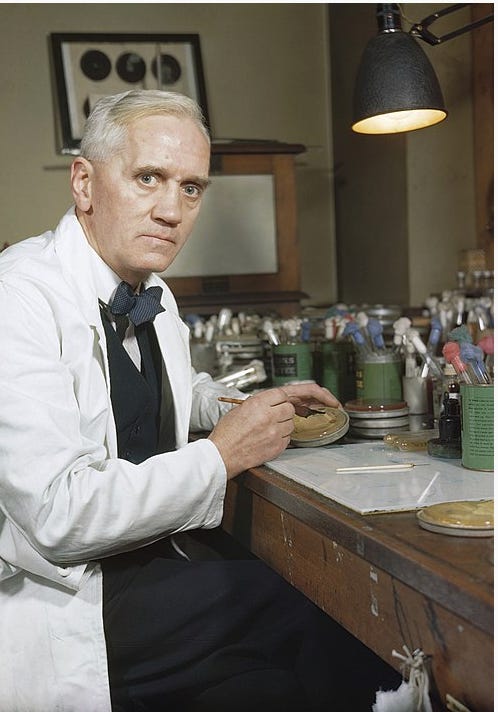
Fleming, a bacteriologist at St Mary’s Hospital in London, observed that a mold on one of his culture plates seemed to kill Staphylococcus bacteria that came into contact with it. He characterized the substance produced by the mold (Penicillium notatum) as “penicillin,” but he was unable to develop the substance into a medicine.
As a result, penicillin’s potential remained undeveloped until the late 1930s, when an Oxford research team, led by Howard Florey, Norman Heatley and Ernst Boris Chain developed a method to isolate and concentrate it. They then conducted animal and early human trials that demonstrated its ability to treat severe infections with relatively low toxicity.
During the Second World War, a major push was made to develop a technique for manufacturing it on a large scale to treat wounded soldiers. British and American scientists collaborated with pharmaceutical companies to achieve this objective. Norman Heatley travelled to the United States to work with Andrew J. Moyer to improve production yields with more efficient fermentation techniques.
Pfizer engineers Jasper Kane and John McKeen developed industrial fermentation methods—originally used in food and chemical industries—to mass manufacture penicillin. The first large shipments of pharmaceutical penicillin were sent to Europe in early 1944 to prepare for the D-Day invasion of Normandy. One year later, the antibiotic became widely available to the public. Quickly it showed great efficacy in treating diseases that had long caused enormous suffering and death such as bacterial septicemia (blood poisoning), bacterial pneumonia, streptococcal meningitis, and syphilis.
In recent years we have had much cause to be dismayed by the pharmaceutical and medical industries. All the same, we should never forget the blessings that modern medicine has given us. The greatest, I believe, was the development of penicillin.
Interestingly, there are hundreds of plants that can eliminate bacterial infections and the toxins they release into the system and help support the immune system so it does its job and help restore damage done once the infection is resolved. AND the bacteria don’t become resistant to the stuff over time. AND if a person is allergic to one pant there are many others that will do the job equally well. I would say the planet and Creator has a better handle on things that can keep us healthy than humans do. We are short-sighted and often financially driven which often blinds us to the problems of the things we so proudly make. The thousands of years of remedies for patterns in a body we’ve come to label “an infection” could be used to our advantage. They are, most of the time, gentle and non-toxic; not expensive; can resolve the problem; and leave us connected with our surroundings in ways pharmaceuticals cannot and never will. I’ve been helping folks resolve bacterial infections without penicillin or other Pharma antibiotics - including STDs for well over 30 years.
Penicillin is great, if you are not allergic to it.