


“It’s a mess, ain’t it, sheriff?”
“If it ain’t, it’ll do till the mess gets here.”
-Cormac McCarthy, No Country for Old Men
Nel mezzo del cammin di nostra vita / mi ritrovai per una selva oscura / ché la diritta via era smarrita.
Midway upon the journey of our life / I found myself within a forest dark, / For the straightforward pathway had been lost.
-Dante Alighieri, Inferno
In the fall of 1991, while going to college in Boston, I made a big effort to learn how to windsurf, which is a formidably difficult sport to master. I’ll never forget sparkling autumn afternoons when a strong breeze was blowing. Right after my last class, I jumped into my car, my windsurfing gear strapped to the roof, and drove down to Duxbury Bay, four miles north of Plymouth—a lovely patch of water surrounded by beautiful, New England colonial style homes.
My impression of Duxbury was that it was a place of perfect Yankee respectability, inhabited by some of the most reasonable, educated, and civilized people in the country.
I was therefore recently surprised to learn that Duxbury was the town in which Lindsay Clancy—a 35-year-old labor and delivery nurse at Massachusetts General Hospital—strangled her three children on the evening of January 24, 2023.
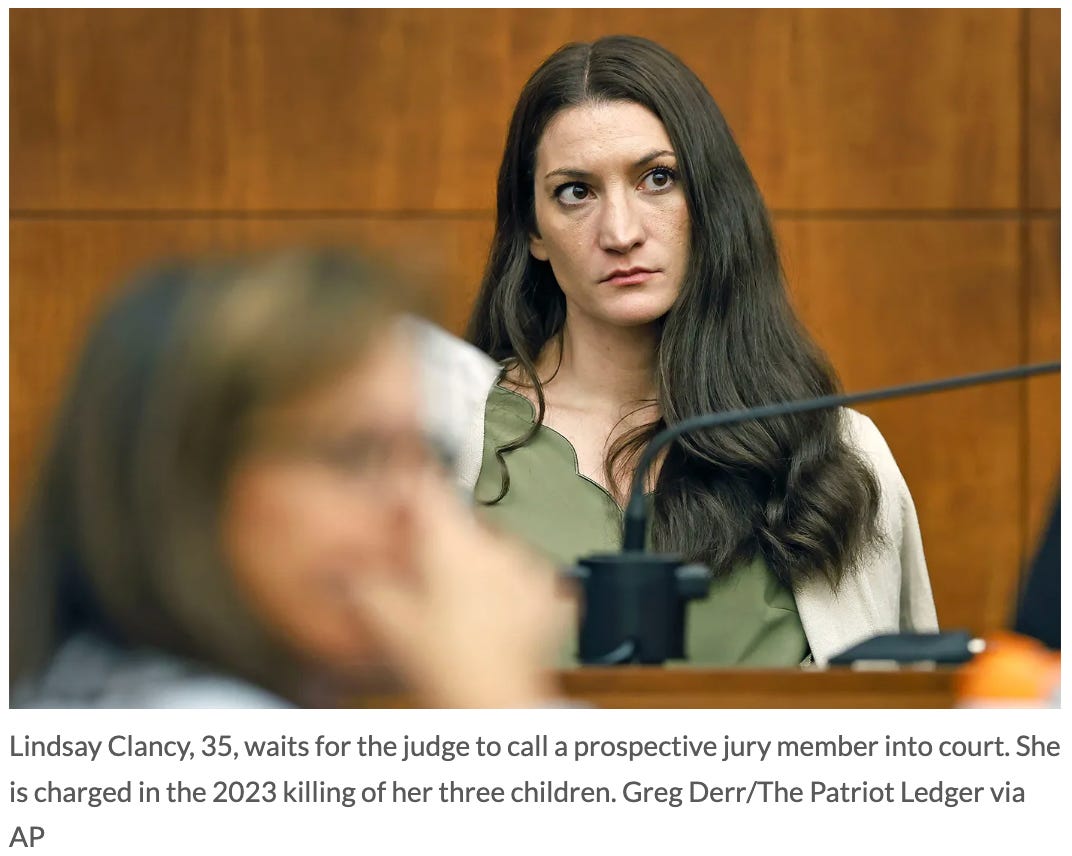
The three children were Cora, 5; Dawson, 3; and Callan, who was about eight months old. Cora and Dawson were pronounced dead that evening; Callan was flown to Boston Children’s Hospital and died three days later.
The medical examiner attributed the deaths to asphyxia. Lindsay Clancy then purportedly tried to kill herself by jumping from a second-story window, whereupon she sustained injuries that left her paralyzed from the waist down.
Lindsay and her then-husband, Patrick Clancy, had married in 2016 and settled on the South Shore. She complained of postpartum anxiety after her first two births. After Callan’s birth in May 2022, her mental health deteriorated. According to the official narrative, she was prescribed a changing mix of antidepressants, anti-anxiety drugs, sleep aids, and an antipsychotic.
On New Year’s Day 2023, she admitted herself to McLean Hospital with depression and suicidal thoughts and was discharged several days later. Relatives later reported that she had voiced fear of harming her children and that she was not herself. Her defense claimed that, at the time of the disaster, she heard “a commanding male voice telling her to kill the children and then herself.”
On the afternoon of the catastrophe, she took Cora to a pediatrician, played in the snow with the older children, and sent family photos. She then sent Patrick out for a child’s medication and takeout from a restaurant farther away than their usual spots.
According to prosecutors, while her husband was away, she killed the children in the basement with exercise resistance bands. When he returned, he found her injured outside and the children downstairs. He told arriving officers his wife had killed them.
She was charged with three counts of first-degree murder and pleaded not guilty. Prosecutors argued she sent her husband on the errands to provide her with the opportunity to kill the children, and that the killings displayed hallmarks of deliberate action.
The defense did not deny she caused the deaths. It argued she was in postpartum psychosis, overmedicated, and legally insane under Massachusetts law. The case has become a national argument over “postpartum psychosis” — an exceedingly rare diagnosis, so rare that I could only find one other well-documented case of filicide that was attributed to postpartum psychosis—namely, that of Andrea Yates, a Texas mother who drowned her five children in 2001.
After almost three years of pretrial detention in psychiatric care, Lyndsay was tried in Plymouth Superior Court in the summer of 2026. On September 4, 2026, after about a week of deliberations, the jury deadlocked. Reporting indicated an 11–1 split toward acquittal. The judge declared a mistrial.
Several things about this story strike me as extremely strange and worthy of investigation.
During the autumn of 2022 and early 2023, Lindsay was prescribed 30 prescriptions for 13 drugs. I wonder if her doctors were themselves lunatics.
Despite being a walking pharmacy who’d recently been institutionalized, Lindsay was soon scheduled to return to work at Mass General and reportedly told her husband she was anxious about returning to work. What kind of psychiatric professional would even consider clearing her to go back to work in a hospital maternity ward?
On the evening she killed her kids, she succeeded in giving her husband the impression that she was well enough to be alone with them.
She had apparently said nothing before about hearing a commanding male voice telling her to kill her kids. This suggests that this “commanding male voice” happened to speak to her for the first time while her husband was away from home to pick up dinner at a place unusually far afield from their usual spots.
Jumping out of a second story window is not a reliable way to kill oneself, which makes me wonder if she miscalculated that she would sustain dramatic injuries from which she would nevertheless recover. I stress that I wonder about this. I am NOT claiming that she indeed made this miscalculation.
After making a colossal mess of her treatment for postpartum depression and psychosis, how did her treating psychiatrists assist her in becoming fit to stand trial after she killed her three children? At what point following the disaster did the state conclude that she was fit enough to stand trial, and how was this assessment made?
Four months after his wife strangled his three children, husband Patrick Clancy moved to New York City and filed for divorce. About four months later, he started dating the woman who became his second wife. At the same time, he has described Lyndsay as a loving wife and mother who indeed suffered from a psychotic break from reality. To be sure, everyone processes trauma and grief differently, and I can understand that Mr. Clancy badly needed a change of scenery. Nevertheless, per standard procedure, law enforcement would be fully justified in taking a close look at him.
Taken together, all of the above strikes me as expressive of a couple, a medical system, and a society bereft of reason and prudence. A casual observer could perhaps be forgiven for wondering if the entire Commonwealth has lost its way.
DR ROGER MCFILLIN > Lindsey Clancy was placed on a psychiatric drug with no FDA approval for postpartum depression. Within 48 hours, she hadn't slept at all. Doctors abruptly stopped the drug, itself a dangerous move, then added a benzodiazepine and Benadryl on top of it.
Nobody had tested whether she could actually metabolize these medications. Specific genetic variants affecting drug metabolism are linked to homicidal thoughts, suicidal ideation, and akathisia, and clinical psychologist Dr. Roger McFillin says the onset "can happen immediately."
In under four months, Clancy went from one prescription to 13 drugs. "The more drugs that you enter into the system, the body, and then you stop them and you start them and you increase doses, you are increasing the likelihood of an adverse event," @DrMcFillin says, adding that "drug induced homicides do occur, especially within these psychiatric drugs.
The jury consisted of nine women and three men. What we haven't heard, or at least I haven't, is what happened during voir dire. I understand that only one juror, a man, refused to acquit. He held his ground, and that resulted in the mistrial. Although I don't know everything about this trial, I still salute this man.