


As plague hysteria begins spreading across headlines around the world, there is one detail almost nobody is talking about: governments and military biodefense programs have already poured major resources into developing dozens of plague vaccines.
More than 21 plague-vaccine candidates are under development, spanning mRNA, self-amplifying RNA, recombinant protein, viral-vector, live-attenuated and other technologies.
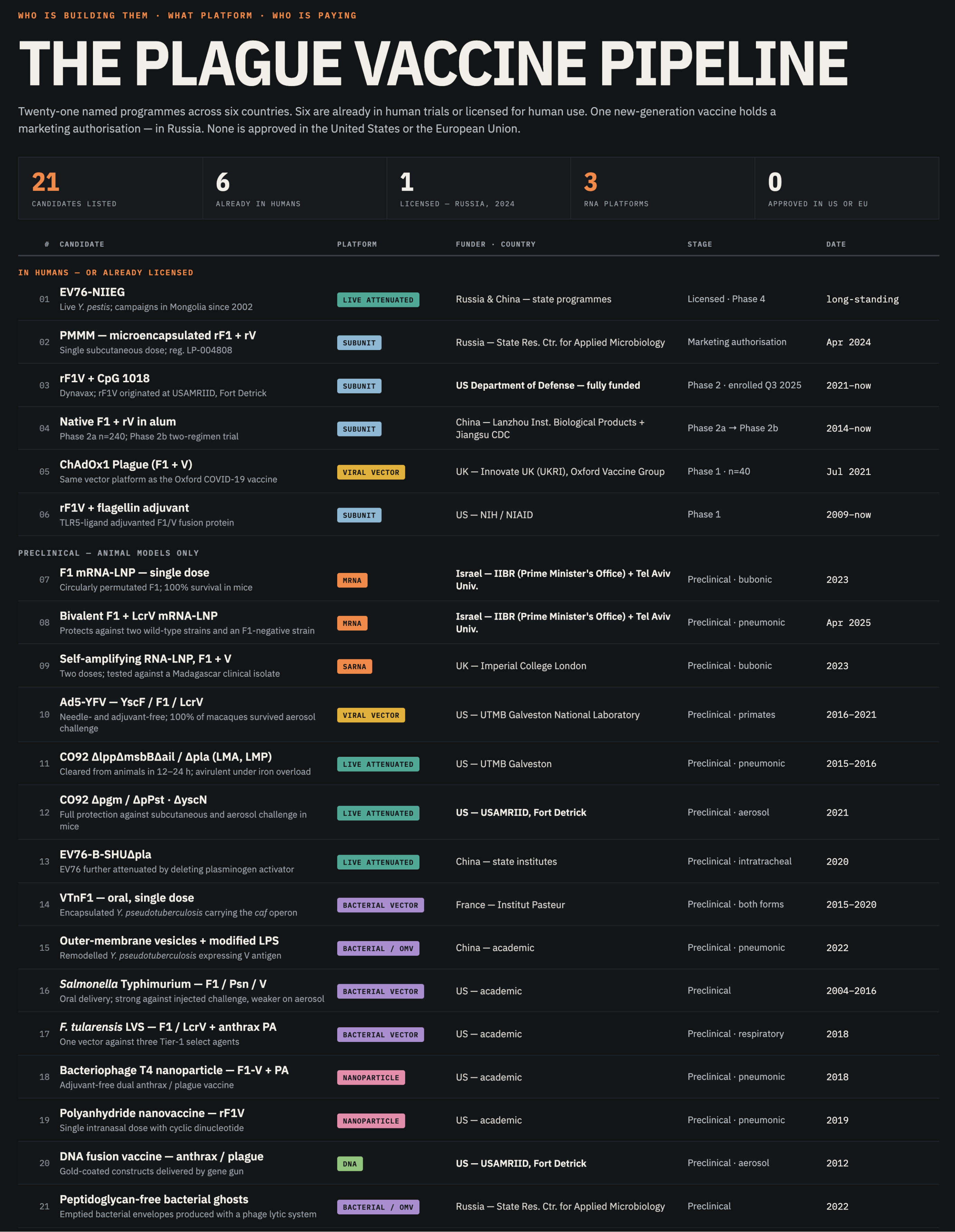
Why were governments and military biodefense programs already investing so heavily in plague vaccines before the current plague hysteria erupted?
Some of the major programs include:
ISRAEL — mRNA-LNP: Tel Aviv University and the Israel Institute for Biological Research published an F1-based mRNA vaccine in 2023 and a bivalent F1/LcrV mRNA formulation against pneumonic plague in 2025. Both remain preclinical.
UK — SELF-AMPLIFYING RNA (saRNA-LNP): Researchers at Imperial College London, Institut Pasteur de Madagascar, and Dstl Porton Down published a self-amplifying RNA plague vaccine in 2023. The vaccine used two saRNA constructs encoding the F1 and V antigens of Y. pestis, delivered in lipid nanoparticles. The authors described it as the first RNA plague-vaccine approach using self-amplifying technology. It remains preclinical.
U.S. MILITARY — rF1V-1018: The Department of Defense is funding development of a plague vaccine whose clinical-trial protocol explicitly states that its proposed indication is pre-exposure protection of military personnel against pneumonic plague resulting from aerosol exposure to Y. pestis. The original rF1V candidate was developed at USAMRIID at Fort Detrick. The newer program combines it with Dynavax’s CpG 1018 adjuvant and has advanced through Phase 2 testing.
U.S. MILITARY FUNDING: Dynavax states that the program is fully funded by the U.S. Department of Defense. A new agreement worth approximately $30 million was signed in late 2024 to support additional clinical and manufacturing work through the first half of 2027, followed by another approximately $14 million in 2025 for additional nonhuman-primate studies.
OXFORD — ChAdOx1 PLAGUE VACCINE: Oxford launched a human Phase 1 trial in 2021 using the ChAdOx1 adenovirus platform—the same vaccine-platform technology used for the Oxford/AstraZeneca COVID-19 vaccine. Forty healthy adults were enrolled in the initial trial.
CHINA — F1+rV: Chinese researchers advanced an F1+rV subunit plague vaccine into human trials. A Phase 2a program included 240 healthy adults, and the international plague-vaccine pipeline subsequently listed the Chinese candidate in Phase 2b development.
RUSSIA — NEW MOLECULAR PLAGUE VACCINE: In April 2024, Russian regulators granted marketing authorization to a new single-dose microencapsulated molecular plague vaccine (PMMM) containing recombinant F1 and rV antigens.
Needless to say, I would NOT take an experimental plague vaccine. I’d rather take my chances with doxycycline and its documented 97% SURVIVAL RATE:

That number comes from an actual randomized human clinical trial. Researchers enrolled 65 patients with plague and randomized 30 to doxycycline and 35 to gentamicin. Among the doxycycline-treated patients, 29 of 30 survived (97%). The only doxycycline-treated patient who died did so during the first two days of treatment after presenting with advanced disease.
Even if a modified plague strain were released and was resistant to doxycycline, that would not suddenly make it resistant to every other antibiotic. We still have numerous treatment options spanning multiple antibiotic classes. And in the highly unlikely scenario that none of the standard drugs worked, researchers could rapidly screen the strain against large libraries of approved, investigational, and repurposed antibacterial compounds to identify agents that could still stop it.
According to Russian authorities, there is currently no plague outbreak, and reports of a laboratory accident are false. But the scale of the response does not match those claims. Nearly 200 contacts were reportedly placed under observation, more than 60 institute employees were isolated, access was restricted at multiple hospitals, and the FSB was reportedly involved.
Nevertheless, a classical plague pandemic in modern times would be almost impossible, as we are not living in the Middle Ages. The only possible exception would be a deliberately engineered, military-grade Yersinia pestis strain designed to spread more efficiently between people, cause more severe disease, and evade existing treatments. Even that would likely not become a pandemic.
Only time will reveal what actually happened in Irkutsk.
Epidemiologist and Foundation Administrator, McCullough Foundation
Support our mission: mcculloughfnd.org
Please consider following both the McCullough Foundation and my personal account on X (formerly Twitter) for further content.
And it's not a one-time coincidence; it happens every time something new is released, I mean, found.
They can “develop” all the PLANdemic they want however we will not be FOOLED again. No shots, no masks, no 6; apart.