


In 1998, I was invited to join the Napoleonic Society of America by an eccentric man who had converted his large office into a shrine dedicated to the French general and emperor. A vast conference table was decked with models of Napoleon’s famous victories at Austerlitz, Jena, and Wagram, which the peculiar man showed me with extraordinary enthusiasm.
“What do you think about Napoleon’s Russian campaign of 1812?” I asked.
“A regrettable mistake,” the man said, suddenly becoming sober. “He underestimated the resolve of Alexander I and the hardness of the Russian winter.”
“How many of his soldiers paid the price for his underestimation?” I asked.
“No one knows exactly,” he replied.
This is true. Estimates of the size of the Grande Armée that crossed the Neman River into Russia in June 1812 vary widely between 500 and and 600 thousand. Six months later, only 120,000 returned, and most of these had suffered severe injuries and amputations from frostbite.
In other words, around 400,000 young soldiers from Western Europe were condemned to suffer unfathomably painful deaths to serve the monstrous vanity and ambition of a single man.
These were mostly conscripted farm boys and tradesmen from all over Napoleon’s European possessions—sons, husbands, and fathers who were needed back home to take care of their parents, wives, and children. The suffering they endured before death finally took them is unimaginable to anyone who hasn’t experienced it.
Letters that some wrote to their mothers and wives shortly before they died were subsequently found on their dead bodies and saved in archives. They are heartbreaking to read. One young officer recorded his anguish at watching his beloved horse die of starvation. Another boy writes to his mom that he misses her cooking, as he hasn’t eaten anything but lousy quarter rations for days on end.
Given the strategic brilliance that Napoleon had displayed earlier in his career, it’s an astonishing fact that all of his assumptions about the prospects of his Russian campaign were dead wrong.
Russia wasn’t Austria or the principalities of Germany, but a vast, sparsely populated country that couldn’t provide enough food and fodder for so many men and horses under the best of circumstances.
On top of this, Tsar Alexander I and his generals were determined to make life as hard as possible for Napoleon’s army. The Russians didn’t just strategically retreat—they burned all of the grain and drove all the livestock east so that Napoleon’s men would have nothing to sustain them on the long eastward march to Moscow.
And then, in what may be the toughest sacrifice ever made, the Russians burned Moscow to the ground instead of surrendering it to Napoleon.
Alexander’s message to the Emperor of the French was clear—namely, “I would rather sacrifice everything than surrender to you. Fuck you Napoleon Bonaparte and the horse you rode in on.”
With nothing to support the army in Moscow, Napoleon had no choice but to abandon the city to retreat back to the Neman River that bordered the Duchy of Warsaw, over 1000 kilometers away.
Even then, his decision-making was incredibly wanton. Instead of quickly recognizing that his situation was untenable, he waited till October 19—just before the terrible Russian winter set in. Moscow lies at 55 degrees north of the equator, just three degrees south of Juneau, Alaska.
Heavy, cold rains fell on October 22, making the roads muddy and difficult to trudge with their remaining equipment, weapons, and stores packed into heavy carts. The first snow fell on November 3.
Napoleon’s advisor, Armand de Caulaincourt, described what it was like for the woefully equipped and provisioned soldiers when night fell and temperatures dropped as low as minus 35 degrees Celsius.
The cold was so intense that bivouacking was no longer supportable. Bad luck to those who fell asleep by a campfire! Furthermore, disorganization was perceptibly gaining ground in the Guard. One constantly found men who, overcome by the cold, had been forced to drop out and had fallen to the ground, too weak or too numb to stand. They begged one to let them alone. Once these poor wretches fell asleep they were dead. If they resisted the craving for sleep, another passer-by would help them along a little farther, thus prolonging their agony for a short while, but not saving them, for in this condition the drowsiness engendered by cold is irresistibly strong.
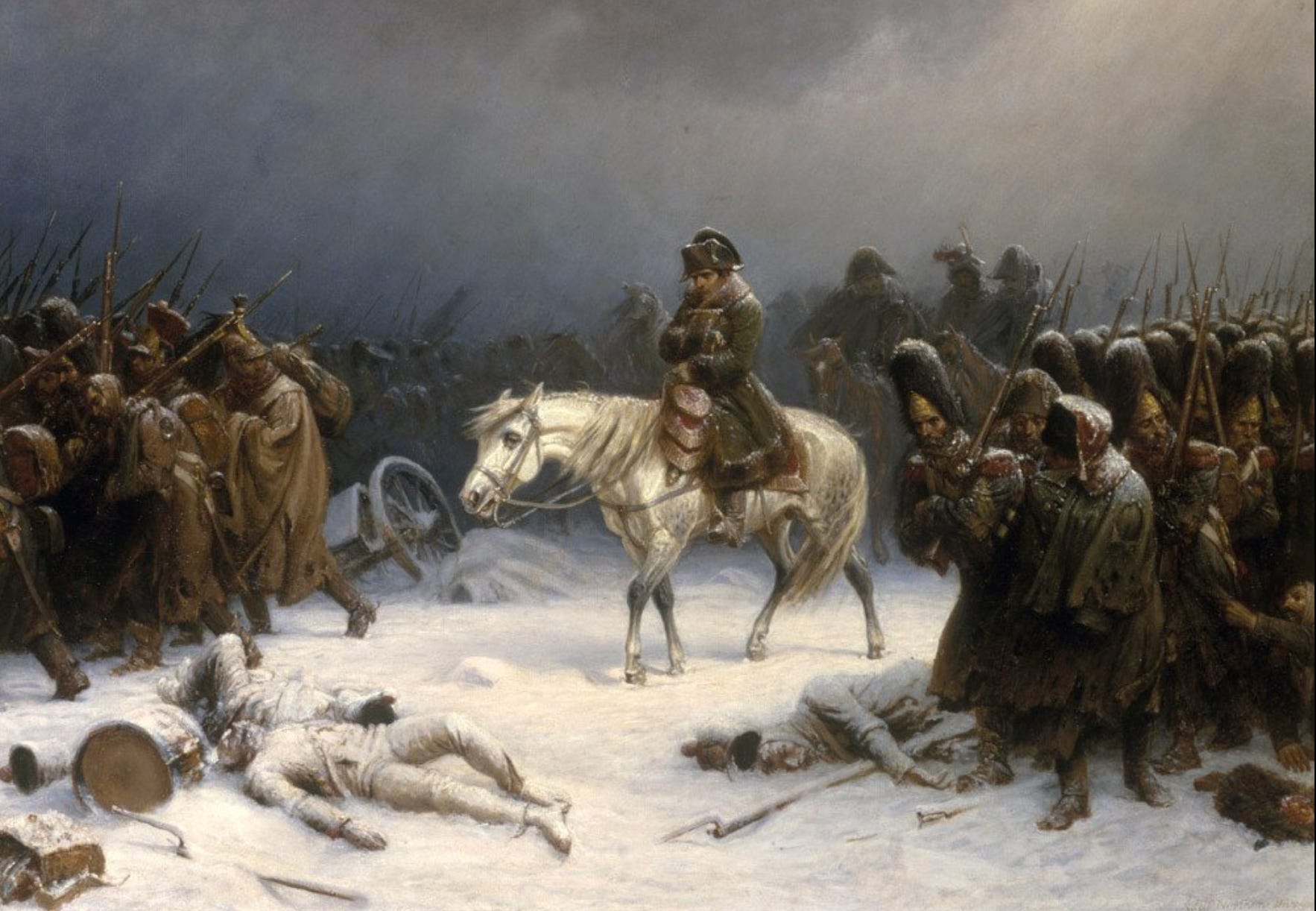
This was payback time for the Russians, and their fabled Cossack cavalry had a ball harassing the retreating army, attacking the exhausted and starving soldiers with lances and sabers, literally hacking them to pieces.
On December 5, Napoleon abandoned his army by sled, leaving his brother-in-law, Joachim Murat in command. On December 14, what was left of the once grand army left Russian territory.
The lesson from Napoleon’s 1812 campaign (and Hitler’s 1941 campaign) is clear — France, Germany, and the UK should show greater respect to Russia.
Approximately 700,000 Russians (soldiers and civilians) died as a result of Napoleon’s 1812 invasion. In 1941, Hitler’s army is estimated to have killed or wounded six million Russian soldiers. Fourteen million Russian civilians are estimated to have died from violence, famine, and exposure after their homes were destroyed.
Hitler’s Operation Barbarossa was launched from Poland and through Ukraine, with around 250,000 Ukrainian nationalist soldiers joining the German Army to attack Russia. Ukraine’s Azov Battalion traces its lineage to the Organization of Ukrainian Nationalists. Its leader, Stepan Bandera, was a notorious Nazi collaborator.
The bloody-minded fools in charge of U.S. and European foreign policy should have thought about these historical facts before they armed and trained the Ukrainian military to serve as NATO’s attack dog against Russia.
Especially bizarre has been the German government’s decision to repudiate the excellent and mutually beneficial German-Russian friendship cultivated by former Chancellor Gerhard Schroeder and Vladimir Putin, and the great and useful fruit of their friendship, the Nord Stream Pipeline.
I am confident that an Austrian-style neutrality deal for Ukraine would have averted the disaster of the last four years. With Russian forces now just 75 miles east of the great Black Sea port of Odessa, it appears that the West is now on the cusp of suffering its greatest strategic defeat since December 1812.
Europe’s leaders apparently learned nothing from Napoleon’s disastrous 1812 campaign, and they now seem determined to pursue war with Russia. President Trump should tell them to cease their agitations and mind their own business before they get a lot more people killed.
Excellent summary, thank you
Painful to read, heartbreaking beyond comprehension.
Man's biggest folly is that he ignores Almighty God and refuses to seek His council. Disaster always follows. Daniel the Prophet understood this well and said in Daniel 2:
20“Blessed be the name of God forever and ever,
to whom belong wisdom and might.
21He changes times and seasons;
he removes kings and sets up kings;
he gives wisdom to the wise
and knowledge to those who have understanding;
22he reveals deep and hidden things;
he knows what is in the darkness,
and the light dwells with him."
If you think previous wars were bad, I tell you the unvarnished truth; humanity has seen nothing yet. God has graciously revealed His plans, but very few search the scriptures to know them, and even fewer heed His warnings.