


A new randomized, double-blind, placebo-controlled trial suggests creatine may do far more than support gym performance. In middle-aged and older adults, taking 10 grams of creatine per day for 12 weeks increased lean tissue mass, strength, muscular endurance, and several markers of cognitive and metabolic health, even in participants who were not enrolled in the structured exercise program.
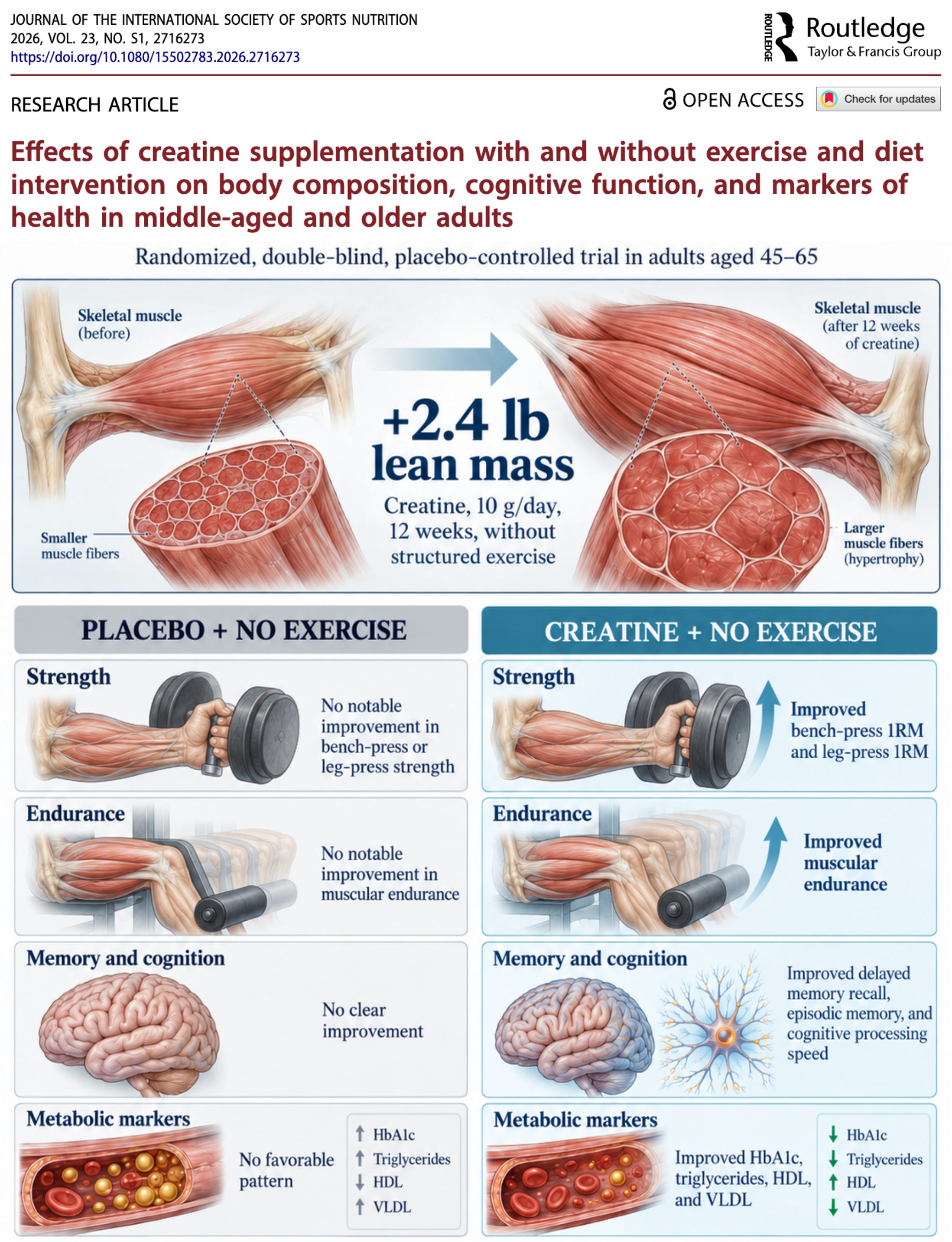
The most eye-catching finding was the change in body composition. Participants taking creatine without structured exercise gained about 2.4 pounds of lean tissue mass in 12 weeks, while the placebo + no-exercise group actually lost about 0.35 pounds of lean mass over the same period.
Because creatine increases intracellular water within muscle, some of the increase in lean mass may reflect increased cellular hydration rather than solely new muscle tissue.
Creatine alone was also associated with improvements in:
Muscular strength
Muscular endurance
Delayed memory recall
Episodic memory
Cognitive processing speed
HbA1c
Triglycerides
HDL cholesterol
VLDL cholesterol
The physical effects were particularly notable because the researchers found that creatine supplementation without training increased both 1-repetition maximum leg press and bench press strength. When creatine was combined with resistance and aerobic exercise, the gains in strength and endurance were generally even greater.
The cognitive findings were also intriguing. In the no-exercise creatine group, the researchers found evidence of improved delayed word recall, word recognition, and picture-recognition reaction time.
Creatine combined with exercise also produced additional improvements in selected cognitive measures, including picture recall, processing speed, and choice-reaction time.
There were also favorable metabolic signals. The no-exercise creatine group showed improvements in HbA1c as well as more favorable changes in triglycerides, HDL cholesterol, VLDL cholesterol, and the cholesterol-to-HDL ratio compared with placebo. The lipid findings were exploratory, but the overall pattern was favorable.
The exercise-plus-creatine group did even better physically. At 12 weeks, participants combining creatine with the exercise and diet intervention gained about 1.27 kg, or 2.8 pounds, of lean tissue mass, while also experiencing larger improvements in strength and endurance.
Creatine was not simply helping people lift more weight after training. In this randomized, double-blind, placebo-controlled trial, 10 grams per day produced measurable changes in body composition, strength, memory, cognitive processing, and metabolic markers even without a structured exercise program.
Epidemiologist and Foundation Administrator, McCullough Foundation
Support our mission: mcculloughfnd.org
Please consider following both the McCullough Foundation and my personal account on X (formerly Twitter) for further content.
Great study! I don't know how you do it Nicolas getting all this research out to us so fast plus all else that your job requires. You are amazing!
Brought to you by Creapure. You have to be really careful about stuff that comes from the Journal of the International Society of Sports Nutrition on this topic. It's got a long history on this, and a long history of misrepresenting information. The devil is very much in the detail:
"Because creatine increases intracellular water within muscle, some of the increase in lean mass may reflect increased cellular hydration rather than solely new muscle tissue."
It's almost certainly water. Lean mass doesn't automatically mean muscle. Lean mass is anything that's not fat.
For those interested we have a number of articles on this subject, including talking about the new interest in "10g" which appeared a few years back. Check out fitnesstroll on here.