


A newly published case report in Frontiers in Neuroscience describes a remarkable and unexpected clinical response in an 80-year-old woman with advanced Alzheimer’s disease following a single high-dose psilocybin intervention.
The patient had lived with Alzheimer’s disease for approximately 10 years and experienced severe functional decline over the preceding five years. According to the report, she had become largely monosyllabic, demonstrated profound cognitive impairment, chronic urinary incontinence, impaired mobility, dysphagia, executive dysfunction, and severe reduction in spontaneous communication and emotional engagement.
After receiving a single 5g oral dose of psilocybin-containing mushrooms (Enigma strain), the patient reportedly experienced rapid and sustained functional improvement across multiple domains.
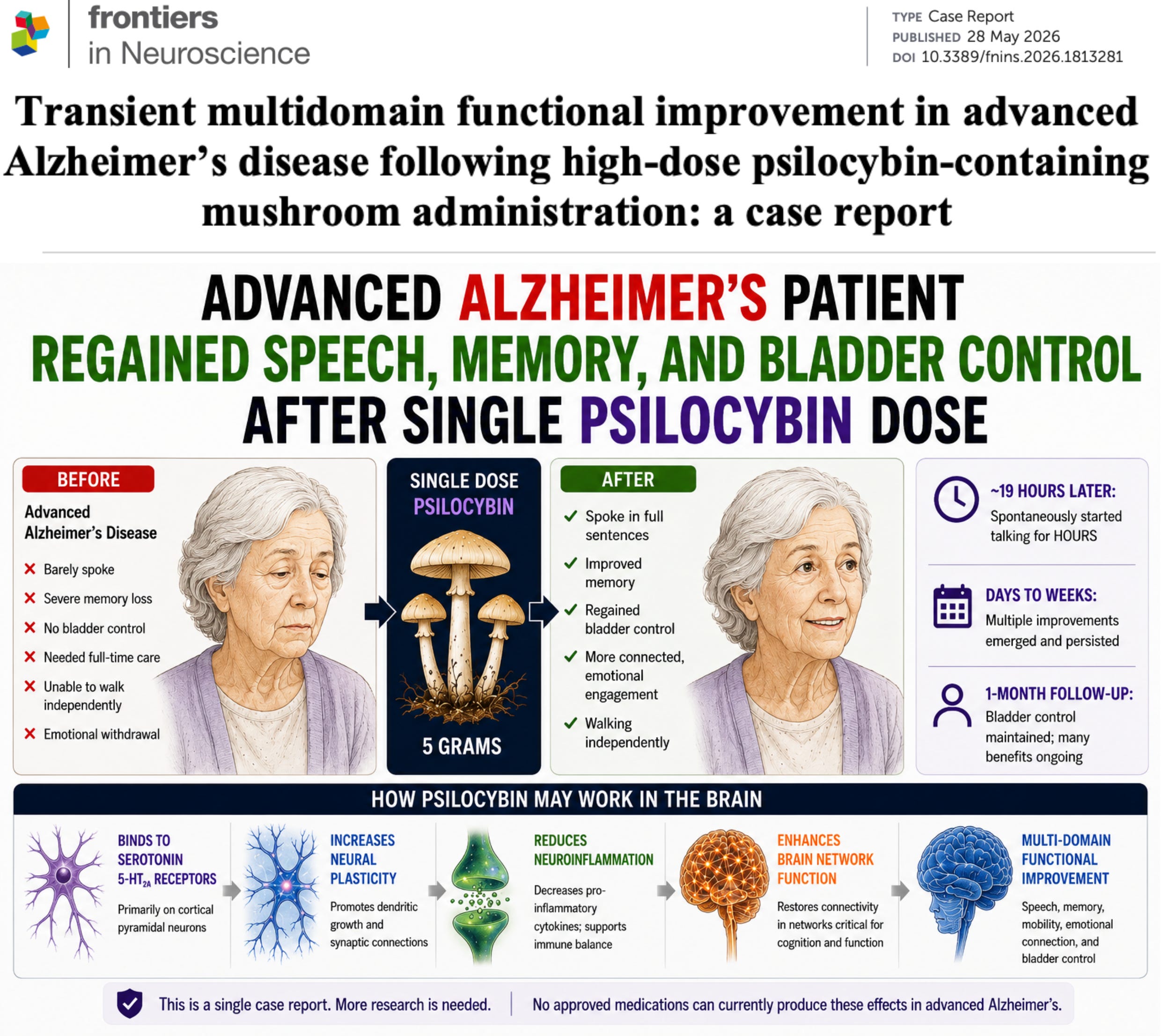
During the acute phase, the patient entered a prolonged deep sleep-like state accompanied by profuse sweating and clinically suspected hyperthermia.
Then, approximately 19 hours later, something unexpected occurred.
The patient spontaneously awakened and began speaking for hours, engaging in autobiographical conversation and recalling memories that had not been expressed in years.
Over the following days, her family reported meaningful improvements in:
Speech and communication
Memory and contextual recognition
Walking and mobility
Emotional connection and social engagement
Bladder control, after years of chronic urinary incontinence
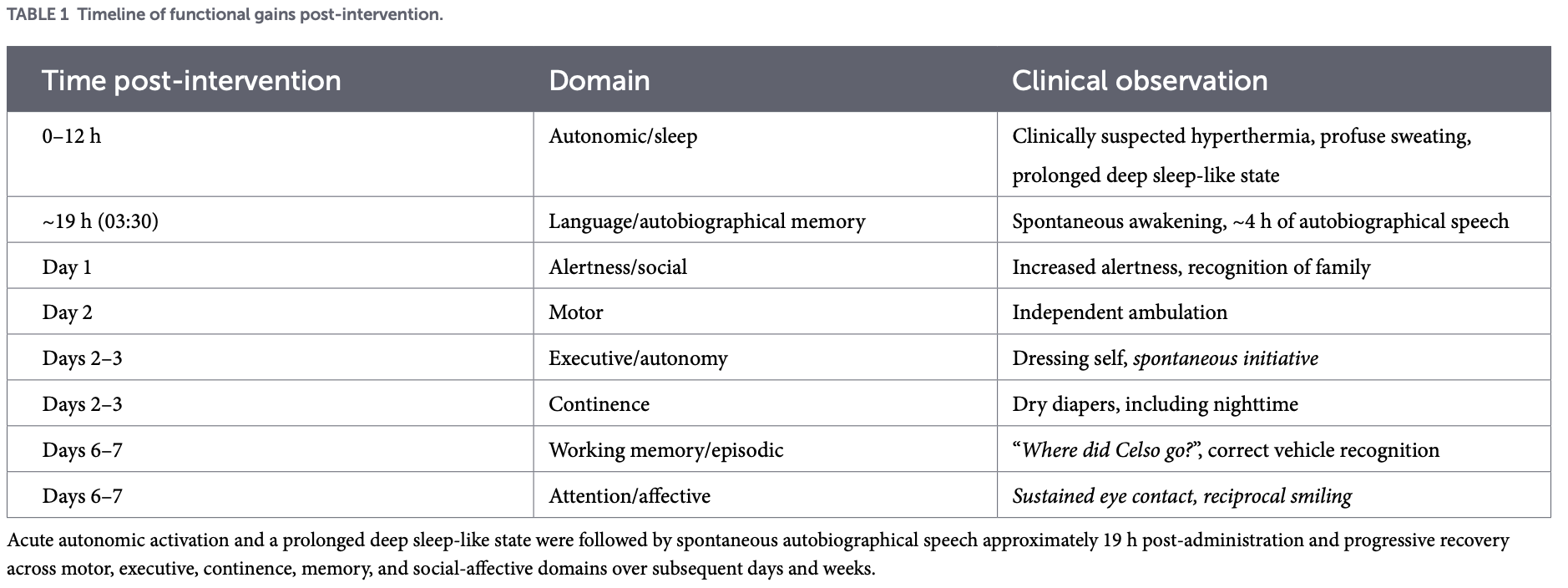
Most notably, the improvements were not merely immediate and fleeting.
At 1-month follow-up, bladder control reportedly remained restored, and the patient was described as still functionally improved compared with baseline. Due to the persistence of meaningful benefits, a second supervised psilocybin session was performed one month later.
To be clear, this is one published case report, not a randomized controlled trial, and causality cannot be established.
Nevertheless, the implications are difficult to ignore.
There are currently NO approved Alzheimer’s medications known to produce rapid, multi-domain improvements of this magnitude in advanced disease. Existing therapies may modestly slow decline or provide limited symptomatic benefit in some patients, but none are known to rapidly restore speech, continence, emotional engagement, and functional capacity in a patient with advanced Alzheimer’s.
Two of my grandparents died with advanced Alzheimer’s disease, and every medication they were prescribed ultimately failed to meaningfully alter the course of decline. Millions of families across the world face the same devastating reality.
These findings urgently need replication. For millions watching a parent or loved one disappear to Alzheimer’s, even the possibility of restoring lost function warrants serious scientific investigation.
Epidemiologist and Foundation Administrator, McCullough Foundation
Support our mission: mcculloughfnd.org
Please consider following both the McCullough Foundation and my personal account on X (formerly Twitter) for further content.
THANK YOU Nicolas for this PRICELESS report!!! Now the question: where to buy the mushroom spores in order to grow them in the garden, if possible???
Expect mushrooms to be banned, pharma will be looking at how to do it, now; just in case.