


A remarkable study published in eLife demonstrates the powerful neuroplasticity-promoting properties of psilocin, the active compound formed when the body metabolizes psilocybin.
Researchers exposed human cortical neurons to psilocin for just 10 minutes before examining changes in neuronal growth, gene expression, and synaptic function.
Rapid and Sustained Neuronal Growth
Within just 24 hours of psilocin exposure, researchers observed:
41% INCREASE in total nerve branch length
48% INCREASE in local nerve branch intersections
40% INCREASE in total nerve branch intersections
Remarkably, these effects persisted well beyond the initial 10-minute exposure.
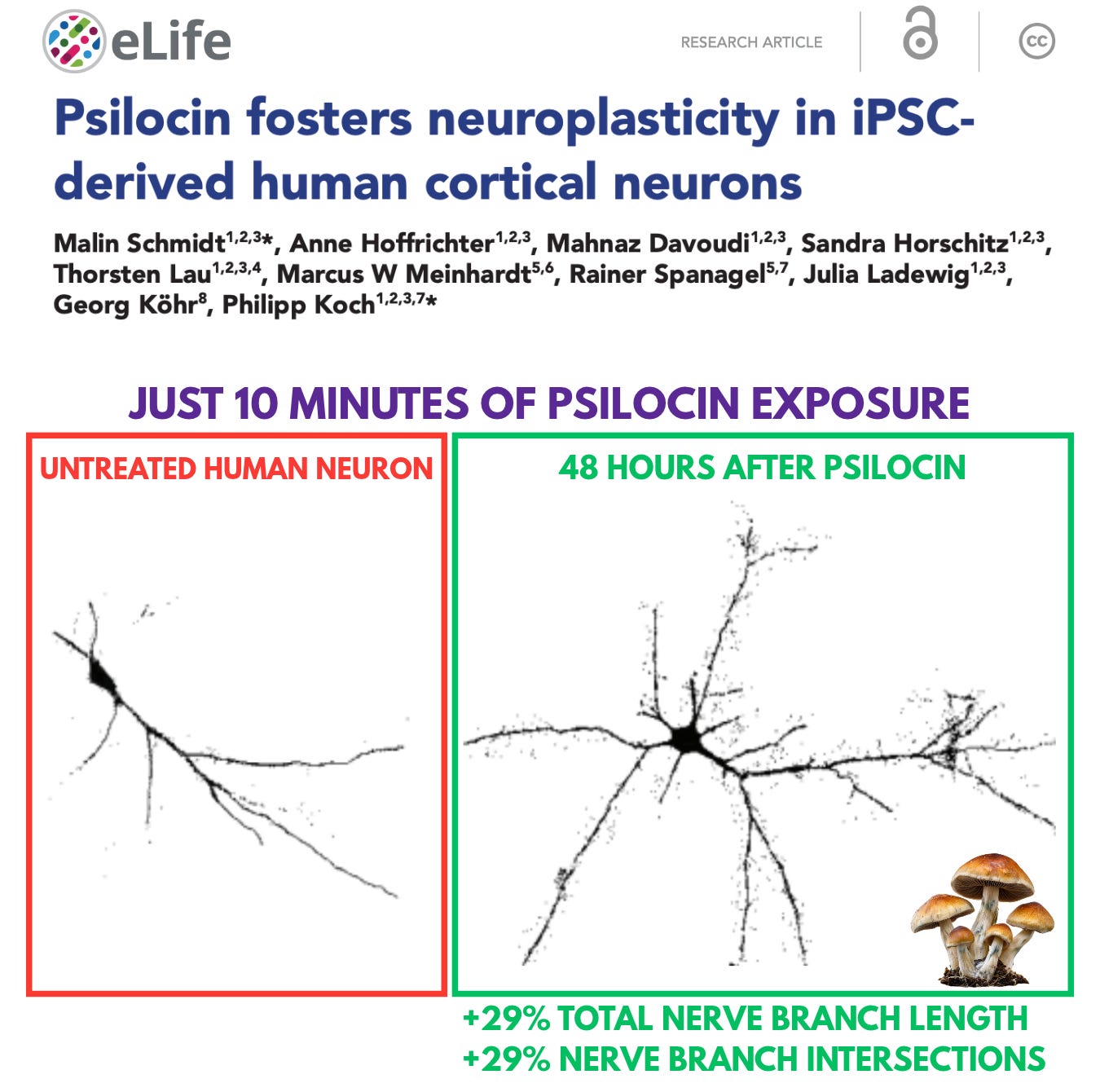
Even after 48 hours, total nerve branch length and total branch intersections remained 29% greater than those of untreated cells.
The microscopy images demonstrate the striking differences in neuronal growth and branching between untreated and psilocin-exposed human brain cells:
A 73% Increase in “Fertilizer for the Brain”
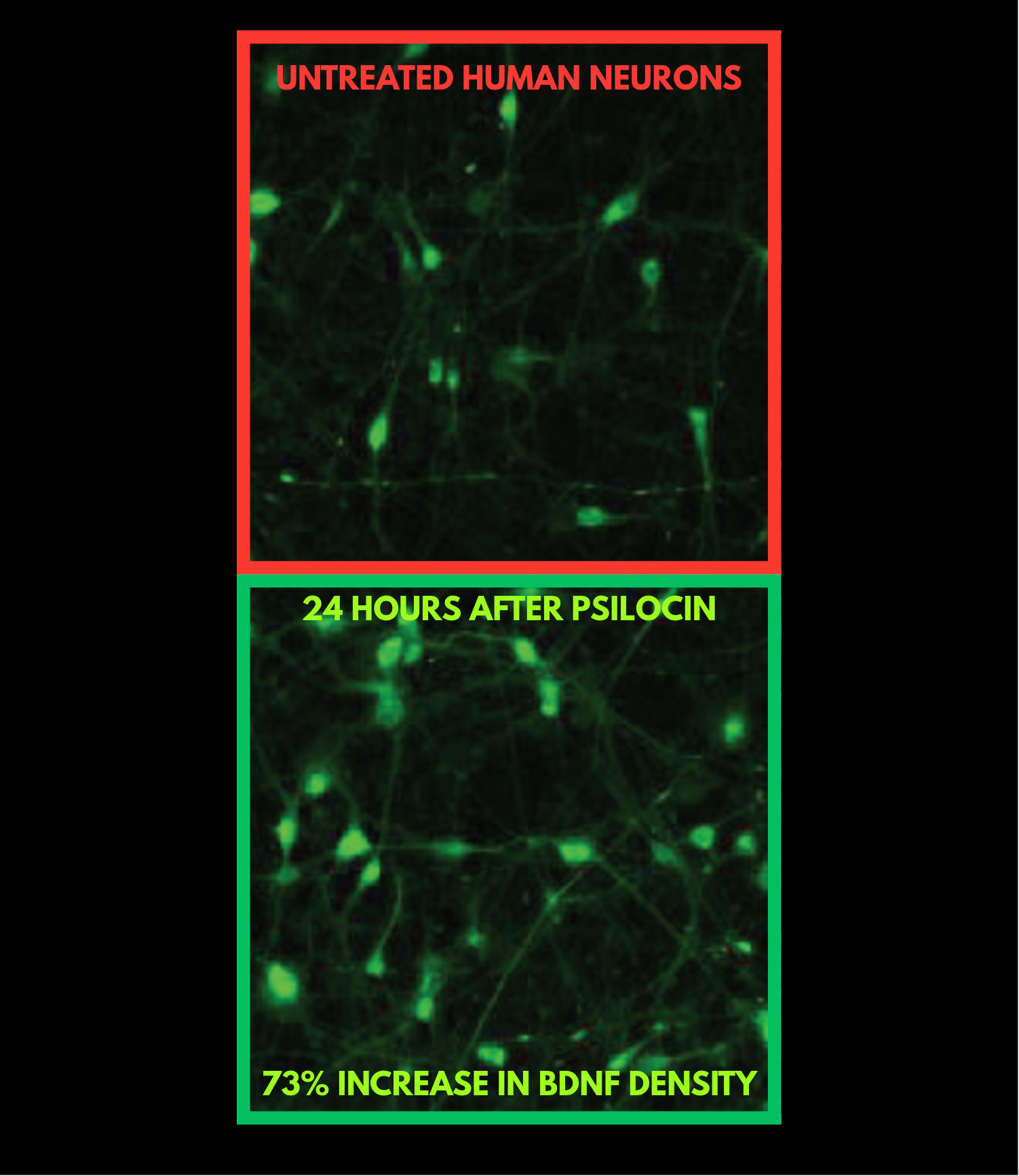
Researchers also observed a 73% increase in brain-derived neurotrophic factor (BDNF) density following just 10 minutes of psilocin exposure.
BDNF is often referred to as “fertilizer for the brain” because of its critical role in neuronal growth, survival, synaptic plasticity, learning, and memory.
The researchers demonstrated that psilocin activates serotonin 5-HT2A receptors, triggering downstream biological signaling pathways involved in neuronal growth and plasticity.
Could This Help Explain the Remarkable Improvements Observed in Advanced Alzheimer’s Disease?
These findings may provide biological clues to a remarkable case report published in Frontiers in Neuroscience in May 2026:

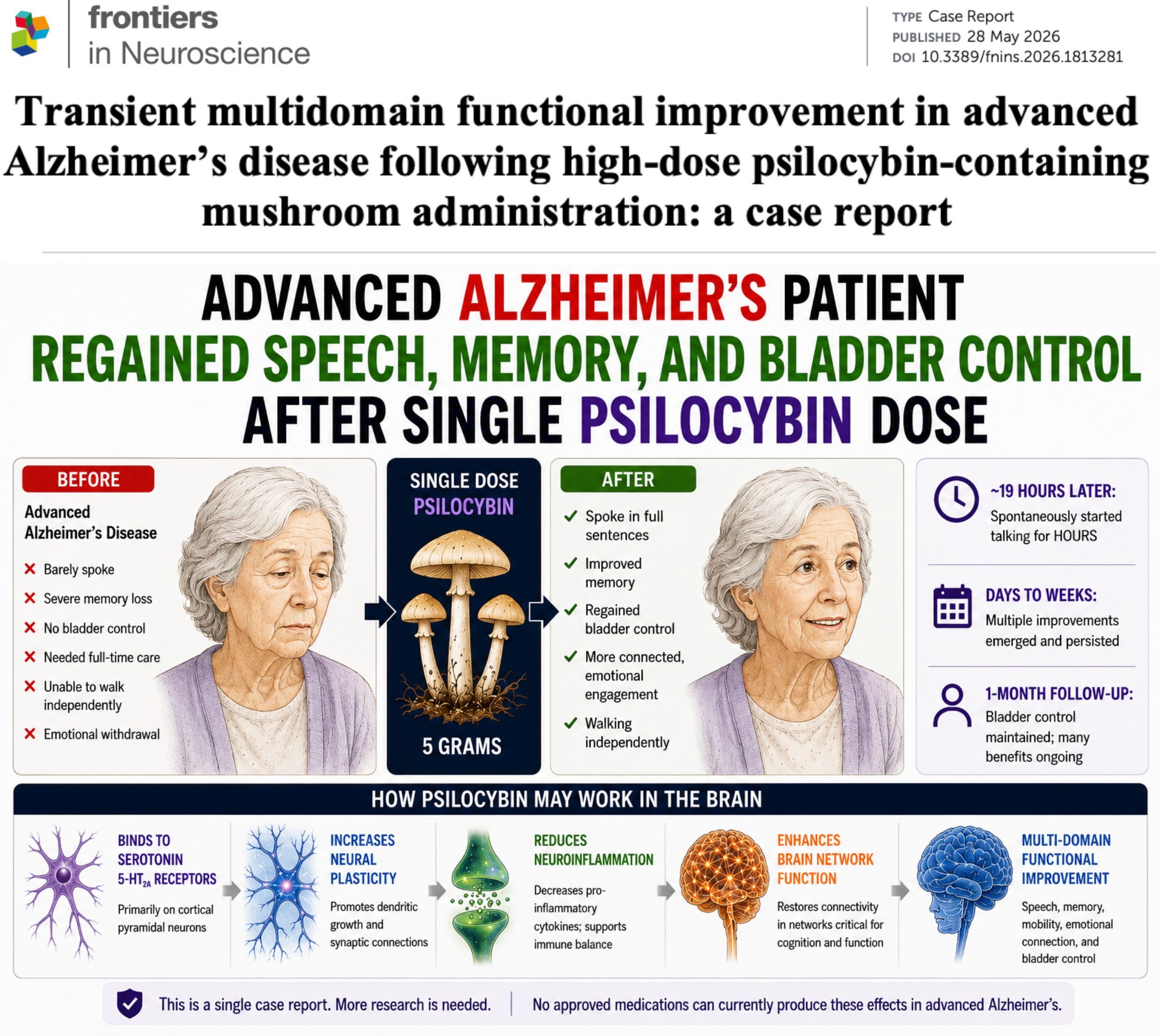
The report documented a woman in her 80s with advanced Alzheimer’s disease who regained multiple lost abilities following a single dose of psilocybin mushrooms.
The patient had suffered from Alzheimer’s disease for approximately 10 years and had experienced profound functional decline.
Following the initial administration, researchers documented:
Recovery of autobiographical memory
Recovery of conversational speech
Increased emotional responsiveness
Recovery of independent walking
Restoration of bladder control
Improved ability to dress herself independently
Just 19 hours after administration, the patient spontaneously began speaking about her life for approximately four hours.
Further research is urgently needed as millions of people worldwide continue to suffer from devastating neurological disorders for which no cure currently exists.
Epidemiologist and Foundation Administrator, McCullough Foundation
www.mcculloughfnd.org
Please consider following both the McCullough Foundation and my personal account on X (formerly Twitter) for further content.
What is best, highest quality, cleanest brand of psilocybin & where can i purchase?
HAVING HAD A CRIPPLING HEMORRHAGIC STROKE I AM KEEN TO READ ABOUT ANYTHING WHICH MIGHT PROMOTE HEALING. MY NEUROLOGIST TOLD ME, "It's never coming back." HE WASN'T BEING UNKIND, HE WAS REFLECTING THE CURRENT VIEW OF MEDICINE IN AMERICA. SINCE THEN I HAVE BEEN ON Lion's Mane Mushroom AT 4,000mg PER DAY AND I CAN REPORT I HAVE MADE PROGRESS OVER THE PAST THREE AND A HALF YEARS.
OF COURSE, Psilocin IS ILLEGAL WHERE I LIVE. ALSO, Psilocin IS NOT TO BE CONFUSED WITH PSYLLIUM HUSK WHICH IS A LAXATIVE.
"Psilocin cannot be legally purchased for retail or personal use in the United States.
Under federal law (the Controlled Substances Act), both psilocin and psilocybin (the compound converted into psilocin by the body) are classified as Schedule I controlled substances, making their sale, purchase, and possession illegal nationwide. In Kentucky specifically, psilocin is also classified as a Schedule I hallucinogenic substance under state law. [1] (https://jamanetwork.com/journals/jama/article-abstract/2812934), [2] (https://jamanetwork.com/journals/jama/fullarticle/2854042)
While a few states, such as Oregon and Colorado, have enacted state-level programs for supervised administration, psilocin is not sold in retail stores or shipped legally across state lines. Legal access is strictly limited to approved clinical trials or state-regulated, licensed service centers where the substance is administered on-site under supervision. [1] (https://jamanetwork.com/journals/jama/fullarticle/2846422), [2] (https://jamanetwork.com/journals/jama/article-abstract/2812934)
"