


Driving through Aberdeen, Scotland yesterday, I thought of the medical historian, Dr. Charles Creighton, whose 1889 book, Jenner and Vaccination is a critical and at times hilariously funny evaluation of the life and work of Edward Jenner. While visiting St. Andrews, Scotland today, I strolled over to St. Mary’s College—the oldest at the University of St. Andrews, which awarded Jenner a Doctor of Medicine degree in exchange for a fee—one of many features of Jenner’s life of which Creighton was highly critical.
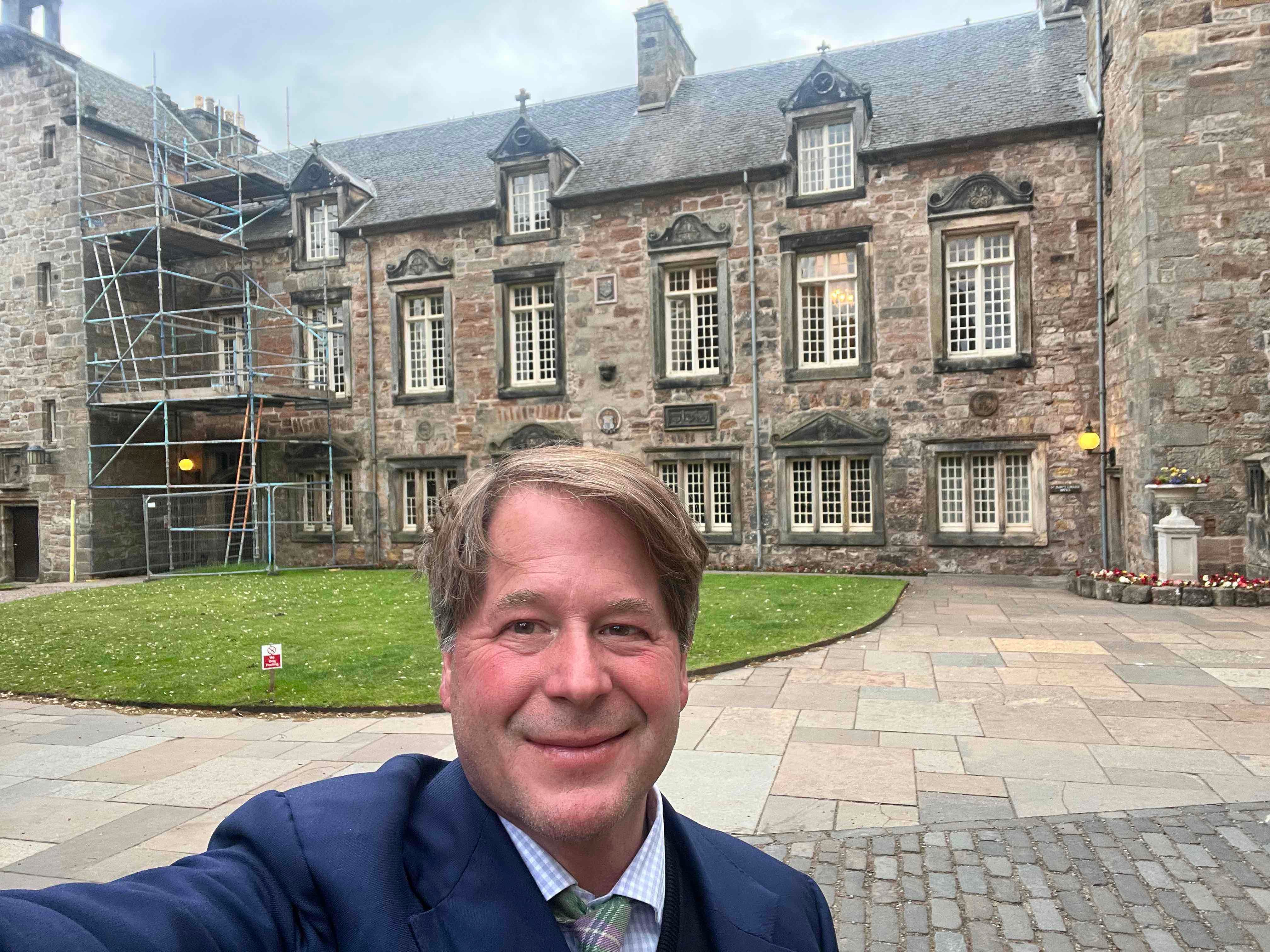
The experience made me nostalgic for my happy time researching’s Jenner’s life and work for my book (with Dr. Peter McCullough) Vaccines: Mythology, Ideology, and Reality. I am indebted to Dr. Samuel A. Mascorro for providing me with a bibliography and photocopies of various medical histories published in the 19th century.
The following is a reproduction of Chapter 4 of Vaccines: Mythology, Ideology, and Reality, which tells the story of Jenner’s wondrous adventures. If you enjoy the chapter, please buy a copy of the book!
Chapter 4: “Of the Cow”: The Original Vaccine
Gloucestershire is a pastoral district that lies about 100 miles west of London. Tourists know it for its Cotswolds region, which strikes many as the quintessence of rural charm. For centuries the county has had a flourishing dairy industry, and its famous Gloucester cheese has been made since the 16th century. Jane Austen was apparently inspired by the Cotswolds village of Adlestrop, one of the ancestral homes of her cousins, the Leigh family, whom she frequently visited. The parsimonious character of Fanny Dashwood in Sense and Sensibility seems to have been inspired by Austen’s aunt (by marriage) Mrs. Leigh-Perrot. About forty miles southwest of Adelstrop lies the city of Berkeley, where Edward Jenner was born on May 17, 1749—the eighth of nine children of the vicar of Berkeley, the Reverend Stephen Jenner, and his wife Sarah.
Generally credited as the father of vaccinology, Jenner is the subject of countless laudatory tributes. In 1881, Louis Pasteur proposed naming all inoculations (against all infectious disease pathogens) “vaccines” in honor of Jenner’s cowpox vaccine against smallpox, though his proposal did not catch on until the 20th century. Many published evaluations of Jenner’s work are reverential and bring little to no critical scrutiny to bear on his assumptions, methods, and conclusions. John Baron’s The Life of Edward Jenner, published in 1827, began the tradition of Jenner hagiography. It starkly contrasts with Charles Creighton’s hyper critical Jenner and Vaccination, published in 1889. The truth about Jenner probably lies somewhere in between.
In many respects, he was the sort of English country gentleman whom Jane Austen might have gently satirized in her novels. The vicar’s son likely would have gone to Oxford and trained for the clergy had it not been for the death of both parents when he was young, which was also a blow to his family’s finances. And so, when he was thirteen, he was apprenticed to a local physician. After six years of training, he went to St. Georges Hospital in London to work for the famous surgeon and naturalist, John Hunter. Hunter introduced him to the eminent botanist Joseph Banks, who had just returned from Captain Cook’s first around-the-world voyage. Jenner helped Banks to catalogue the specimens he’d collected on the voyage. Banks later became the president of the Royal Society and remained so for more than forty years.
Following Jenner’s training in London, he returned to his native Berkley and established a medical practice in which he frequently inoculated his patients for smallpox with the variolation method. He also continued his collaboration with John Hunter in the field of natural philosophy. During the 1770s, Hunter concerned himself with the question of “Animal Heat,” and he was keen to take body temperature readings of hibernating hedgehogs. He assigned this difficult task to the unfortunate Jenner, instructing him “to find out their haunts and observe, if you can, what they do.”[i] In the sort of comical letter that Jane Austen might have fabricated in one of her novels, Hunter instructed Jenner to find a hibernating hedgehog, make an incision in its belly, implant a thermometer, and take temperature readings—all without disturbing the hibernating creature. Unable to perform this task, Jenner wrote to Hunter in September 1778 that his industry in taking the hedgehog’s body temperature had been impaired by a broken heart he’s suffered from his unrequited love for a local girl.
“Let her go, never mind her. I shall employ you with hedgehogs,”[ii] Hunter replied. Following Jenner’s misadventure with hedgehogs, he attempted to answer once and for all a question that had puzzled ornithologists for centuries—namely, how exactly did an imposter cuckoo fledgling eject all other fledglings from the nest, thereby becoming the sole beneficiary of the sparrow hen’s maternal ministrations? In his 1788 paper, “Observations on the Natural History of the Cuckoo,” published in the Philosophical Transactions of the Royal Society, Jenner claimed that the fledgling cuckoo hatched first and then quickly set about using the little space on his back between his fledgling wings to push the sparrow’s eggs out of the nest. Jenner’s 19th century critics regarded this as a fanciful idea that he must have fabricated, but his account was confirmed by photographers in the 20th century. With the publication of this paper, Jenner was made a fellow of the Royal Society, which greatly elevated his perceived authority as a scientist.
In 1792, Jenner obtained a medical degree from St. Andrews University, Scotland. His 19th century critics pointed out that he purchased the degree, though it seems his fee was accompanied by recommendations from friends who were respected in the medical profession. At last, he was able to advertise himself as a physician and surgeon (MD, FRS), so he quit his general practice and became a medical consultant.
Jenner frequently met with his rural colleagues and country doctors at his local Medico-Convivial Society, which convened at the Ship Inn (located on the banks of the Berkeley Pill, a tidal estuary near the River Severn). At one of these gatherings, they discussed the pustules that sometimes erupted on cows’ teats. These resembled smallpox pustules and occasionally appeared on the hands and forearms of milkmaids—a malady commonly known as cowpox.
An old medical legend has it that, in his youth, Jenner had once met a Bristol milkmaid who proclaimed, “I shall never have smallpox for I have had cowpox. I shall never have an ugly pockmarked face.” Jenner’s first biographer, John Baron, probably fabricated this tale to avoid giving credit to the country doctor John Fewster, who, in 1796, reported cases he’d observed earlier in his career of cowpox conferring immunity against smallpox.[iii] Another story known to members of the Medico-Convivial Society was that, in 1774, a dairy farmer named Benjamin Jesty inoculated his wife and daughter with material he’d taken from cowpox pustules. Word had it that the Jesty women had indeed never contracted smallpox. Other country doctors who attended the meeting had also heard the story of Farmer Jesty’s purportedly successful cowpox inoculation experiment, which was not consistent with multiple documented cases of dairymaids contracting smallpox after they contracted cowpox.
In 1794, Jenner wrote to colleagues of his growing conviction that exposure to cowpox conferred immunity to smallpox. On April 15, 1794, he received a letter from Dr. Haygarth of Chester, an eminent physician of the time, who wrote:
Your account of the cowpox is indeed very marvellous, being so strange a history, and so contradictory to all past observations on this subject [that] very clear and full evidence will be required to render it credible. . . . I trust that no reliance will be placed upon vulgar stories.[iv]
Shortly thereafter, Jenner contracted typhus, which resulted in his 1795 move to Cheltenham, a spa town where the aristocracy congregated during the summer to “take the waters.” Attractive, socially gifted, and a lively conversationalist, Jenner made influential connections during his convalescence in Cheltenham.
In May 1796, after returning to Berkely, he conducted his first human experiment with cowpox inoculation. His account of it is worth reproducing in full:
Sarah Nelmes, a dairymaid at a farmer’s near this place, was infected with the Cow Pox from her master’s cows in May, 1796. She received the infection on a part of the hand, which had previously in a slight degree been injured by a scratch from a thorn. A large pustulous sore and the usual symptoms accompanying the disease were produced in consequence. The pustule was so expressive of the true character of the Cow Pox, as it commonly appears on the hand, that I have given a representation of it in the annexed plate.
I selected a healthy boy [James Phipps, the son of Jenner’s gardener], about eight years old, for the purpose of inoculation for the Cow Pox. The matter was taken from a sore on the hand of a dairymaid (Sarah Nelmes), and it was inserted on the 14th of May, 1796, into the arm of the boy by means of two superficial incisions, barely penetrating the cutis, each about half an inch long.
On the seventh day he complained of uneasiness in the axilla, and on the ninth he became a little chilly, lost his appetite, and had a slight head-ache. During the whole of this day he was perceptively indisposed, and spent the night with some degree of restlessness, but on the day following he was perfectly well.
In order to ascertain whether the boy, after feeling so slight an affection of the system from the Cow-pox virus, was secure from the contagion of the Small Pox, he was inoculated the 1st of July following with variolous matter, immediately taken from a pustule. Several slight punctures and incisions were made on both arms, and the matter was carefully inserted, but no disease followed. . . . Several months afterwards, he was again inoculated with variolous matter, but no sensible effect was produced on the constitution.[v]
Jenner presented this account in his paper titled “An Inquiry into the Causes and Effects of the Variolae Vaccinae, a disease discovered in some of the western counties, especially Gloucestershire, and known by the name of Cow-pox.” By naming the disease Variolae Vaccinae—Latin for “Smallpox of the Cow,” Jenner not only gave it a scholarly ring; he also implied that “Smallpox of the Cow” was essentially the same disease that devastated humans, only—for reasons that he did not try to explain—far less dangerous. Here it’s worth reminding the reader that Jenner did not know the causative agent of smallpox nor of cowpox. He referred to both maladies as a “virus,” but in the older sense of the word—that is, “a substance produced in the body as the result of disease, especially one capable of infecting others.” Throughout the paper he also refers to “the smallpox poison” and “variolous matter.”
Jenner submitted his paper to the Royal Society, but Joseph Banks did not find it worthy of publication. And so, two years later, in 1798, Jenner decided to publish a revised version of the paper as a pamphlet, and not as a Royal Society publication. The pamphlet begins with the claim that cowpox was not primarily a disease that affected cows, but horses. As he put it:
The farriers have called it the grease. It is an inflammation and swelling in the heel, from which issues matter possessing properties of a very peculiar kind, which seems capable of generating a disease in the human body (after it has undergone the modification which I shall presently speak of), which bears so strong a resemblance to the smallpox that I think it highly probable it may be the source of the disease. In this dairy country a great number of cows are kept, and the office of milking is performed indiscriminately by men and maid servants. One of the former having been appointed to apply dressings to the heels of a horse affected with the grease, and not paying due attention to cleanliness, incautiously bears his part in milking the cows, with some particles of the infectious matter adhering to his fingers. When this is the case, it commonly happens that a disease is communicated to the cows, and from the cows to the dairymaids, which spreads through the farm until most of the cattle and domestics feel its unpleasant consequences. This disease has obtained the name of the cow-pox.[vi]
After making this declaration, he presents numerous anecdotes of individuals in Gloucestershire who had, in previous years, purportedly been exposed to cowpox and did not subsequently contract smallpox after close contact with the sick or after deliberate inoculation. Case XVII details Jenner’s experiment with James Phipps, which he introduces with the sentence, “The more accurately to observe the progress of the infection I selected a healthy boy, about eight years old, for the purpose of inoculation for the cow-pox.”
Upon reading this account, the reader wonders why cowpox in humans had long been perceived among experienced farmers to be a disease that primarily afflicted dairy maids and not farriers whose hands were exposed to the initial disease-causing matter. Did the disease become more transmissible or virulent to humans in the intermediary species of the cow? That “the grease” was frequently referred to as foul smelling raises the suspicion that it was not a viral illness, but an anaerobic bacterial disease commonly known as thrush (Fusobacterium necrophorum). The causes of all microbial infections, including pyogenic bacterial infections that resembled cowpox pustules, were not understood in 1798. They only became understood with the development of modern bacteriology during the latter half of the 19th century.
Although Jenner was guessing about what farmers called the grease and cowpox, his perception of an infectious agent being transferred by unwashed hands was insightful. Forty-nine years later, Professor Ignaz Semmelweis in Vienna had a similar thought when it occurred to him that medical students were, with their unwashed hands, transferring an infectious agent from corpses in anatomy class to the reproductive tracts of women in the maternity ward. In yet another example of the extraordinary confusion that prevailed in medical circles during this period, most of Semmelweis’s medical colleagues in Europe regarded his perception as crazy.
The totality of circumstances raises the suspicion that Jenner’s horse grease theory was a gambit for dismissing documented cases of dairy maids who contracted cowpox but still subsequently contracted smallpox. To contend with this problem, Jenner posited that there were two maladies commonly referred to as cowpox. He asserted that “genuine cowpox” was the illness that originated in horse grease. The other malady, which he called “spurious cowpox,” was, he claimed, the “spontaneous cow-pox” that affected cows and “left the system as susceptible of the small-pox as before.” He did not present any evidence to support this theory. He merely asserted it to be the case. As Jenner’s critic, Charles Creighton, put it:
The “genuine” cowpox of Jenner was, in short, whatever should not be followed by an attack of smallpox, whereas that cowpox was “spurious” which the smallpox contagion gave no heed to; and that distinction was called for in the first instance by way of confronting the testimony of Jenner’s medical neighbours, that they had known many cowpoxed milkers . . . who had fallen victims to smallpox in the usual way.[vii]
After presenting his case studies—including his experiment with James Phipps—Jenner made his triumphant conclusion:
What renders the cow-pox so extremely singular is, that the person who has been thus affected is for ever after secure from the infection of small-pox: neither exposure to the variolous effluvia, nor the insertion of the matter into the skin producing this distemper.
Charles Creighton emphasized that Jenner’s paper contained an enormous flaw. As he put it:
Jenner kept silence about the cases of cowpoxed milkers subsequently smallpoxed, which he might easily have collected in considerable numbers from the experience of his own district. He confined his attention to such cowpoxed milkers as had not subsequently received smallpox either by accident or design; and these cases he adduced as experimental proof of the protective power of cowpox.[viii]
Just before Jenner went to press, he met an influential botanist and physician named William Woodville, who was the chief physician of London’s Smallpox and Inoculation Hospitals. Woodville found the theory of cowpox inoculation compelling, but not Jenner’s theory that horse grease was the origin of cowpox, so he advised Jenner to strike this origin theory from his paper.[ix]
In January 1799, Woodville procured cowpox material from diseased cow at a dairy farm in Gray’s Inn Road, London, and he used it to conduct vaccine experiments at his hospital, which he interpreted as successful. Unfortunately for Jenner’s horse grease theory, Woodville ascertained that no horses or farriers had been anywhere near the dairy cows for a significant period before the outbreak.[x]
Suspicion eventually arose that, within the setting of Woodville’s Smallpox and Inoculation Hospital, his cowpox vaccine was contaminated with smallpox. The result was that his vaccination program was probably indistinguishable from his earlier variolation program. This touched on a major problem with so-called challenge experiments using smallpox inoculum to test the efficacy of the cowpox vaccine. During the era of variolation between 1721 and 1799, mild symptoms following variolation were interpreted to mean the inoculation had “taken”—that is, induced mild smallpox that would protect against severe smallpox. However, when it came to challenging (with smallpox inoculation) experimental subjects who had received the cowpox vaccine, mild symptoms of smallpox following smallpox inoculation were often interpreted to mean the vaccine had worked. But if this was true, how could one know that vaccination worked better than variolation?[xi]
Apparently recognizing that his initial claim about genuine and spurious cowpox wasn’t persuasive, Jenner published a revised pamphlet in 1799, titled Further Observations on the Variolae Vaccinae, in which he offered practical advice for recognizing genuine cowpox lesions and distinguishing them from other similar pustular lesions that were not genuine cowpox. The British microbiologist and smallpox researcher, Derrick Baxby, interpreted this as a good faith attempt to identify authentic cowpox, and not merely an attempt to explain away vaccine failures, though he conceded that other vaccinators sometimes performed this sleight of hand trick.[xii] In December 1799, Jenner published a third pamphlet, Continuation of Facts and Observations in which he did not once mention his horse-grease theory. Two years later, he published yet another revision titled On the Origin of the Vaccine Inoculation in which he again made no mention of horse grease.
This final revision of his pamphlet found a large and receptive readership in Britain, the United States, and on the European continent. Soon many physicians in England and the U.S. began using what they believed to be “vaccine”—that is, pus and lymph from cowpox pustules—to perform inoculations on their patients. The trouble with this enterprise lay in the difficulty of obtaining “genuine” cowpox lymph and ascertaining that it was, in fact, genuine, and not the “spurious” variety.
In 1802, Jenner petitioned Parliament to receive a reward for his discovery, making special mention of his claim that he had inoculated his own child (Edward Robert Jenner) with genuine cowpox. The boy died in 1810, purportedly of tuberculosis. One wonders if he contracted bovine tuberculosis from the vaccine. Parliament formed a committee to consider the matter, and it’s likely that Jenner’s Cheltenham connections were helpful on this occasion. Students of this period of British Parliamentary history are familiar with the extensive influence peddling that shaped public policy at the time. The committee was persuaded that Jenner had in fact discovered a means of preventing smallpox and declared: “As soon the New Inoculation becomes universal it must absolutely extinguish one of the most destructive disorders by which the human race has been visited.” As a Parliamentary reward for his discovery, Jenner received £10,000 (about a million U.S. dollars today). Five years later, in 1807, Parliament gave him an additional award of £20,000.[xiii]
The difficulty of finding enough of genuine cowpox from sick cattle obliged the medical profession to employ the “arm to arm” method of vaccination. This involved inoculating one human with “genuine cowpox.” After pustules erupted at the inoculation site, the inoculated person would then rub the pustules on his arm together with an incision made in the arm of the next person to receive the inoculation. With the rapid and widespread adoption of this method, thousands of Englishmen were vaccinated with what was believed to be cowpox during the early years of the 19th century. In addition to being of questionable efficacy, this procedure also exposed the inoculation recipient to the risk of being infected with other communicable diseases such as syphilis, tuberculosis, and smallpox itself.[xiv]
[i] Charles Creighton, Jenner and Vaccination, London, Swan Sonnenschein, 1889, p. 7, PDF p. 19.
[ii]Ibid.
[iii]Arthur W. Boylston, M.D., The Myth of the Milkmaid, The New England Journal of Medicine, January 31, 2018.
[iv] Charles Creighton, Jenner and Vaccination, London, Swan Sonnenschein, 1889, p. 36 (PDF p. 48).
[v] Edward Jenner, Inquiry into the Causes and Effects of the Variolae Vaccinae, London: 1798.
[vi]Edward Jenner, Inquiry into the Causes and Effects of the Variolae Vaccinae, London: 1798. Reproduced as Paper I in The Three Original Publications on Vaccination Against Smallpox by Edward Jenner, https://biotech.law.lsu.edu/cphl/history/articles/jenner.htm#paperI
[vii]Charles Creighton, Jenner and Vaccination, London: Swan Sonnenschein, 1889, p. 63, PDF p. 74. https://ia800709.us.archive.org/7/items/JennerAndVaccinationCharlesCreighton/Jenner%20and%20Vaccination%2C%20Charles%20Creighton.pdf
[viii] Ibid, p. 39, PDF p. 51
[ix] Ibid, p. 102, PDF p. 114
[x] Ibid, pp. 158, PDF p. 170
[xi] Ibid, pp. 147-148, PDF 159-160
[xii] Derrick Baxby, Two Hundred Years of Vaccination, Current Biology, July 1, 1996. https://www.cell.com/current-biology/pdf/S0960-9822(02)00590-0.pdf
[xiii]Kendall A. Smith, Edward Jenner and the Small Pox Vaccine, Frontiers in Immunology, 13 June 2011
[xiv] Donald A. Henderson and Bernard Moss, Chapter 6: Smallpox and Vaccinia, Vaccines, Stanley A Plotkin, MD and Walter A Orenstein, MD., Philadelphia: Saunders, 1999. https://www.ncbi.nlm.nih.gov/books/NBK7294/
So Jenner’s vaccine was made of unknown ingredients, sloppily tested on naive subjects without informed consent, deemed ‘safe and effective’ using biased data and fabricated distinctions, and heavily promoted to the medical and governmental authorities of the day. Has anything changed since then?
I love your writing, John. I still miss hearing it in your voice, so I’m glad the audiobook is narrated by you. I already have this book and it’s nice to be reminded of a chapter worth revisiting.