


By Peter A. McCullough, MD, MPH
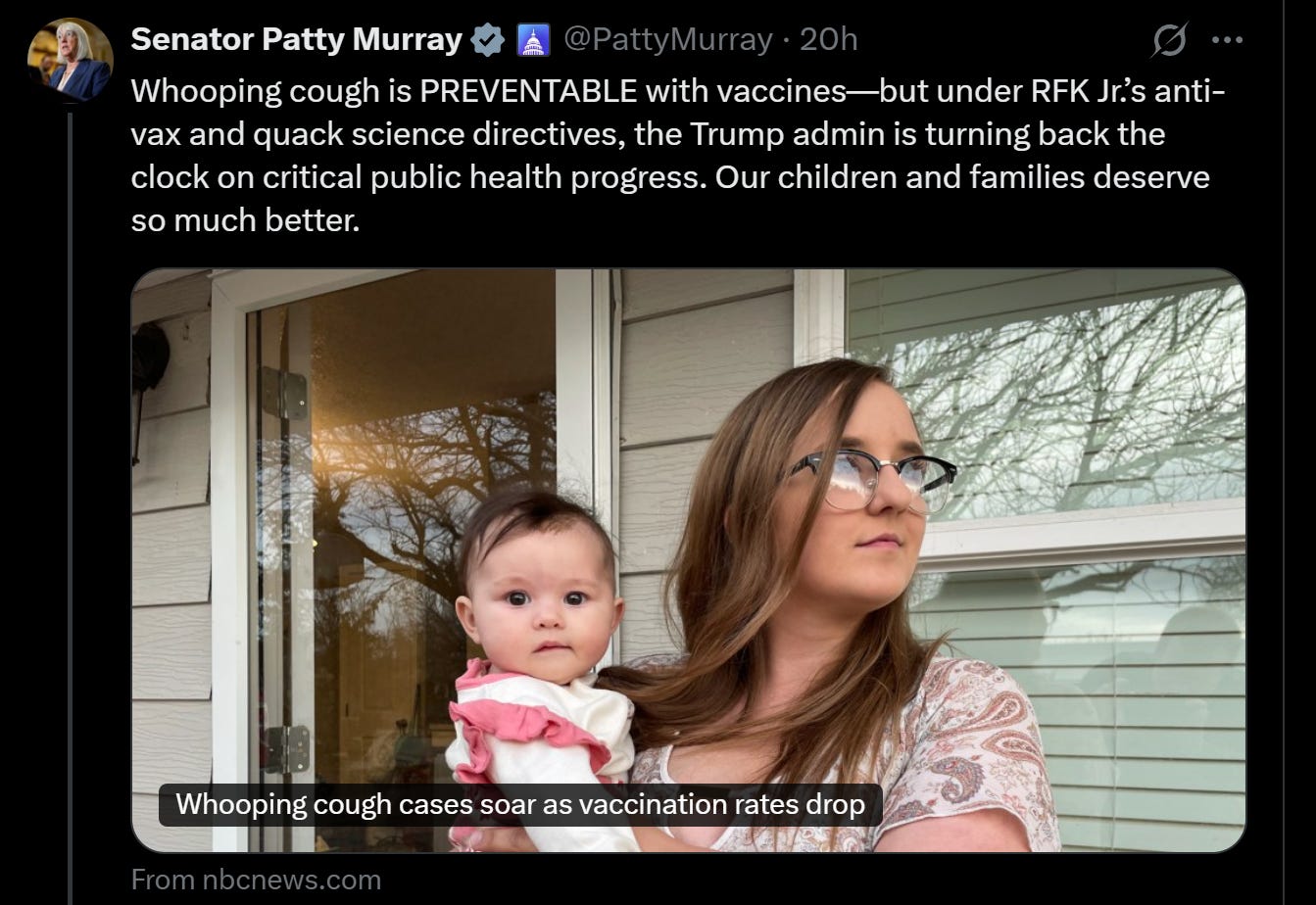
The vaccine debate is heating up with fear-driven politically charged comments coming out from lawmakers who are over their heads on infectious disease epidemiology and vaccinology. Senator Patty Murray (D-WA) who graduated from Washington State University (WSU) with a B.A. in physical education Tweeted out this proclamation regarding pertussis vaccination.
This review was assisted by AlterAI
Introduction
Pertussis, or whooping cough, caused by Bordetella pertussis, has re‑emerged as a public‑health concern despite long‑standing immunization programs. Global vaccination coverage with diphtheria‑tetanus‑pertussis (DTP or DTaP/Tdap) exceeds 90%, yet cyclical outbreaks continue in highly vaccinated populations. ¹ ² The paradox lies in waning immunity, pathogen adaptation, and suboptimal mucosal protection conferred by the current acellular vaccines (aP). An analysis of these failures, their clinical repercussions, and therapeutic approaches illustrates the limitations of a vaccine that partially prevents severe disease but not transmission.
Transition from Whole‑Cell to Acellular Vaccines
The original whole‑cell vaccine (wP) was introduced in the 1940s when along with improved living conditions, sanitation, and treatment, mortality fell from pertussis by > 90 % .³ However, the vaccine often caused high‑grade fever, prolonged crying, or hypotonic–hyporesponsive episodes, prompting replacement with acellular (aP) formulations in the 1990s across North America, Western Europe, and Australia. Acellular pertussis vaccines contain up to five purified antigens—pertussis toxin (PT), filamentous hemagglutinin (FHA), pertactin (Prn), and fimbrial proteins—but they omit the broad antigenic spectrum and toll‑like receptor stimulation produced by the natural infection or whole‑cell preparations.⁴ The immediate benefit was improved tolerability, however the new shot had undermined durable immunity.
Waning Immunity and Vaccine Failure
Acellular vaccine immunity declines sharply within 2 – 5 years after completion of the primary series.⁵ ⁶ Klein et al. reported that DTaP effectiveness drops from ≈ 98 % in the first year after the fifth dose to ≈ 70 % within five years.⁵ Booster Tdap vaccination during adolescence restores antibody titers transiently, but protection wanes again by 2 – 3 years.⁷ A 2012 California outbreak demonstrated that 81% of laboratory‑confirmed cases occurred among children fully vaccinated.⁸ A similar pattern was observed in Senator Murray’s Washington State (2012) and Australia (2015) where the majority of pediatric cases were fully vaccinated.⁹ ¹⁰
The current pertussis vaccine does not stop transmission.¹¹ Animal models¹² and human challenge studies ¹³ confirm that vaccinated hosts can be asymptomatic carriers, creating a reservoir for spread even in highly vaccinated communities.
Pathogen Adaptation
Genomic surveillance has shown that Bordetella pertussis evolves under vaccine‑induced selection pressure. Pertactin‑deficient mutated strains now account for > 60 % of isolates in the United States and Australia.¹⁴ ¹⁵ Because pertactin is a principal antigen in acellular vaccines, loss enhances pathogen fitness and reduces antibody neutralization. In addition, altered promoter regions of the pertussis toxin gene (ptxP3 lineage) yield higher toxin production and increased virulence¹⁶ emerging as a consequence of decades of mass vaccination.
Clinical Presentation and Treatment
In outbreaks among vaccinated children, symptoms are frequently mild: persistent paroxysmal cough without classic “whoop,” sometimes lasting weeks but rarely causing life‑threatening apnea or pneumonia.¹⁷
Antibiotic therapy: Macrolides (azithromycin, clarithromycin, or erythromycin) are first‑line agents. Azithromycin is preferred because of simpler dosing and less gastrointestinal toxicity.¹⁸ Antibiotics shorten the infectious period if given in the catarrhal or early paroxysmal stage and reduce secondary transmission through post‑exposure chemoprophylaxis within 21 days of symptom onset.¹⁹ However, they do not significantly alter the course of late‑stage cough.
Supportive care: Rarely infants with apnea or cyanosis require hospitalization for oxygen, gentle suctioning, and nutritional support. Extracorporeal membrane oxygenation (ECMO) may be considered in severe life threatening persistent hypoxemia/hypoperfusion.²⁰ Corticosteroids, beta‑agonists, and antitussives are reasonable adjuncts. There are no large-scale randomized trials of multidrug treatment strategies.
Outcomes: Case fatality rates in vaccinated schoolchildren are extremely low (< 0.01 %), but secondary infection in infants under 3 months can be severe. Mortality in that group during the 2010–2012 U.S. resurgence was ≈ 1 % of reported cases ⁸ ²¹ however details on the lack of early treatment are not disclosed.
Public Health Responses and Vaccine Alternatives
Outbreak management focuses on early detection by PCR testing, macrolide prophylaxis for household contacts, and boosters for pregnant women and close caregivers.²² Despite frequent boosting, epidemiologic models show that Tdap cannot sustain herd immunity due to rapid immunity decay.⁶ ²³ ²⁴
Conclusions
The resurgence of pertussis in highly vaccinated populations exposes the inherent limitations of mass vaccination with the acellular pertussis vaccine. Short‑lived immunity, shallow mucosal protection, and pathogen evolution explain the continued outbreaks among vaccinated children. Fortunately, clinical outcomes for these patients are usually benign, and standard macrolide therapy is effective in treatment and prevention of transmission. Early diagnosis and therapeutics remain the cornerstones of pertussis control, not political charges for more vaccination.
Please subscribe to FOCAL POINTS as a paying ($5 monthly) or founder member so we can continue to bring you the truth.
Peter A. McCullough, MD, MPH
FOCAL POINTS has partnered with Patriot Mobile to defend your medical freedom. Join Patriot Mobile today!

References
World Health Organization. Pertussis vaccines: WHO position paper. Wkly Epidemiol Rec. 2015;90:433‑460.
Mooi FR, van der Maas NA, de Melker HE. Pertussis re‑emergence: national and international perspectives. Clin Microbiol Infect. 2014;20:22‑27.
Cherry JD. Impact of pertussis vaccine on the epidemiology of pertussis. Rev Infect Dis. 1984;6:S443‑S449.
Plotkin SA. The pertussis problem. Clin Infect Dis. 2014;58:830‑833.
Klein NP et al. Waning protection after fifth dose of DTaP vaccine in children. N Engl J Med. 2012;367:1012‑1019.
Sheridan SL et al. The impact of a transition from whole‑cell to acellular pertussis vaccine on immunity in Australia. Matern Child Health J. 2014;18:1930‑1939.
Klein NP et al. Tdap effectiveness in adolescents during pertussis outbreaks. Clin Infect Dis. 2019;68:376‑382.
Winter K et al. California pertussis epidemic, 2010. Clin Infect Dis. 2012;54:1730‑1736.
Washington State Department of Health. Pertussis epidemic summary 2012. Olympia, WA.
Lam C et al. Pertussis outbreaks in Australia and waning immunity. Med J Aust. 2017;206:403‑407.
da Silva Antunes R et al. Impaired Th1 and Th17 cell responses among children receiving acellular pertussis vaccine. J Infect Dis. 2018;218:1989‑1999.
Warfel JM et al. Acellular vaccine‑induced immunity does not prevent colonization in baboons. Proc Natl Acad Sci USA. 2014;111:787‑792.
Roestenberg M et al. Human challenge with Bordetella pertussis. Lancet Infect Dis. 2023;23:133‑142.
Martin SW et al. Pertactin‑negative Bordetella pertussis strains in the United States. N Engl J Med. 2015;372:583‑584.
Lam C et al. Genomic diversity of pertactin‑deficient strains in Australia. Emerg Infect Dis. 2019;25:1194‑1197.
Mooi FR et al. Evolution of Bordetella pertussis and increased toxin expression. Emerg Infect Dis. 2009;15:1206‑1213.
Cherry JD. Clinical manifestations of pertussis in the vaccinated. Future Microbiol. 2019;14:1085‑1094.
Altunaiji S et al. Antibiotics for whooping cough (in adults and children). Cochrane Database Syst Rev. 2020;(4):CD004404.
Centers for Disease Control and Prevention. Pertussis (Treatment and Prophylaxis) Clinical Guidelines. 2024 update.
Rowlands HE et al. Severe pertussis in infants: mechanisms of leukocytosis and therapeutic options. Pediatr Crit Care Med. 2010;11:698‑703.
Skoff TH et al. Sources of infant pertussis infection, United States 2010‑2012. Clin Infect Dis. 2015;61:1650‑1657.
ACIP. Updated recommendations for Tdap vaccination in pregnancy. MMWR. 2023;72:113–120.
Domenech de Celles M et al. Impact of booster vaccinations on pertussis transmission in the U.S. PNAS. 2022;119:e2120064119.
Locht C et al. Safety and immunogenicity of live attenuated pertussis vaccine BPZE1 in adults. Lancet Infect Dis. 2020;20:1296‑1305.
I see that former US Senator Ben Sasse now has Stage 4 pancreatic cancer. I did a quick search on the web, and it looks like he took the first two doses of the Covid "vaccine" and at least the first booster.
I'm wondering if any of our politicians who took the jabs and pushed the jabs so hard on others are starting to regret those decisions?
https://pubmed.ncbi.nlm.nih.gov/30793754/
“Because of linked-epitope suppression, all children who were primed by DTaP vaccines will be more susceptible to pertussis throughout their lifetimes, and there is no easy way to decrease this increased lifetime susceptibility.”