


Alpha-gal syndrome (AGS) — the tick-borne allergy that turns red meat, pork, and sometimes dairy into an anaphylaxis risk — is no longer rare.
A new study presented at the American College of Gastroenterology 2025 Annual Scientific Meeting delivers the clearest picture yet: the incidence of alpha-gal syndrome has exploded among Americans.
Researchers analyzed the TriNetX US Collaborative Network (a large real-world database spanning dozens of health systems) and identified 3,828 adults tested for alpha-gal specific IgE (≥0.1 kU/L) between 2010 and 2025.
Of those, 749 patients tested positive (23%) — making this the largest real-world AGS cohort reported to date.
Among people tested for alpha-gal syndrome, positivity rates skyrocketed over time:
2013–2014: 1.8% tested positive
2019–2020: 14.2% tested positive
2021–2022: 38% tested positive
2023–2024: 100% positivity among newly identified cases meeting study criteria
At the same time, the incidence rate surged from 0.95 cases per 100 patient-years in 2013–2014 to 94.06 in 2023–2024 — representing a 9,801% increase in the rate of newly identified alpha-gal syndrome cases.
Even from 2021 to 2024 alone, incidence rose from 23.46 to 94.06 cases per 100 patient-years — a 301% spike in just a few years.
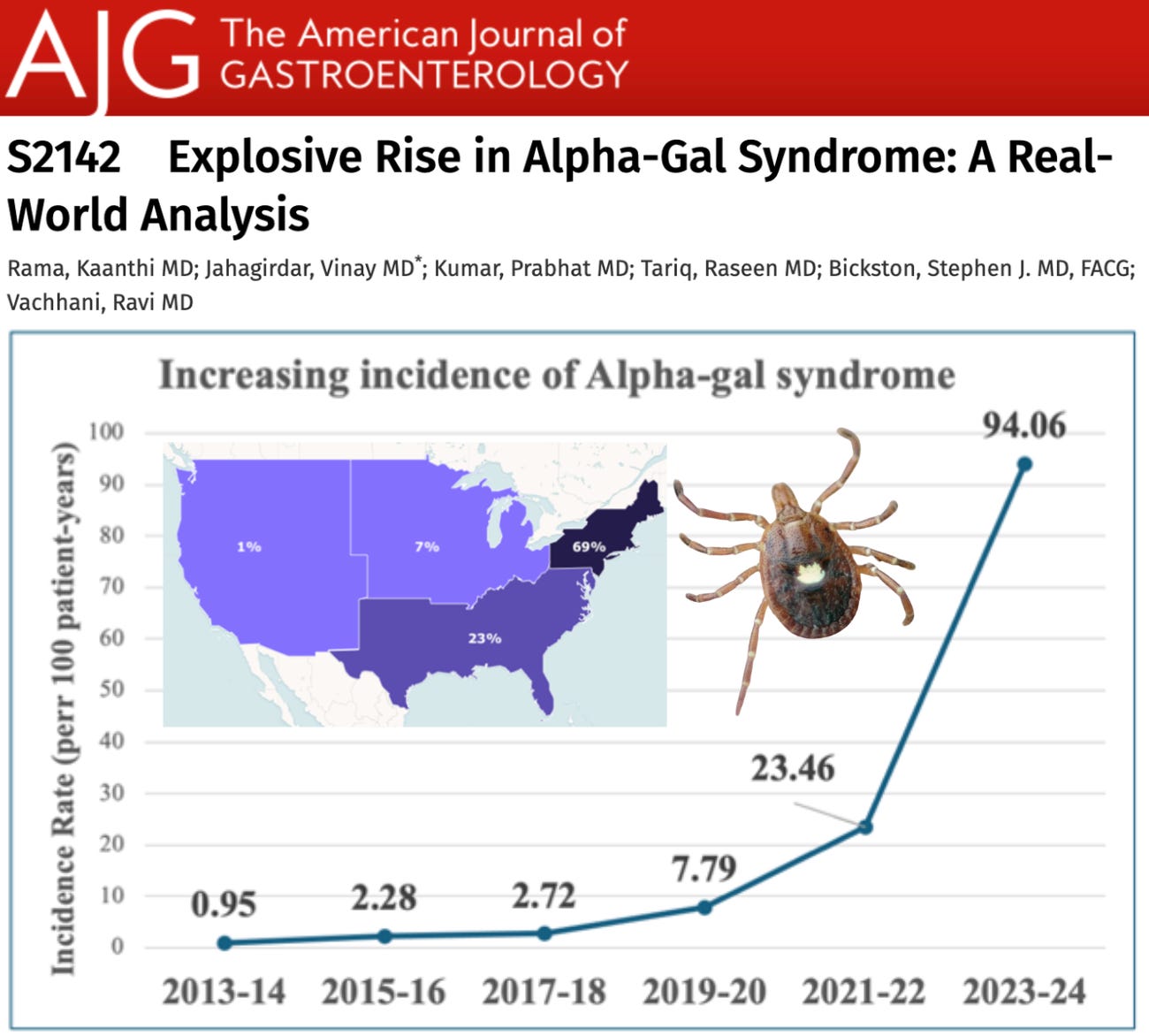
While increased awareness and testing likely play a role, the large magnitude of the increase suggests a genuine rise in clinical cases.
These data are concerning in light of a peer-reviewed paper from Western Michigan University professors arguing that genetically engineering lone star ticks via CRISPR to deliberately spread alpha-gal syndrome would be “morally obligatory” as a form of “moral bioenhancement” to discourage people from eating meat.


It’s also important to remember that in the late 1960s, Army-funded biowarfare researchers released 282,800 radioactively labeled ticks across field sites in Virginia and Montana — including 152,000 Carbon-14 labeled lone star ticks in Montpelier and Newport News, Virginia — to study how far and how fast the ticks could spread.

Given the scale of the current alpha-gal syndrome epidemic — with incidence rates increasing by approximately 100-fold in just one decade — a serious, transparent, and independent investigation is now critically needed.
We must fully examine whether any past or present bioterror-related activities, laboratory releases, or government entomological programs may have played a role in the rapid proliferation of lone star ticks and the resulting surge in alpha-gal syndrome cases.
Epidemiologist and Foundation Administrator, McCullough Foundation
Support our mission: mcculloughfnd.org
Please consider following both the McCullough Foundation and my personal account on X (formerly Twitter) for further content.
Call Billy to know what he's done.
Alpha gal syndrome is completely curable with acupuncture and nutritional adjustment. Study proved this a few years back.
https://pmc.ncbi.nlm.nih.gov/articles/PMC8729907/