


Yesterday, I visited a dermatologist who has a number of interesting 19th century dermatology books and beautiful portraits of Ferdinand von Hebra and Moritz Kaposi. I snapped a picture of both, but the sunlight entering the room behind me made a mess of the photos. Below is my lousy shot of Dr. von Hebra.
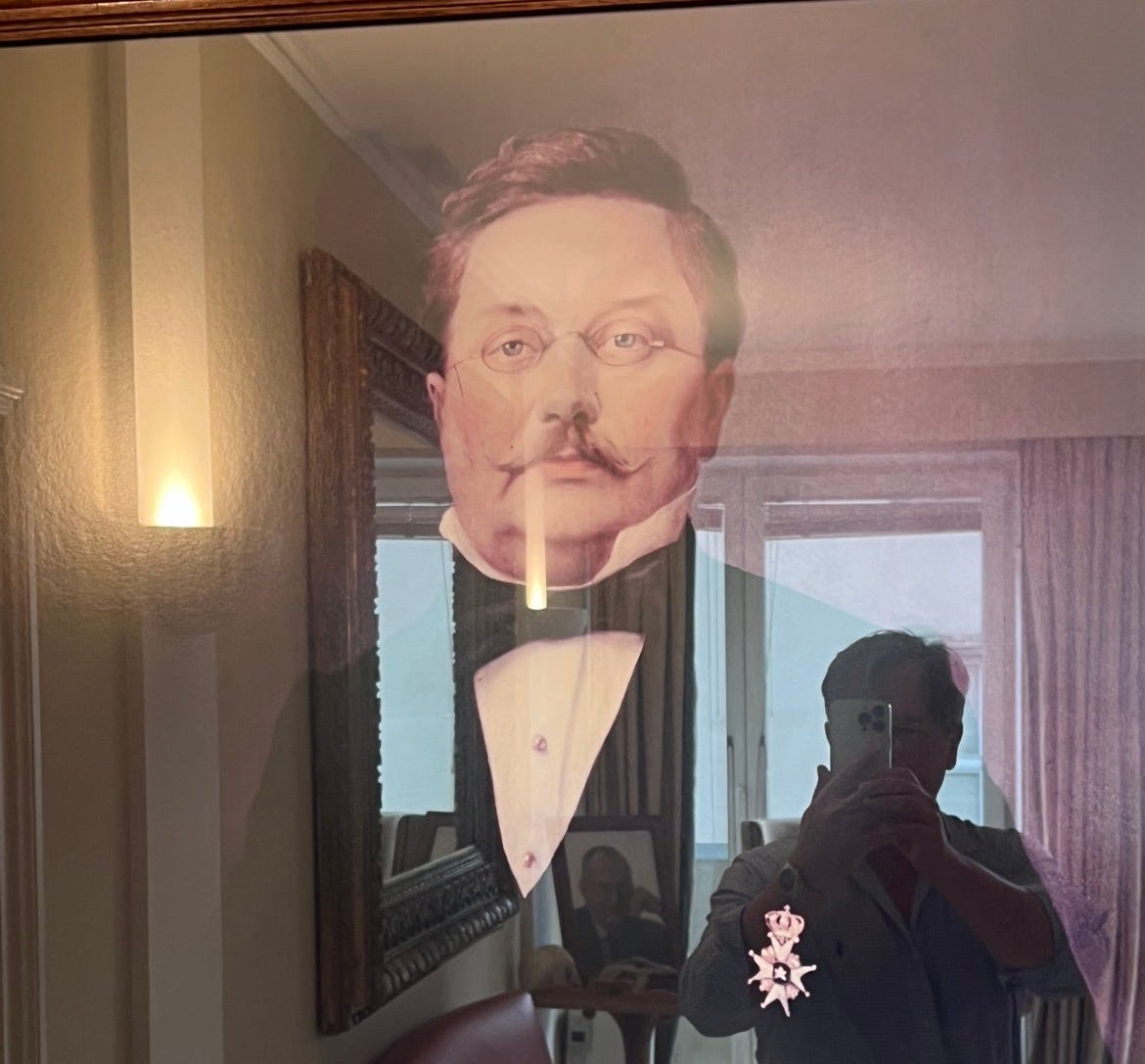
Ferdinand von Hebra: Pioneer of Modern Dermatology
I’ve always been fascinated by individuals who —out of sheer curiosity— make a pioneering investigation of something that no one else before them had really examined.
Ferdinand Karl Franz Schwarzmann, Ritter von Hebra (1816–1880) had just finished his medical training at the University of Vienna and kept asking the eminent clinician, Dr. Joseph Škoda, questions about diseases of the skin.
One day Škoda told him something along the lines of, “I don’t think we know much about the reality of the skin, and no one apart from you is that interested in it. Why don’t you make a study of it?”
And so, Hebra got to work. Rather than viewing skin diseases as surface manifestations of internal imbalances, he set about directly examining lesions through microscopic analysis, and studying their pathological anatomy. His approach decisively broke from tradition.
One of his earliest contributions was in his 1844 work on scabies. Though the itch mite had been observed before, Hebra discovered evidence that scabies was caused by the parasite Sarcoptes scabiei, not humoral factors. This helped dismantle outdated theories and reframed many itchy conditions as specific pathological processes.
He also differentiated psoriasis from leprosy in 1841 and described numerous conditions, including erythema exudativum multiforme (now often linked to herpes-associated erythema multiforme), impetigo herpetiformis, and what he initially termed seborrhea congestiva (later recognized as a form of lupus erythematosus). He further advanced treatments such as mercury inunctions for syphilis, sulphur and iodine applications. He even invented a water bed for managing extensive skin defects.
Hebra’s great literary achievement was his Atlas der Hautkrankheiten (Atlas of Skin Diseases), published in installments between 1856 and 1876. This monumental work featured life-sized, chromolithographic illustrations—many by artists Anton Elfinger and Carl Heitzmann—that provided unprecedented visual documentation of skin diseases. All across Europe it served as a diagnostic tool and an educational masterpiece.
In 1849, Hebra became the first professor of dermatology at Vienna General Hospital. He established the New Vienna School of Dermatology, which trained generations of specialists and transformed Vienna into the global center for the field.
His lasting influence stems from his classification of skin diseases based on their underlying pathology rather than mere symptoms or appearance. By treating the skin as an organ worthy of specialized study—capable of expressing both local and systemic problems—he laid the intellectual and institutional foundations for modern dermatology. Today, his emphasis on precise observation, histopathology, and evidence-based therapy continues to inform the specialty.
Sadly, Dr. von Hebra was involved in one of the saddest episodes in medical history. Among the medical eminences of Europe at the time, he was one of the only supporters of Dr. Ignaz Semmelweis, who famously proposed the theory that hand-washing with chloride of lime reduces the incidence of puerperal fever. In the December 1847 and April 1848 issues of the Viennese medical journal, Hebra endorsed Semmelweis’s findings. He was also Semmelweis’s only friend who kept in touch with him after he left Vienna.
Upon Semmelweis’s subsequent return to Vienna from Hungary, he is said to have become increasingly angry and depressed from ruminating over the fact that Europe’s top obstetricians still refused to teach their pupils the value of hand-washing. He began publishing open letters to top professors — letters that were perceived as threatening, such as the following from 1861:
I am aware that since 1847, thousands upon thousands of women and infants have died who would not have died if I had not remained silent, but had instead subjected every error spread about puerperal fever to the necessary rebuke […]. The killing must stop, and to ensure that the killing stops, I will stand guard, and anyone who dares to spread dangerous errors about puerperal fever will find in me a vigorous opponent. For me, there is no other way to put a stop to the killing than the ruthless exposure of my opponents, and no one with a heart of gold will criticize me for taking this course of action.
– To Späth in Vienna, 1861
However, Mr. Court Councillor, should you continue to educate your pupils in the doctrine of epidemic puerperal fever without having refuted my teaching, then I declare you before God and the world to be a murderer.
– To Scanzoni in Würzburg, 1861
Due to Semmelweis’s suffering from depression, János Balassa signed a document which committed him to a mental institution. On July 30, 1865 Dr. von Hebra was one of the party who arranged Semmelweis’s fake trip to his “new water-cure hospital”, actually taking his long-time friend to a Viennese asylum for the insane located in the Lazarettgasse (Landes-Irren-Anstalt). Upon arriving at the institution, Semmelweis realized what was happening and tried to flee, but was forcibly subdued by the asylum’s guards and died two weeks later.
I have read two competing accounts of how he sustained the wound that led to his septicemia and death. The most widely reported is that, after being committed to the asylum in 1865, he was brutally beaten by guards while attempting to escape. He sustained severe injuries and open wounds on his right hand. These wounds became infected, resulting in gangrene, acute osteomyelitis, and ultimately fatal septicemia.
Other Semmelweis researchers have proposed that the wound may have been a cut that he sustained while performing a dissection or surgery shortly before his institutionalization. If so, this eerily mirrors the death of his colleague, Jakob Kolletschka, whose fatal infection from a scalpel cut during an autopsy inspired Semmelweis to embark on his inquiry about “corruption” transferred from cadavers to pregnant women by medical students going from anatomy class to the obstetrics department.
Perhaps out of horror and shame about what happened to Semmelweis at the asylum, Dr. von Hebra was not amongst the attendees of Semmelweis’ funeral.
Nothing more dangerous than an insecure physician who cops to the party line.