


Whenever I mention the debates and writings of James Madison, author of the U.S. Constitution, I am often perceived to be indulging in academic musings about a quaint, late 18th century gentleman scholar whose ideas have no relevance to the “complex reality of today’s geopolitical situation.”
WRONG. Madison’s observations—as well as those of George Washington in his Farewell Address of 1796 — are as relevant today as they were in 1796.
When it comes to foreign affairs, the stupidity and vulgarity of the notion “this time it’s different—this time we really should rid of this foreign bad guy” — never cease to get on my nerves, even though it’s been a constant emotion in human affairs for thousands of years. As Madison put it in the Federal Convention debates of 1787:
The means of defence against foreign danger have been always the instruments of tyranny at home. Among the Romans it was a standing maxim to excite a war, whenever a revolt was apprehended. Throughout all Europe, the armies kept up under the pretext of defending, have enslaved the people.
It makes absolutely no difference if some foreign military adventures are perceived as low risk-high reward. If the executive—in this case, President Trump—is granted discretionary power to take such actions, what will prevent the next U.S. President from embarking on a foreign military adventure that doesn’t have the same favorable risk-reward profile?
Remember, the U.S. government and its mainstream media lackeys are capable of spinning the risk-reward profile of a foreign military adventure however they like, and most Americans have no means of ascertaining if they are being told the truth of the matter.
The whole point of the U.S Constitution is to limit the state in its ability to take aggressive, executive actions. Once We the People start making exceptions for a particular executive whom we happen to like, we have just given up our constitutional protections and gambled with the constitutional protections of our children and grandchildren.
The equivalent in domestic affairs would be to grant HHS Secretary Kennedy broad powers to invoke a public health emergency whenever he sees fit—not stopping to think that the next HHS Secretary probably won’t be as wise and principled as Kennedy.
Again, the whole point of the Constitution is to LIMIT the power of the state to do whatever it sees fit.
When the Roman Senate granted Octavian imperium maius—effectively making him commander-in-chief of most legions while maintaining the appearance of shared power—the Senate effectively ended the Roman Republic, thereby bringing the Roman citizenry under the power of a dynastic state with direct command of the military.
Octavian—who thereby became the Emperor Augustus—was a prudent and moderate man who used his imperial power wisely. His successors, Tiberius, Caligula, and Nero, weren’t so great.
These basic lessons and principles, which Madison repeatedly pointed out in his debates and writings, are simple and easy to grasp. And yet, for reasons that aren’t clear to me, the American people seem incapable of learning them.
Back in 2003, we were told that the U.S. military would easily take out Saddam Hussein, that the majority Shia faction in Iraq would dance in the streets and align themselves with the U.S. occupation authority, and that the rejuvenation of the Iraqi oil industry would pay for the entire operation. On May 1, 2003, President George W. Bush declared the Mission Accomplished.
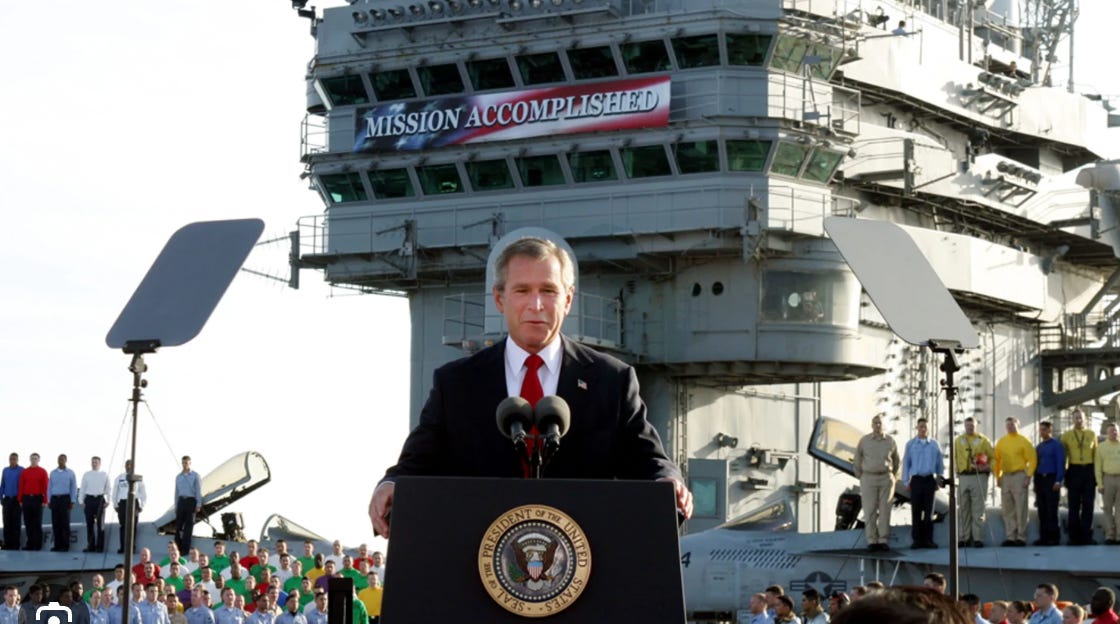
I won’t recite the long and dreary list of everything that went wrong with the occupation of Iraq, as it’s really too depressing. For now, I’ll just remind the reader of all the lame excuses we were given for why it didn’t turn out to be a cake walk after all.
It turned out that the body politic of Iraq was a lot more complicated and unruly than we expected, that the majority Shia weren’t as cooperative as expected, that the removal of Saddam Hussein strengthened Iran’s hand in the region, and that guerrilla fighters planting roadside bombs could create an astonishing amount of trouble, even for the vaunted “Most Powerful Military in History.”
I dare say that the majority of Americans aren’t even aware of the 450,000 U.S. Soldiers Diagnosed with Traumatic Brain Injury Since 2001, mostly caused by roadside bombs in Iraq and Afghanistan. Think about that number: 450,000 young men, many with families, who have been neurologically damaged.
I can already hear the retort: “Yes, John, but this time it’s different. The Venezuelan people aren’t lunatic, religious fanatic Arabs who don’t speak an Indo-European language. They are reasonable Latin Americans and we can easily communicate with them.”
Maybe this is true, but even if it is, the problem with this reasoning is that it grants the executive discretionary power to decide if some military actions abroad are worthwhile (low risk/ high reward) while others are not.
The argument that such military adventures are “limited” and “don’t require putting loads of regular Army and Marine boots on the ground” is equally specious. What happens when word gets out that the Americans are only willing to do limited special forces operations and airstrikes, but don’t have the stomach for full occupation?
What happens when the executive enjoys a few resounding successes at “quick and limited military operations,” and these successes embolden him to take greater risks?
Napoleon’s quick and decisive victories early in his career led many to believe that he was a military strategist of such genius that he could do no wrong. This went to his head and he ultimately took his army to Russia in 1812.
Hitler’s quick and easy seizing of Austria and the Sudetenland by only threatening to send the German army led many to believe he was a strategist of such genius that he could do no wrong. This went to his head and he ultimately sent the German army to Russia in 1941.
At a recent dinner party, a great and dear friend assured me that the United States military is now so capable that it would make short work of the Russian military. No comment.
I could go on, but I’ll conclude by highly recommending the essay Three Key Lessons from the US’s Venezuela Intervention by Ryan McMakan, published by the Mises Institute.
Oh, I forget, he is untouchable, as are treasonous members of Congress. The US is such a hopelessly corrupt place that our only hope is to take out foreigners in in Latin America. Now I understand!
Here is a list of Foreign Regime Changes Brought About By US Presidents without the Approval of Congress. Can you explain why it's not special pleading to say that now that Trump does it, it must be stopped?
1893 | Hawaii | Benjamin Harrison | US-backed overthrow of Queen Liliʻuokalani, leading to annexation.
1903 | Panama (from Colombia) | Theodore Roosevelt | Supported Panamanian independence to secure canal rights.
1903–1925 | Honduras | Theodore Roosevelt et al. | Multiple interventions supporting coups and regimes.
1906–1909 | Cuba | Theodore Roosevelt | Occupation and installation of a new government under the Platt Amendment.
1909–1933 | Nicaragua | William H. Taft et al. | Interventions leading to the installation of the Somoza family.
1913 | Mexico | Woodrow Wilson | Support for coup against Francisco Madero, installing Victoriano Huerta.
1915–1934 | Haiti | Woodrow Wilson | Occupation and imposition of a new constitution.
1916–1924 | Dominican Republic | Woodrow Wilson | Marine occupation and installation of US personnel in government.
1948 | Costa Rica | Harry S. Truman | Support for opposition in civil war, leading to José Figueres Ferrer’s rule.
1949 | Syria | Harry S. Truman | CIA-backed coup installing Husni al-Za'im.
1952 | Egypt | Harry S. Truman / Dwight D. Eisenhower | CIA support for the Free Officers Movement overthrowing the monarchy.
1953 | Iran | Dwight D. Eisenhower | Operation Ajax: CIA-orchestrated coup against Mohammad Mosaddegh.
1954 | Guatemala | Dwight D. Eisenhower | Operation PBSuccess: CIA-backed coup against Jacobo Árbenz.
1960–1965 | Congo | Dwight D. Eisenhower et al. | CIA involvement in the assassination of Patrice Lumumba and support for Mobutu.
1963 | South Vietnam | John F. Kennedy | Authorized coup against Ngo Dinh Diem.
1963 | Iraq | John F. Kennedy | CIA support for Ba'athist coup against Abdul Karim Qasim.
1964 | Brazil | Lyndon B. Johnson | CIA support for military coup against João Goulart.
1965 | Dominican Republic | Lyndon B. Johnson | Military intervention to prevent leftist takeover, leading to a new government.
1965 | Indonesia | Lyndon B. Johnson | CIA facilitation of anti-communist purges leading to Suharto's rise.
1970 | Cambodia | Richard Nixon | Support for coup against Norodom Sihanouk, installing Lon Nol.
1971 | Bolivia | Richard Nixon | CIA support for Hugo Banzer's coup against Juan José Torres.
1973 | Chile | Richard Nixon | CIA-backed coup against Salvador Allende, installing Augusto Pinochet.
1974–1991 | Ethiopia | Gerald Ford et al. | Support for rebels against the Derg, leading to its fall.
1975–1991 | Angola | Gerald Ford et al. | CIA support for UNITA against MPLA.
1976 | Argentina | Gerald Ford | Endorsement and CIA support for coup against Isabel Perón.
1979–1992 | Afghanistan | Jimmy Carter / Ronald Reagan | Operation Cyclone: CIA arming mujahideen, leading to regime collapse.
1981–1982 | Chad | Ronald Reagan | CIA training and support for Hissène Habré's takeover.
1981–1990 | Nicaragua | Ronald Reagan / George H.W. Bush | Support for Contras leading to Sandinista electoral defeat.
1983 | Grenada | Ronald Reagan | Operation Urgent Fury: Invasion overthrowing the Marxist government.
1989 | Panama | George H.W. Bush | Operation Just Cause: Invasion removing Manuel Noriega.
1991 | Haiti | George H.W. Bush | Initial support for coup against Jean-Bertrand Aristide (later reversed).
1996–1997 | Zaire (Congo) | Bill Clinton | Support for AFDL rebels overthrowing Mobutu Sese Seko.
2000 | Yugoslavia | Bill Clinton | CIA funding for opposition leading to the ouster of Slobodan Milošević.
2003–2006 | Somalia | George W. Bush | CIA funding warlords and support for Ethiopian invasion.
2004 | Haiti | George W. Bush | Support for removal of Jean-Bertrand Aristide.
2011 | Libya | Barack Obama | NATO intervention leading to the overthrow of Muammar Gaddafi.