


On Sunday, President Trump announced on his Truth Social account that he is patching things up with North Korean dictator, Kim Jong Un, and is therefore no longer concerned about the security of South Korea — one of the US’s key trading partners.
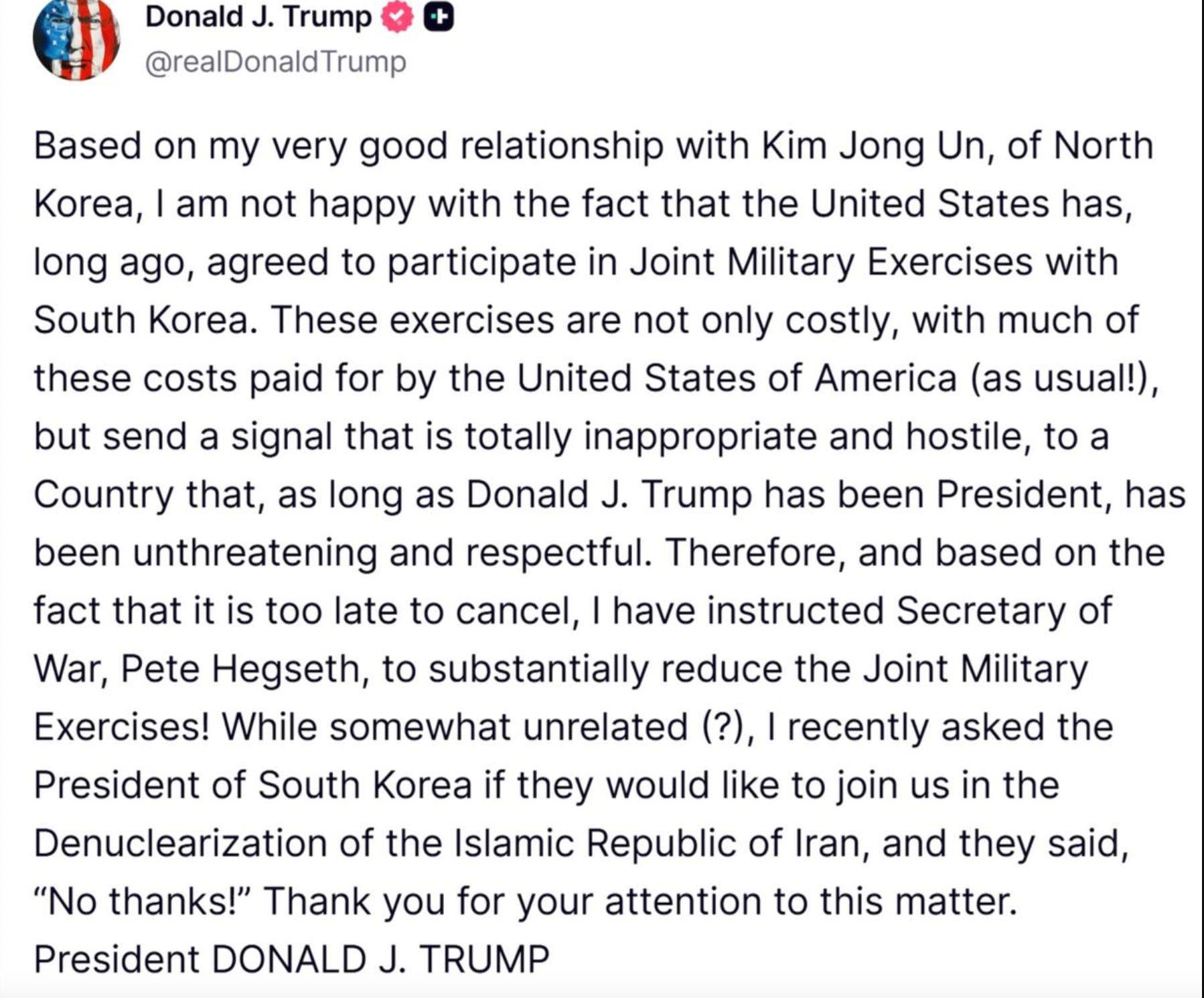
This is a classic example of an overextended empire picking too many fights at once and trying to placate one opponent so that it can shift military resources to putting out a fire in another part of the empire.
In 2006, North Korea began successfully testing nuclear weapons. Since then, its dynastic dictator, Kim Jong Un—widely regarded as aggressive and unpredictable—has repeatedly threatened “shocking and unimaginable disaster,” and “total destruction” of the United States if it takes military action against North Korea.
In recent years, North Korean leader Kim Jong Un has repeatedly issued stark threats against the United States, framing them as responses to perceived hostility, joint military exercises, or the need to expand nuclear capabilities.
These statements, typically delivered through the Korean Central News Agency (KCNA), emphasize Kim’s readiness to use overwhelming or nuclear force if provoked, though they often condition destruction on U.S. or allied actions rather than announcing unprovoked first strikes.
On or around December 31, 2023, Kim met with senior military officers and instructed that if the United States and South Korea opted for military confrontation, North Korean forces must “deal a deadly blow to thoroughly annihilate them by mobilizing all the toughest means and potentialities without moment’s hesitation.”
State media reported this language the following day, linking it to the need to sharpen the country’s nuclear “treasured sword” amid what Kim described as unprecedented U.S.-led pressure.
In August 2025, amid U.S.–South Korea joint drills, Kim again escalated rhetoric. He described the exercises as an “obvious expression of their will to provoke war” and an indication of hostile intent, while calling for the rapid expansion of North Korea’s nuclear armament to match the security environment. This continued a pattern of using drills as a trigger for warnings of strengthened nuclear readiness directed at Washington and its allies.
In early 2026, Kim signaled openness to coexistence with the United States only if Washington accepted North Korea’s irreversible nuclear status and withdrew its “hostile policy,” while simultaneously warning of readiness to respond to any confrontation and emphasizing the ability to inflict decisive damage (with particularly explicit language reserved for South Korea).
By mid-August 2026, as the annual Ulchi Freedom Shield exercises approached, North Korean Foreign Ministry statements—aligned with Kim’s overall posture—vowed to frustrate “outsiders’ hostile acts with “the most powerful and overwhelming force,” respond to a “new level of threat with a new level of a deterrent,” and further strengthen nuclear capabilities. These came alongside missile tests and accusations that U.S. strategy risked pushing the region toward nuclear confrontation.
Despite Kim’s extravagant threats, most military analysts claim that he is a rational actor who understands MAD (Mutual Assured Destruction) and therefore maintains nuclear weapons as a means of deterrence rather than suicidal aggression. However, this assessment is a revision from earlier characterizations of North Korea as irrational (or “crazy,” “mad,” “unpredictable,” or “erratic”) in U.S. and Western discourse during the decades when Washington sought to prevent or reverse its nuclear weapons program.
North Korea’s nuclear program and its aggressive rhetoric naturally bring to mind US relations with Iran. As I note in my new book, Mind Viruses: America’s Irrational Obsessions.
One often hears the assertion that Iran’s Supreme Leader, Ali Khamenei, was a religious fanatic for whom the Cold War doctrine of Mutually Assured Destruction (MAD) does not apply. However, this appears to be more of an assertion than an established fact. Khamenei issue an oral fatwa (religious decree) against the production of nuclear weapons, in October 2003—reiterated in April 2010 and October 2019. He was also known to be strongly dedicated to his wife, six children, in-laws, and seven grandchildren.
The Iranian regime has a forty-seven-year track record of pragmatic survival behavior. It has not invaded neighbors, has used proxies and deniability to avoid direct regime-ending confrontations, adapted to sanctions, negotiated the JCPOA (2015) to ease pressure, and reacted to provocations with calibrated responses such as limited direct strikes on Israel after assassinations. In a 2012 60 Minutes interview, former Mossad chief Meir Dagan characterized the regime “very rational” and said it weighs implications carefully (The Spymaster: Meir Dagan on Iran’s threat,” 60 Minutes, CBS News, Sept. 16, 2012).
Rarely if ever mentioned in the western media is the possibility that if the Iranian regime indeed wishes to acquire nuclear weapons, it is for the rational purpose of deterring aggression from Israel and the United States, both of which are armed with nuclear weapons.
Here it is useful to compare Iran to Pakistan. The latter country is often accused by the United States of sponsoring terrorism and is strongly suspected of having provided a haven for Osama bin Laden for five years in a secure compound in Abbottabad, a military garrison town close to Islamabad. Following India’s acquisition and testing of a nuclear bomb in 1974, Pakistan began developing its own nuclear weapons against strong Israeli opposition. In 1981, the Mossad sent letter bombs to firms in West Germany and Switzerland that were assisting in the effort. Though Pakistan succeeded in acquiring and testing nuclear weapons in 1998, it has never threatened Israel with an atomic bomb attack. The government of Pakistan believes that possessing nuclear weapons is a deterrent against aggression from India and other nations in the region.
I recently performed the following Grok query about Iran.
What is the evidence that the Iranian regime is an irrational actor that does not recognize, and will not be governed by the Cold War doctrine of Mutually Assured Destruction (MAD)? Has the Iranian regime taken actions that are consistent with suicidal irrationality?
Grok responded as follows.
There is limited, mostly speculative or rhetorical evidence that the Iranian regime is an “irrational actor” that rejects the Cold War doctrine of Mutually Assured Destruction (MAD), and virtually no concrete evidence of state-level actions that demonstrate suicidal irrationality. MAD relies on the assumption that rational state actors prioritize national/regime survival above all else and will therefore be deterred from actions (especially nuclear first strikes) that guarantee their own destruction. Critics who argue Iran falls outside this framework typically point to its theocratic ideology, while most strategic analysts (including former Israeli intelligence leaders) conclude the opposite: Iran is a rational, if highly ideological and risk-tolerant, actor that understands deterrence and acts to preserve the regime.
Claimed Evidence for Irrationality / Non-Adherence to MAD
Proponents (often Israeli officials, U.S. hawks, and some think-tank analyses) cite the following:
Religious ideology and eschatology: The regime is Twelver Shia, with a belief in the eventual return of the Hidden Imam (Mahdi). Some hardliners (especially in the IRGC) interpret major chaos or apocalyptic conflict with “infidels” (Israel/U.S.) as hastening this return, potentially making mutual destruction religiously desirable rather than deterrent. Martyrdom (shahadat) is glorified in official ideology, culture, and propaganda. Critics argue this creates a different cost-benefit calculus than secular rational-actor models.
Specific statements suggesting asymmetric nuclear thinking:
Former President Akbar Hashemi Rafsanjani (2001): A single nuclear bomb could destroy Israel entirely, while the Muslim world (with many states) would only be damaged—implying Iran might accept heavy losses in a nuclear exchange.
Repeated eliminationist rhetoric against Israel (e.g., threats to “destroy” Tel Aviv/Haifa or wipe out the “Zionist regime”) by leaders including Supreme Leader Ali Khamenei and former President Mahmoud Ahmadinejad, who blended this with Mahdist/apocalyptic themes.
Historical willingness to absorb massive casualties: During the 1980–1988 Iran-Iraq War, Iran launched “human wave” attacks (including child soldiers and Basij volunteers into minefields), accepting 500,000–1 million deaths rather than seeking early peace. This is cited as evidence of ideological fanaticism over pragmatic survival.
Persistent nuclear pursuit and proxy escalations despite costs: Iran has endured decades of sanctions, sabotage, and strikes while advancing its nuclear program (enrichment to near-weapons grade at times) and arming proxies (Hezbollah, Houthis, Hamas) that conduct attacks risking wider war. Recent 2026 escalations—broad missile/drone strikes and proxy actions across multiple fronts—have been described by Israeli intelligence as “almost suicidal” or “off the rails,” driven by survival desperation rather than cool calculation.
Rejection of Western deterrence logic: The regime’s theocratic/ideological nature (vs. Soviet-style pragmatic totalitarianism) is said to make it less sensitive to threats of annihilation. Some argue MAD only works between states that share a survival-first paradigm.
These points suggest Iran may not be “governed by” MAD in the same way the U.S. and USSR were—its leaders might calculate that limited nuclear use, proxy chaos, or even regime-ending conflict could serve divine/historical purposes or asymmetric goals.
Counter-Evidence: Iran Behaves as a Rational (If Revisionist) Actor
The weight of empirical analysis points the other way:
Pragmatic survival behavior over 47 years: Iran has not invaded neighbors (unlike Saddam’s Iraq), has used proxies and deniability to avoid direct regime-ending confrontations, adapted to sanctions, negotiated the JCPOA (2015) to ease pressure, and calibrated responses (e.g., limited direct strikes on Israel after assassinations, followed by de-escalation windows). Former Mossad chief Meir Dagan explicitly called the regime “very rational” and said it weighs implications carefully.
Nuclear restraint and deterrence awareness: Khamenei issued (or referenced) a fatwa declaring nuclear weapons (especially use) haram/forbidden, though critics note it is oral, focuses more on use than possession, and could be reversed under the Shia principle of expediency if regime survival demanded it. Iran has stayed at the nuclear threshold rather than rushing to a testable weapon—consistent with seeking deterrence without provoking preemptive annihilation. It has not transferred nuclear tech to proxies.
No suicidal state actions: Proxy terrorism and suicide bombings are asymmetric tools (common in weaker actors), not regime self-immolation. The Iran-Iraq War casualties, while horrific, occurred in a defensive conventional war where both sides suffered massively—standard for ideological conflicts (compare WWII or other total wars). Recent escalations occurred under extreme pressure (strikes on Iranian soil) and reflect wounded-animal survival instincts, not proactive suicide.
Brinkmanship, not madness: Iran excels at “gray zone” operations, proxies, and calculated risk to expand influence while avoiding existential retaliation. This is rational deterrence-by-denial and cost-imposition, not rejection of MAD. Kenneth Waltz and others have argued a nuclear Iran would likely stabilize the region via classic balancing, as survival remains the regime’s core imperative.
In short, ideology introduces higher risk tolerance and rhetorical extremism, and statements like Rafsanjani’s highlight an asymmetric view of destruction. But there is no behavioral record of the regime knowingly courting its own assured destruction. MAD’s core logic (survival first) appears to hold; the regime has repeatedly chosen preservation over ideological purity when the stakes were existential.
Bottom line: Claims of Iranian suicidal irrationality are more often policy advocacy (for strikes/preemption) than a description of observed reality. Deterrence has constrained Iran for decades and would likely continue to do so—even with nuclear weapons—though the ideological overlay adds uncertainty and demands robust second-strike capabilities and clear red lines from adversaries. The regime is fanatical in rhetoric and ruthless in tactics, but not demonstrably suicidal.
As President Kennedy vehemently asserted in his letters to Prime Minister David Ben-Gurion in April and May 1963, nuclear proliferation is inherently undesirable. It would therefore be far preferable if the US could induce Iran to give up its 60% uranium.
The trouble the US now faces is that it supported Iraq’s 1980-88 war against Iran, has itself twice attacked Iran, killed its religious leader and multiple members of his family, and threatened to end Iranian civilization forever.
Given these circumstances, it’s hard to image what the US could do to induce Iran to give up its uranium. One could make a strong argument that the most rational decision that Iran could now make is to move forward in developing a nuclear deterrent, following in the footsteps of North Korea, which was largely obliterated by the US Air Force in 1950-53.
At the end of his life, Air Force General Curtis LeMay told Air Force historians that 85% of North Korea’s buildings were destroyed and 20% of its civilian population was killed. Nevertheless, the North Korean regime didn’t capitulate. On the contrary, it survived and concluded it had best acquire nuclear weapons to deter further US aggression in the future.
As we see from President Trump’s Truth Social post, North Korea’s doctrine of nuclear deterrence has worked very well.
The Mullahs and the IRGC have never been rational actors interested in MAD. They’ve always held to their apocalyptic religious faith. They’ve been at war with the US and Israel since they gained control of Iran. They have never been interested in any form of peaceful coexistence. They inspired and organized the 10/7/23 attack against Israel. To pretend otherwise is simply foolish.
Osama died of kidney disease in late 2001.