


Just as untreated cancer tends spread, central power tends to expand its authority, expenditures, and ambitions beyond the limited administrative functions for which it was originally established. Once central power becomes unchecked and unaccountable to the people it governs, it usually becomes aggressive, predatory, and dangerous.
Pernicious power expansion becomes inevitable when central authority controls not only legislative and executive functions, but also the monetary system through which public expenditures are financed. The combination of political authority, taxation, borrowing, and the capacity to create money inevitably results in undue, corrupt, and deleterious expansion.
Government agencies and bureaucracies naturally seek to enlarge their budgets, increase their personnel, and extend their jurisdiction. The economist William Niskanen articulated this principle in his theory of budget-maximizing bureaucracy—that is, that government administrators have incentives to pursue larger budgets because these confer prestige, influence, employment opportunities, and institutional security.
The concentration of monetary power greatly amplifies this tendency. A government restricted to spending only what it can raise through taxation faces an obvious constraint: citizens immediately perceive the financial burden of public projects.
By contrast, a government capable of borrowing extensively or benefiting from monetary creation can finance projects without immediately imposing their full costs upon taxpayers. Borrowing shifts much of the burden onto future generations, while monetary expansion often diminishes purchasing power through inflation. These mechanisms weaken perceptible connection between government spending and the sacrifices required to finance it.
Economists describe part of this phenomenon as fiscal illusion—that is, the way citizens underestimate the true cost of government when expenditures are financed through mechanisms less visible than direct taxation. Monetary sovereignty does not eliminate economic constraints, but postpones the political reckoning that those constraints would otherwise impose.
Once financial constraints are relaxed, the government acquires greater latitude to pursue objectives extending far beyond the protection of persons and property, the enforcement of contracts, national defense, and the maintenance of essential infrastructure.
So emerges the calamity of the government regarding economic development, cultural transformation, scientific research, public morality, social equality, and even the psychological well-being of citizens as legitimate objects of centralized administration.
Each expansion creates constituencies with a material interest in its continuation. Government programs generate administrative departments, contractors, grant recipients, consultants, advocacy organizations, and dependent industries. These groups subsequently become political defenders of the programs from which they benefit.
What begins as a temporary initiative to address a particular problem evolves into a permanent institution whose continued existence depends upon defining new problems requiring its intervention.
The beneficiaries of government expenditure are often concentrated, organized, and highly motivated, while the costs are dispersed among millions of taxpayers. Consequently, a relatively small group seeking a government subsidy or program may exert greater political pressure than the much larger population that must finance it. The result is a political system predisposed to increasing expenditures, even when individual programs yield little if any benefit to the general citizenry.
Adding gasoline to the fire of this corrupt enterprise is the way central power goes to head of dumb, narcissistic, and venal politicians who—upon acquiring the financial and administrative means to reshape society—start fantasizing they have a moral obligation to employ those means.
Problems previously regarded as unavoidable features of human existence, or as matters for families, communities, religious institutions, and voluntary associations, become interpreted as failures of public policy. A social problem is singled out as the rationale for government intervention, while the persistence of the problem is cited as grounds for still greater intervention.
The San Francisco Department of Homelessness and Supportive Housing (HSH) is a perfect illustration of this. The steady growth and budget of this agency has been accompanied by the steady growth of homelessness in San Francisco.
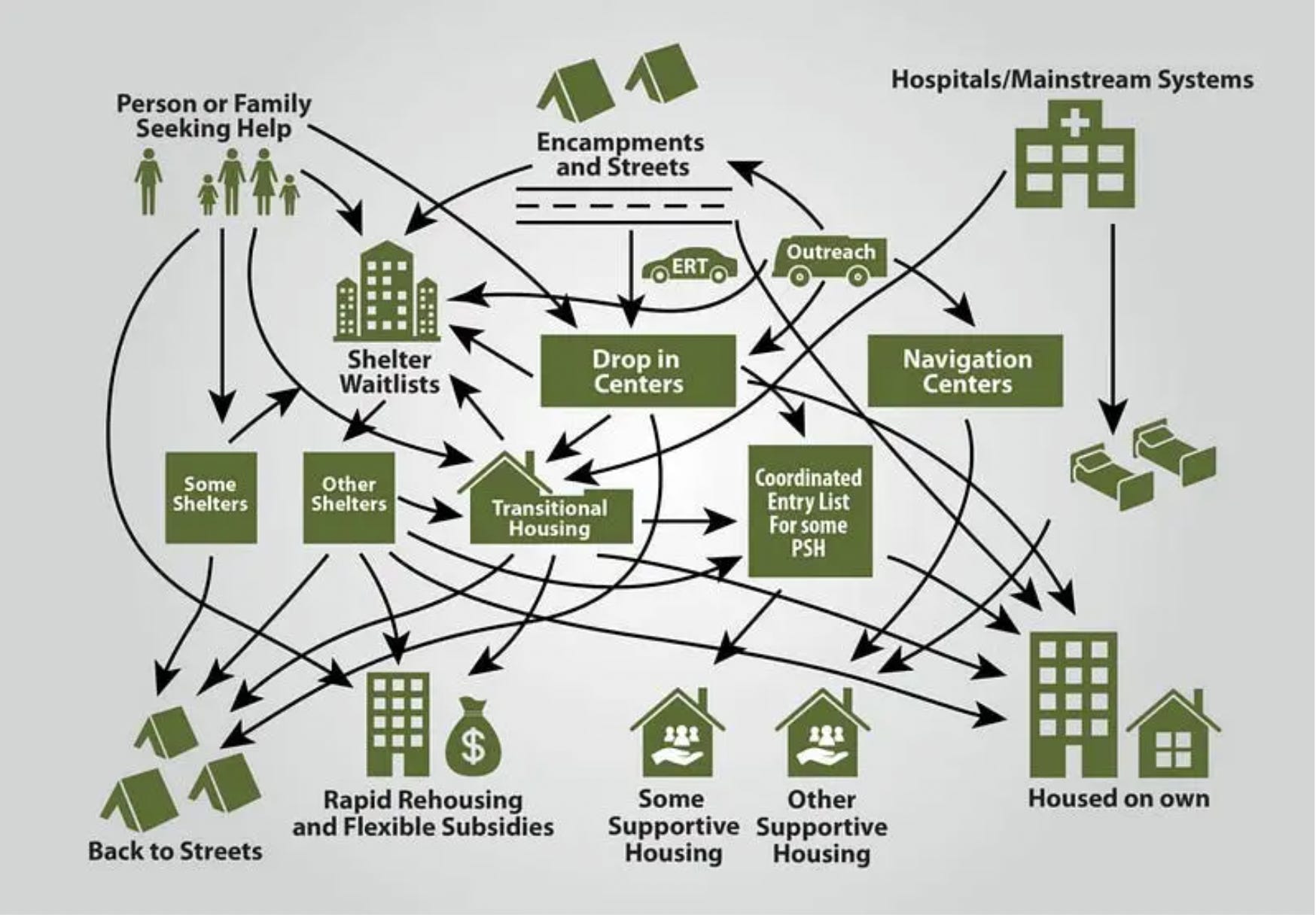
The political philosopher Friedrich Hayek identified this state of affairs as the problem of centralized knowledge. Governments often possess vast financial and administrative resources without possessing the dispersed, particular knowledge necessary to direct a complex society successfully.
The concentration of authority encourages the belief that social and economic outcomes are amendable to being directed by central authority. When interventions produce unintended consequences—as they almost always do—the institutional response is typically to demand additional resources and powers instead of reconsidering the original intervention.
There is an enormous temptation to expand central power mess-making when the same political authority can define a problem, finance its proposed solution, evaluate the results, and determine whether further intervention is necessary.
Such an arrangement dodges the constraints that discipline most organizations. In private markets, enterprises that consistently misallocate resources will fail. Government agencies, by contrast, tend to interpret disappointing results as evidence that their budgets were insufficient. Failure thereby becomes the rationale for expansion rather than retrenchment.
When an institution possesses both the authority to define the scope of its responsibilities and control over the means of financing them, it faces a persistent incentive to enlarge its domain. The more extensive its financial resources, the less dependent it becomes upon the immediate and voluntary cooperation of the society it governs.
The Founding Fathers understood this problem and tried to frame the Constitution to contain it as much as possible. James Madison recognized that political power could not safely be restrained by assuming the virtue of those who exercised it.
In Federalist No. 51, he famously observed that “ambition must be made to counteract ambition.” The purpose of divided government, checks and balances, and constitutional limitations was to make the expansion of power difficult even when those holding office believed their objectives were benevolent.
A government empowered to solve an ever-growing range of problems acquires an interest in the perpetuation of the very problems that justify its power. This is why constitutional restraints, fiscal transparency, decentralization, and independent scrutiny remain essential.
Totally agree. I would add that we need not only constitutional restraints, fiscal transparency, decentralization, and independent scrutiny, but also very focused and determined action to REDUCE the size, scope and authority of government.
A constitution with TEETH (i.e., punish the violators) is also direly needed, though difficult to implement.
Until the dangerously comfortable people of the West recognize that it’s game over unless they stand up and force a course correction, power centralization will accelerate, and the vise will continue to tighten on us all. The counterpoint to centralized, suppressive power, is decentralized, grassroots action in defense of Life and Liberty. We see this clearly with MAHA now for example.
We are all stewards of the freedom we inherited. It’s our duty to pass it forward.
Great work, John!