


Wolgang Ernst Pauli (born April 25, 1900 in Vienna, died December 15, 1958 in Zurich) was the son of the distinguished doctor and professor of chemistry, Wolfgang Josef Pauli, and the godson of Ernst Mach (famous for his Mach number, or the ratio of an object’s speed to the local speed of sound in the surrounding medium).
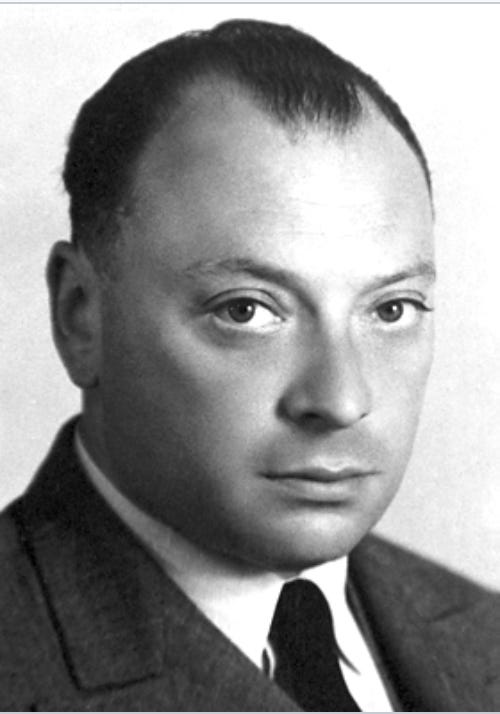
In his mid-twenties he wrote the standard review of relativity and formulated the exclusion principle—the rule that no two electrons can occupy the same quantum state, which earned him the 1945 Nobel Prize.
His study of the deep structure of matter seems to have given him an even greater appreciation of how mysterious the world remains. His famous essay on Kepler treated the astronomer’s mysticism as part of how scientific ideas form, not as a superstition to be redacted.
He had a great sense of humor, and he formulated what strikes me as the funniest of insults. When presented with a bad theory, he was fond of saying that “it’s not even wrong”—that it, it’s too vague to be tested. I often think of this joke when I hear people talking about human-induced climate change.
Pauli was prone to interesting intuitions. To save energy conservation in beta decay he proposed a new, nearly undetectable particle. He described the idea as “a desperate remedy” and later said he had done a terrible thing by postulating something that could not be detected. He bet a case of champagne that it never would be. When Cowan and Reines found neutrinos in 1956, he replied that everything comes to those who know how to wait.
In 1929 he married the Berlin cabaret dancer Käthe Deppner, and when the marriage predictably collapsed within a year, it drove him to drink. Especially humiliating was that she’d left him for a chemist, and he told friends, “If she’d left me for a bullfighter I would have understood, but for an ordinary chemist?”
In 1932 he sought help from Carl Jung. Jung’s assistant, then Jung himself, worked through hundreds of Pauli’s dreams. What began as treatment became a long correspondence on archetypes, alchemy, and whether mind and matter share a deeper order.
For many years he was preoccupied with the number 137 because the number 137.036 represents the approximate inverse (reciprocal) of the fine-structure constant—a fundamental dimensionless quantity in physics
The fine-structure constant combines three pillars of physics—the electron’s charge (electromagnetism), the speed of light (relativity), and Planck’s constant (quantum mechanics). Yet, all the units cancel out, leaving a pure, raw number (approximately 1/137) that dictates the strength of electromagnetism.
Pauli and other pioneering physicists were disturbed that nature outputted a seemingly random fraction rather than a clean mathematical value. He spent decades trying to derive 137 from first principles and famously joked that the first thing he would ask God upon dying is why alpha equals 1/137.
For twenty-five years he worked with Carl Jung to try to ascertain if the number had some mystical, psychological, and symbolic significance.
In 1958, when he was diagnosed with pancreatic cancer and hospitalized in Zürich, he was placed in Room 137. Upon seeing the number on the door as he entered the room, he said to his assistant, “I will not leave this room alive,” which proved to be true.
I was hoping there would be 136 comments ahead of me...I'll wait.
Great post John.