


Over the last few days, multiple people who have read my true crime books have asked me to state my opinion about the Lindsay Clancy case. At a social gathering last night, a group of young women cornered me, but alas, instead wanting to engage me in convivial conversation, they wanted to know what I thought of their view of the matter—namely, that Lindsay Clancy must have been insane when she strangled her kids.
I asked them if they understood why the Plymouth County DA’s office and two court-appointed psychiatrists concluded that Lindsay Clancy was NOT insane when she strangled her three children. They did NOT have a clear concept of this, so this morning I decided to research it.
The office of Plymouth County District Attorney Timothy Cruz contended that Lindsay Clancy was criminally responsible, characterizing her as depressed and suicidal, and that she planned the killings and understood what she was doing.
Prosecutors (Assistant DAs Jennifer Sprague and Shanan Buckingham) conceded she had mental-health problems and that her suicide attempt was real. However, they rejected postpartum psychosis with command hallucinations as the explanation and instead characterized the crime as an “extended suicide” or “altruistic filicide”—that is, she wanted to die and killed Cora, Dawson, and Callan because she believed they would suffer without her, and because the children were the impediment to keeping her from killing herself.
Prosecutors based their contention on the evaluations of two forensic psychiatrists.
Dr. Avram Mack was retained by the DA’s office (through Park Dietz and Associates). He interviewed Clancy at Tewksbury Hospital on April 10 and 12, 2026, reviewed thousands of pages of records, and testified that she had a major depressive episode but retained the capacity to know right from wrong and control her conduct.
Dr. Kirk Heilbrun, a forensic psychologist, was also retained by the DA’s office. He reviewed materials starting in early 2025, spent about 10.5 hours with Clancy over three days in April 2026 (some sessions with Mack present), and offered the prosecution’s “altruistic filicide / extended suicide” theory. Dr. Heilbrun testified that she had had intrusive suicidal thoughts for months and that her motive was “suicide combined with altruistic filicide”—“killing your kids out of love.” Sprague argued in closing that the children were her “protective factors” against suicide, so she had to kill them “to end her misery,” expecting no legal consequences because she planned to die with them.
The defense rested its claim that Lindsay Clancy was suffering from psychosis on the testimony of Dr. Phillip Resnick, who claimed that she was “frankly psychotic, experiencing severe postpartum psychosis, and could not conform her conduct to the law.”
Opening prosecutors’ statements also framed it as a selfish choice to escape a life she no longer wanted. They pointed to planning: sending her husband out for takeout and medication and checking how long he would be gone.
After the mistrial, Cruz stated the case was about “the cruel and calculated killing of three innocents,” that the evidence showed she was in control of her actions, and that the investigation did not establish that postpartum depression caused the homicides.
Motive is not an element the Commonwealth must prove, but the office offered this one so jurors would have a non-psychosis explanation if they found she appreciated wrongfulness and could conform her conduct to the law. The jury hung (reportedly 11–1 for lack of criminal responsibility). Cruz has not announced whether there will be a retrial.
The idea of “suicide combined with altruistic filicide” immediately reminded me of the dramatic case of Magda Goebbels.
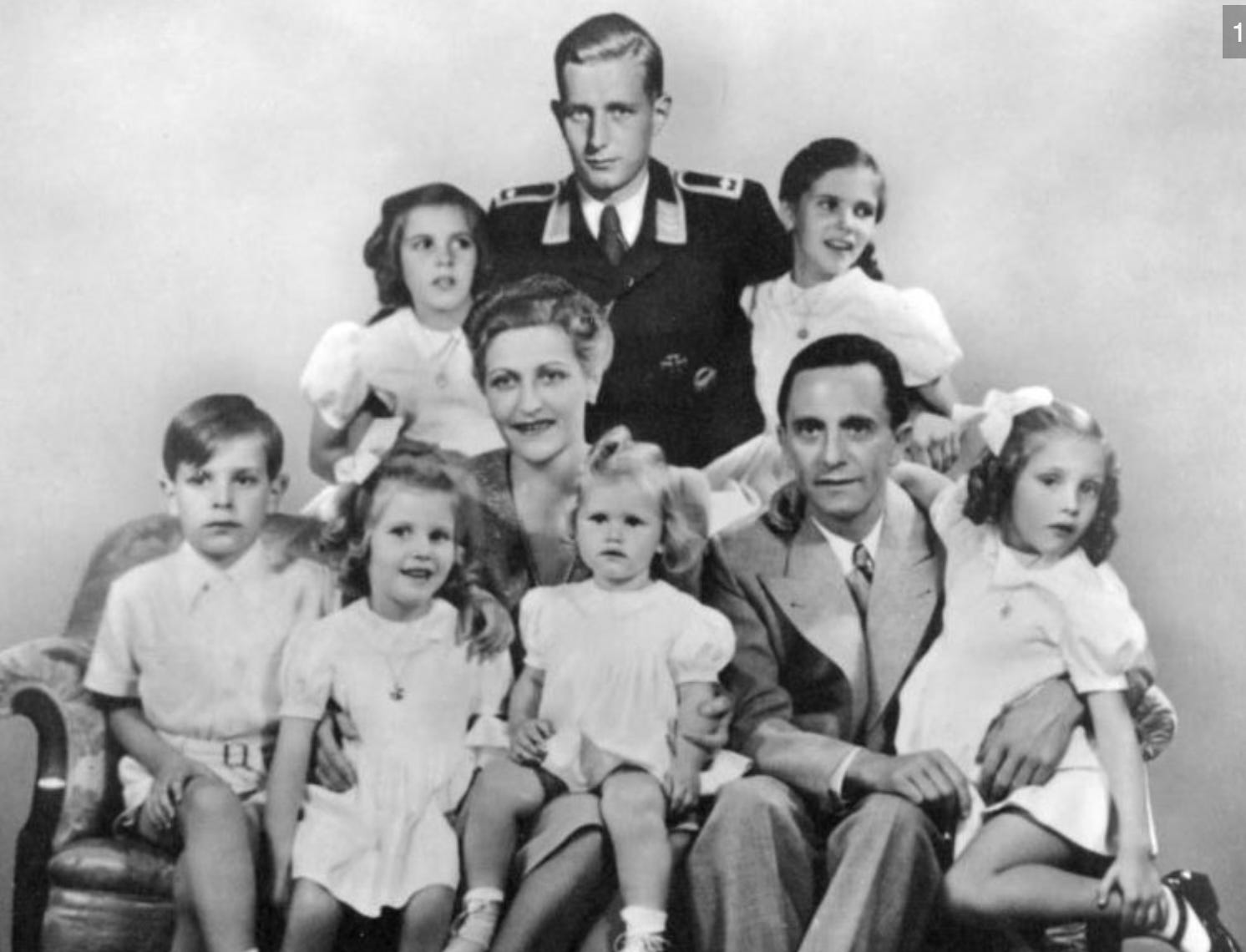
In the final days of the Third Reich, as Soviet forces closed on Berlin in late April 1945, Magda Goebbels chose to remain in the Führerbunker with her six young children rather than accept offers of evacuation. She concluded that life without Hitler and National Socialism was not worth living, and that her children—Helga, Hildegard, Helmut, Holdine, Hedwig, and Heidrun, aged four to twelve—were “too good” for the life that would follow defeat.
She also feared they would grow up hearing their father branded a criminal, suffer public shame, or be taken by the Soviets. In a farewell letter to her eldest son from an earlier marriage, she framed the act as “salvation” and an expression of loyalty to the Führer even in death. She had discussed the possibility weeks earlier and rejected attempts by others, including Albert Speer, to remove the children from the city.
On the evening of May 1, the day after Hitler’s suicide, the children were put to bed. First they were sedated, and cyanide was then administered while they were unconscious. Witness accounts differ on the precise division of labor between Magda Goebbels, SS dentist Helmut Kunz, and Hitler’s physician Ludwig Stumpfegger, but they agree that Magda initiated and oversaw the plan.
She was observed weeping and, according to one testimony, briefly unable to complete the act herself. Afterward she sat silently playing cards. The children’s bodies were later found in their beds.
Joseph Goebbels apparently did not oppose his wife’s decision, though he didn’t share her determination or stomach to do it. He did share his wife’s refusal to leave Berlin, adding a postscript to Hitler’s political testament that the family would stay “for reasons of humanity and personal loyalty.” He feared the children might be taken to Moscow and raised as communists.
Joseph therefore arranged or at least accepted the necessary assistance and, once the children were dead, walked with Magda into the Chancellery garden, where they killed themselves. In the manner of the Austrian Crown Prince Rudolf and his mistress, the Baroness Maria Vetsera in 1889, Joseph apparently first shot his wife and then shot himself.
The literature on “extended suicide” and “altruistic filial suicide” describes overlapping but distinct phenomena. The term “erweiterter Suizid” (“extended suicide”) was introduced by the German psychiatrist Paul Näcke in 1908. It denotes a homicide followed by the perpetrator’s suicide in which the killer, usually in a state of severe depression or psychosis, projects their own hopelessness onto intimates—most often children—and kills them “to spare them suffering.” The act is conceived as rescue rather than aggression.
Subsequent work distinguishes it from the broader, more neutral category of “post-aggression suicide.” Studies from Europe, China, and Hong Kong consistently find that victims are overwhelmingly family members.
Perpetrators have been found to have depressive disorders, and the interval between homicide and suicide is short. A 2024 retrospective of 51 Chinese cases reported female perpetrators slightly outnumbering males, with children as the most common victims, and mechanical asphyxia or sharp instruments as frequent methods; depression was the dominant diagnosis.
In his 1969 paper “Child murder by parents: A psychiatric review of filicide,” published in The American Journal of Psychiatry, expert witness for the defense, Dr. Phillip Resnick presented the following classification system for filicide (the act of a parent killing their child).
The Five Motives of Filicide
Altruistic: Murder committed out of perceived love. It often involves parental suicide ideation. The parent fears leaving the child behind.
Acutely Psychotic: Occurs during severe psychotic episodes. The act lacks any comprehensible motive.
Unwanted Child: The parent views the child as a hindrance.
Fatal Maltreatment: Unintended death caused by cumulative abuse.
Spouse Revenge: Killing to deliberately cause a partner suffering

During the trial of Lindsay Clancy, Dr. Resnick argued the accused was “acutely psychotic” while his colleagues who testified for the defense argued the accused had committed “altruistic filicide” plus attempted suicide. The “altruistic” subtype maps closely onto extended suicide: the parent believes the child would be better off dead than living without them or in a perceived miserable future.
Comparative work on homicide-suicide in Hong Kong found that filicide-suicide more often carried altruistic motives and used less overtly violent means than partner homicide-suicide, which was more commonly driven by hostility or jealousy.
Limits of the Literature
The two concepts meet most clearly in “altruistic filicide-suicide”: a parent who kills children and then themselves while construing the act as protection. Forensic writers note that the perpetrator’s belief is typically delusional or depressive. The literature is thin and fragmentary. Case series are small, definitions vary across languages and legal systems, and motive is typically inferred after the fact.
If the Plymouth DA’s theory is indeed correct, is still fails to address the possibility that Lindsay Clancy’s decision was overwhelmingly influenced by the stupendous cocktail of psychiatric drugs she had been prescribed in the months just before the catastrophe (see my essay Lindsay Clancy and a Society Bereft of Reason and Prudence). As Dr. Peter Breggin and others have documented, some psychiatric drugs can horribly impair the affect and judgement of those who receive them.
She was a psychopath killer. Evil. Death penalty by same means.
"A 44-year-old woman charged with murdering her three children has been found not guilty by reason of insanity.
Conor, nine , Darragh, seven, and Carla McGinley, three, were found found dead at their house in Newcastle, County Dublin in January 2020.
Their mother, Deirdre Morley, was acquitted of all three counts on Thursday."
(Notice that the 3 Morley childrens names all began with the same letters as the 3 Clancy children)
These incidents supposedly both took place on January 24, three years apart.
Oh, Lindsay Clancy and Deirdre Morley were both nurses. 🙄
Weird, huh? 🤔