


Author’s Note: This is the first in a series of articles about T-cell immunity and an immunotherapy for enhancing it.
The decline of T-cells with age—known as immunosenescence—is a primary driver of the increased risk of cancer in older adults.
As the body ages, the thymus gland shrinks, drastically reducing the production of new T-cells capable of hunting down and destroying emerging tumors.
As we learned during the COVID-19 pandemic—and as our corrupt health authorities worked hard to suppress—healthy children were NOT at risk of developing severe COVID-19 because of their large and super active thymus gland. In 2021, I witnessed my five-year old niece contract COVID-19 from her (vaccinated) mother. One day she developed a rash, mild cough, and malaise, and the following day she was fully recovered.
Age-related T-cell decline drives cancer development in the following specific ways:
Decreased Immunosurveillance: Young, healthy immune systems constantly scan the body and eliminate nascent cancer cells before they can form tumors. As T-cell populations drop, this surveillance system weakens, allowing malignant cells to multiply undetected.
Replicative Senescence: The T-cells that remain become “exhausted” or senescent. They lose their ability to divide effectively and fail to mount a strong attack when they encounter tumor antigens.
T-cell Receptor Restriction: The diversity of the T-cell repertoire shrinks, meaning the immune system loses the ability to recognize a wide variety of cancer mutations.
Immunosuppressive Microenvironment: Instead of killing cancer, many aged immune cells accumulate in the tumor environment and actively secrete proteins that protect the tumor and help it grow.
For several years, Professor Angus Dalgleish has been fascinated by the role of T-cells in preventing cancer, and how the increased incidence of cancer with age closely corresponds to T-cell senescence.
A few weeks ago, I spent a day with him at his home near London, talking about this fascinating subject. Over lunch, we discussed the The COVID-19 Vaccine Cancer Catastrophe. One of the most stunning features of this catastrophe is this evidence that COVID-19 mRNA vaccines actually cause T-cell exhaustion.
On a positive note, Professor Dalgleish told me about a therapeutic approach that struck me as highly plausible. This approach originated decades ago with the observation that pastoral tribes in Africa who maintained the ancient lifestyle of living with their cattle experienced lower rates of tuberculosis than non-pastoral populations. This led to the discovery of the therapeutic benefits of Mycobacterium vaccae — a nonpathogenic species of the Mycobacteriaceae family of bacteria that lives in the soil.
Like the word vaccine, the species name derives from the Latin word, vacca (cow), as the first Mycobacterium strain was cultured from cow dung in Austria in 1964 by R. Bönicke and E. Juhasz, who worked at the Leibniz Lung Center in Borstel, Germany.
The bacterium was subsequently isolated from soil in the Ugandan Lang’o District, where locals claimed that a muddy substance had the power to cure a number of ailments.
This led to experiments using Mycobacterium vaccae in conjunction with the BCG vaccine, which resulted in significant improvement of the BCG vaccine’s efficacy against tuberculosis.
Research is currently being conducted using killed Mycobacterium vaccae immunotherapy for allergic asthma, cancer, depression, leprosy, psoriasis, dermatitis, eczema and tuberculosis.
Professor Dalgleish is especially interested in how an intradermal, inactivated close relative of Mycobacterium vaccae—a bacterium called Mycobacterium obuense—stimulates the body's innate immune system to recognize and attack cancer cells.
Upon hearing about this product, I was instantly reminded of my longstanding intuition that Homo sapiens —which emerged around 300,000 years ago and migrated out of Africa—has an innate immune system that evolved within the context of living with animals, especially with cattle.
The Lascaux Cave Paintings in Dordogne, France—often called the “Sistine Chapel of Prehistory”—dates back approximately 17,000 years, and prominently features striking images of aurochs, the now extinct ancestor of modern cattle.
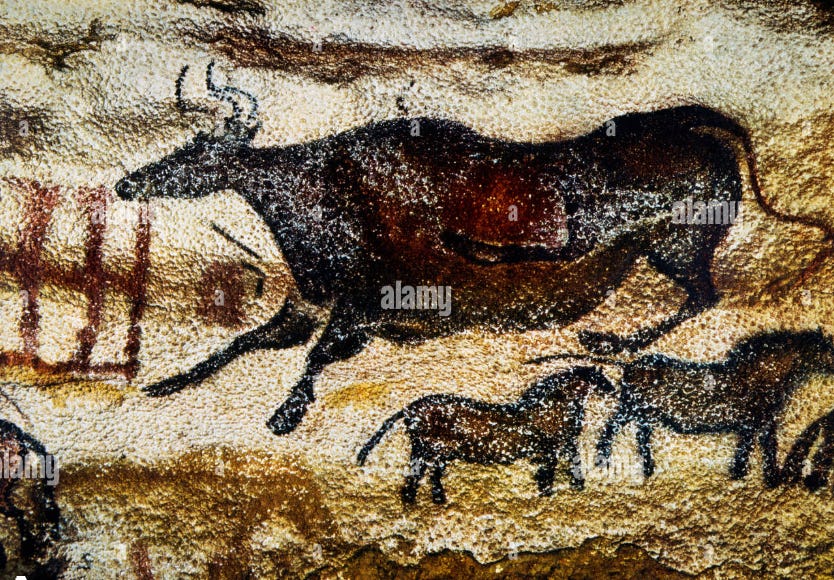
Cattle are thought to be the origin of a number of pathogens such as measles, tuberculosis, brucellosis, and anthrax. Tuberculosis and measles subsequently became especially pathogenic for populations living in cities. It appears that—as a result of selective evolutionary pressure from living with cattle— T-cell immunity is stimulated in the presence of cattle and conversely declines among city-dwellers who do not live with cattle.
Reflecting on idea causes me to wonder if it may be the true explanation for 18th century anecdotes in Gloucestershire, England that dairymaids did NOT contract smallpox. Edward Jenner assumed it was because they had already contracted cowpox, but now I wonder if they simply had vastly superior T-cell immunity.
For more about this fascinating subject, see Professor Dalgleish’s paper Infection, immunoregulation, and cancer, which he coauthored with the British immunologist, Graham A.W. Rook
Author’s Note: If you found this article interesting and informative, please become a paid subscriber to our Focal Points newsletter. For just $5.00 per month, you can support us in our effort to conduct the kind of investigative scholarship and reporting that you will NOT find in mainstream media or even in mainstream academic journals that have been captured by the pharmaceutical industry.
Dr. Patrick Soon-Shiong is an interesting researcher, but he hasn't made any observations that were not already made by Dr. Dalgleish.
This makes me wonder why people like Bill Gates are so set on getting rid of all the cattle due to "global warming". He wants them all gone and us eating fake lab meat. Maybe he knows without the cattle less people will have stronger T cells. Why is he still free to speak on these issues as tho he is an expert?? He and Faux-chi need to share a prison cell.