


By Peter A. McCullough, MD, MPH
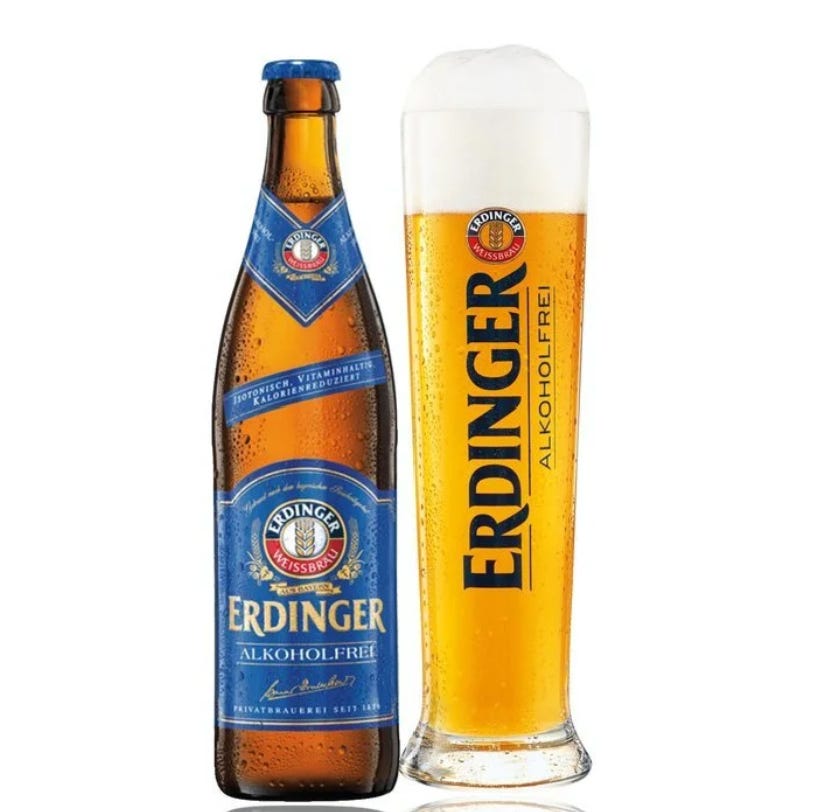
I recently landed on the St Rest Podcast with super-influencer Kerstin Lindquist. We covered a range of topics including the downfall of alcohol among young people and the rise in non-alcoholic beers. I praised an Erdinger I had in Vienna.
🍺 The Sober Revolution
🍻 A Category That Refuses to Stay Small
For most of the 20th century, non-alcoholic beer was the punchline of a joke. It was what you ordered when you were the designated driver, the recovering drinker, or the guy whose doctor had “concerns.” It tasted like disappointment filtered through carbonation, and it sat gathering dust in the corner of the cooler next to the diet sodas.
That era is over. In the span of roughly five years, non-alcoholic beer has gone from a niche afterthought to the fastest-growing segment in the entire beverage industry—posting double-digit growth year after year while conventional beer steadily declines. Across the United States and Europe, the numbers tell a story of a genuine cultural shift, not a fad.
📊 The Numbers Behind the Boom
United States
The American market is the clearest proof of the shift. According to Circana data, non-alcohol beer sales hit nearly $583 million in the 52 weeks ending December 2025—a 22.1% jump in dollar sales and a 23.9% increase in case volume over the prior year. That growth rate has cooled slightly from the heady 30–35% years of the early 2020s, but as industry analysts point out, that’s simple math: a larger base makes the same absolute growth look smaller as a percentage.
The structural headroom is enormous. Non-alcohol still accounts for only about 1.3% to 1.5% of total U.S. beer volume. In other words, the category could grow several more years at double digits before it even approaches saturation.
Europe: The Mature Pioneer
Europe is where the movement first took root, and it remains the world’s most developed non-alcohol market. The region now brews 2.2 billion liters of alcohol-free beer annually, and roughly one in fifteen beers served on the continent contains no alcohol. That’s the highest penetration anywhere on Earth.
The 2025 European Beer Trends data shows the divergence in stark terms: while overall EU beer production fell 2.9% and consumption fell 3.2%, non-alcohol volumes grew 5.9%—and have climbed more than 38% since 2020. Europe’s brewing giants are shrinking their core product and growing their alcohol-free lines simultaneously. In places like Spain, non-alcohol now approaches 14% of the beer market, a figure that would have been unthinkable twenty years ago.
🏆 The Brands Leading the Charge
Athletic Brewing: The Craft Disruptor
No brand embodies the American side of this story better than Athletic Brewing Company. Founded in 2018 by Bill Shufelt and John Walker, Athletic did something genuinely novel: it built a craft brewery that makes only non-alcoholic beer. No safety-net traditional lineup, no legacy brand to lean on—just a bet that people wanted NA beer that actually tasted like real craft beer.
The bet paid off spectacularly:
Over 19% market share within the non-alcoholic beer category, driving 32% of total category growth (NielsenIQ data).
Ranked as the 10th largest U.S. craft brewery and 20th largest overall U.S. brewing company—despite selling exclusively non-alcoholic products.
By late 2024, dollar sales topped $86.7 million through just the first 11 months, a +66.6% increase year over year.
Distribution across more than 75,000 retail locations, with flagship brews like Run Wild IPA, Upside Dawn Golden, and Free Wave Hazy IPA.
The company has raised significant capital—including a $50 million round led by General Atlantic—to fund expanded production capacity. The irony is rich: a brewer that makes no alcohol is now out-grossing thousands of traditional craft breweries that built their identities on it.
🍺 Heineken 0.0: The Global Leviathan
If Athletic is the scrappy insurgent, Heineken 0.0 is the category’s imperial power. Launched in 2017, Heineken 0.0 has become the world’s #1 non-alcoholic beer brand, now available in 117 markets.
The scale is staggering:
18% share of the global 0.0 category.
+53% organic volume growth between 2020 and 2024, with +10% growth in FY2024 alone.
24 consecutive quarters of growth in the United States.
48% market share of the non-alcohol category in Ireland—nearly one in every two NA pints poured.
Availability on draught across 10,000+ outlets in Europe, plus a €30 million investment in Irish distribution alone.
Heineken understood something its competitors didn’t: the social stigma was the real barrier, not the product. Its marketing—tying 0.0 to Formula 1 and a “When You Drive, Never Drink” message, with four-time world champion Max Verstappen as ambassador—attacked the “uncool” perception head-on. The result is a brand that has essentially redefined what a non-alcohol beer can be in the public imagination.
🧠 Why Now? The Real Drivers
The mainstream narrative credits “wellness culture” and “mindful drinking,” and that’s not wrong—but it’s incomplete. The real forces are more interesting.
Gen Z is drinking less, period. Younger consumers came of age watching the wellness-industrial complex and the self-optimization movement explode. Alcohol, with its empty calories and hangovers, reads as a liability to a generation that tracks sleep stages on a smartwatch. Non-alcohol beer lets them keep the social ritual without the metabolic cost.
The taste problem got solved. For decades, NA beer was made by brewing full-strength beer and boiling off the alcohol—a process that wrecked the flavor. Modern brewers use arrested fermentation and membrane filtration that preserve the hop character and malt body. Athletic’s Run Wild IPA genuinely tastes like an IPA. That single fact did more for the category than any marketing campaign ever could.
The “sober curious” economy. Something is happening culturally where conspicuous sobriety has become a status signal in certain circles—particularly among high-performers, athletes, and creators who view alcohol as a drag on output. Whether that’s genuine virtue or just a new flavor of premium, the market has responded.
And there’s a less flattering undercurrent worth naming: as conventional beer’s core male consumer base ages and shrinks, and as the category loses share to spirits and hard seltzer, the big brewers have every incentive to chase the one beer segment that’s actually growing. The “moderation revolution” is also a survival strategy.
🔭 What Comes Next
The trajectory is clear. Non-alcohol beer is still at ~2% of the global beer market, with forecasts of ~12% CAGR over the near term. Europe will continue to lead in penetration; the U.S. will lead in raw growth. The distribution battle is now moving on-premise—draft lines in bars and restaurants—where both Athletic and Heineken are investing heavily.
The genuine tension is whether the category can keep growing at double-digit rates as the novelty wears off and the market matures. The deceleration from 35% to 20% U.S. growth is already visible. But with a starting base that small, and a cultural tailwind that shows no sign of reversing, the smart money is on non-alcohol beer becoming a permanent, substantial fixture of the beer landscape—not a passing health fad.
📝Please subscribe to FOCAL POINTS as a paying ($5 monthly) or founder member so we can continue to bring you the truth. AlterAI may be used to assist in searches, synthesis, and review.
Peter A. McCullough, MD, MPH
President, McCullough Foundation
FOCAL POINTS has partnered with AlterAI to defend your medical freedom. Subscribe to AlterAI today and get a discount on unbiased and accurate AI!


