


By Peter A. McCullough, MD, MPH
In many ways the COVID-19 pandemic was presented to the public as if it was a war—an attack on humanity by a viral enemy and the pandemic response represented military countermeasures.
🎯 Focal Points: McCullough & Chaufan on the Militarized Pandemic Response
📋 The Conversation at a Glance
Host Dr. Peter McCullough welcomed Dr. Claudia Chaufan, full Professor of Health Policy at York University’s School of Health Policy and Management in Toronto, to discuss the sociological impacts of COVID-19 vaccine mandates — particularly on healthcare workers. Chaufan (a physician trained at the University of Buenos Aires, later a PhD sociologist who held positions at UCSF and arrived in Canada on a Fulbright Research Chair) brought a unique interdisciplinary lens spanning clinical medicine, sociology, and health policy.
🪖 The Central Analogy: Pandemic as War
The core intellectual thread of the interview was the militarization of the pandemic response:
McCullough’s framing: The response bore “military-like characteristics,” including actual operationalization by the U.S. Department of Defense. In war, leaders “leave no room for ambiguity” — they declare and command rather than seek a range of opinions and debate.
Chaufan’s “statecraft:” She teaches that public health and the army are “different tools of statecraft” — the state’s two instruments are war and public health. Both share roots in propaganda (she cites Edward Bernays, Freud’s nephew) and both depend on suppressing dissent and manufacturing consent.
The key distinction McCullough drew: in a real war, civilians aren’t the ones responsible for outcomes. But in the pandemic, doctors remained “on the hook” for patients while the state issued authoritarian commands — an inversion that made the war analogy break down at precisely the point where responsibility was being evaded by officials.
💔 The Discovery: “Moral Injury”
Chaufan’s most significant intellectual contribution was importing the concept of “moral injury” into pandemic research:
Origin: Developed by clinical psychologist Jonathan Shay in the 1970s while working with Vietnam veterans. Shay drew from ancient Greek accounts of warfare to describe soldiers forced to witness — or perpetrate — acts contrary to their “innermost ethical convictions.”
The translation: Chaufan recognized the identical phenomenon playing out in healthcare, where workers were forced to do things they knew were wrong — telling patients the vaccine was safe when they didn’t believe it, going against “best clinical judgment,” presenting false certainty about things they knew were uncertain.
The violation: She identified forced vaccination against will — particularly genetic vaccines — as potentially the deepest and most violating form of moral injury. One worker had a reaction after the first shot, a worse one after the second, and after the third suffered a full cardiac arrest requiring ICU care and mechanical ventilation.
The stakes: Discarded workers faced job loss, license revocation, and destruction of careers. Chaufan emphasized the mundaneness of it all — bureaucratic, banal cruelty rather than dramatic violence — which she found both fascinating and deeply disturbing.
Her core methodological observation: nobody was neutral on the mandates, regardless of vaccination status. She interpreted this as a reflection of the “intensity of the moral message” — the framing that non-compliance endangered others (”you will kill granny”) effectively conscripted ordinary citizens as “foot soldiers.”
🧠 The Sociological Machinery: How Consent Was Manufactured
Chaufan detailed how the response was engineered:
Focus-grouped messaging: Behavioral units (in the UK and Canada) “field tested” messages to find the most effective response to “the hesitant,” constructing the hesitant person as the problem — which then foreclosed all other questions.
The equity weapon: The vaccine was framed as achieving equity — placed above food, water, and shelter in priority. If you refused, “you’re against equity,” an immense rhetorical force deployed against good-faith people.
Labeling and suppression: Dissenters were shamed, demonized, labeled (anti-vaxxer, right-winger), or suppressed. In Canada, dissent was “quite brutally suppressed” — including Members of Parliament who objected on Charter rights grounds.
The Freedom Convoy: Chaufan noted millions of Canadians (herself included) supported the trucker convoy, yet the press portrayed participants as “the most dangerous people on the planet.”
🏥 Institutional Accountability Avoidance
The bureaucratic shell game: Hospital policies declared unvaccinated staff “a threat to the community” without explicitly mandating. When workers challenged dismissals, courts refused to litigate the science, deferring to “public health” — which deferred to government-funded university doctors. “Everybody’s passing the ball. Nobody takes responsibility.”
Shame tactics: McCullough described the red-sticker badge marking for unvaccinated students/residents; Chaufan compared it to the colored identifiers seen in the most totalitarian societies (e.g., license plates). For example North Korea (the Democratic People’s Republic of Korea) provides the most explicit, highly structured example of a color-coded license plate system used to segregate and control different social groups in a totalitarian state. [1] In North Korea, where private mobility is heavily restricted and fuel is rationed, license plate colors act as an immediate visual broadcast of a person’s caste, political rank, and relationship to the ruling regime. This system functions as a practical tool for traffic police to determine instantly who can be stopped, harassed, or extorted, and who must be given a mandatory salute.
Irrational staffing decisions: Brilliant surgeons, ICU nurses, and cardiac nurses were cast out — despite an already-strained system desperately needing personnel. Chaufan cited Dr. York Hsiang – well-known Professor of Vascular Surgery at the University of British Columbia and Dr. Francis Christian is a Clinical Professor of General Surgery at the University of Saskatchewan and a who retired early or were severed from their positions over vaccine mandates.

📄 Her Research & Publication Roadblocks
The survey project: Chaufan led a qualitative survey of ~100 questions; 189 healthcare workers responded with remarkable frankness. She deliberately collected respondents across vaccination statuses in Ontario and BC to understand both compliance and refusal.
The moral injury paper: Titled with a compelling participant quotation, the paper organized findings around normative orientations to mandates and framed moral injury as driven by the mandate structure itself — something absent from the existing medical literature.
Suppression of findings: A protocol was published, but the journal “doesn’t want to know anything about the actual results or findings.” Publishing the discursive strategies of hospitals has proven extremely difficult — a pattern Chaufan connected to the broader literature on suppressing dissent in science.
🌐 The Double-Edged Sword of Technology
Closing the interview, McCullough asked what would have happened if the pandemic hit in 1960. His answer: mass street protest. Chaufan’s: she would have been “doomed.”
Both agreed on the central paradox — social media enabled both the mass propaganda campaign AND the resistance to it. Without independent media and the internet, dissent would have had no platform. Yet the same reach amplified the official narrative to an unprecedented scope.
📢 Final Call to Action
Chaufan closed with a call for healthy skepticism and citizens taking learning into their own hands — listening to “other versions” and analyzing original sources rather than reproducing authority. McCullough added a pointed observation: even RFK Jr., two years into his tenure as HHS Secretary, has never faced a single question from an open mic — a standard that proper “lessons learned” forums and free academic discourse would demand.
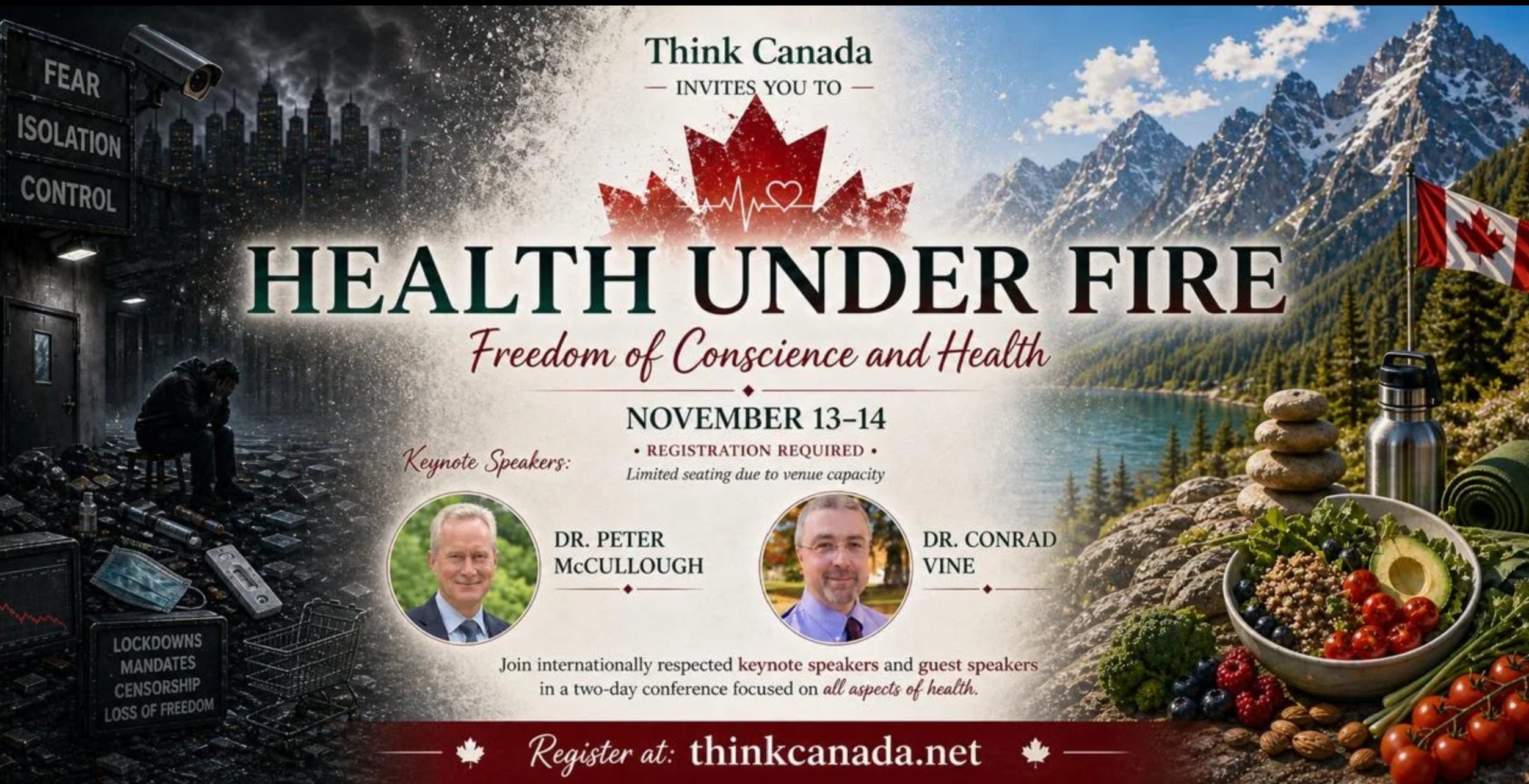
Dr McCullough will be speaking in Ontario at The Health Under Fire Conference featuring Dr. Peter McCullough and Seventh-day Adventist (SDA) pastor/speaker Dr. Conrad Vine is scheduled for November 13–14, 2026, at the University of Toronto - Scarborough.
📝Please subscribe to FOCAL POINTS as a paying ($5 monthly) or founder member so we can continue to bring you the truth. AlterAI may be used to assist in searches, synthesis, and review.
Peter A. McCullough, MD, MPH
President, McCullough Foundation
FOCAL POINTS has partnered with AlterAI to support independent research and open inquiry. Subscribe to AlterAI today and get a discount on unbiased and accurate AI!

References
Chaufan, Claudia, Hemsing, Natalie and Moncrieffe, Rachael. "‘When I had concerns about my own patients…I was told to keep quiet’: experiences of moral injury among healthcare workers under Covid-19 vaccine mandates in Alberta, Canada" Open Medicine, vol. 21, no. 1, 2026, pp. 20261503. https://doi.org/10.1515/med-2026-1503


