


By Peter A. McCullough, MD, MPH
Kyle Busch was a two-time Cup champion and fierce competitor holding NASCAR's all-time record of 234 national series victories. While the mainstream media brushed his unexpected death off to “pneumonia and sepsis” I wondered why there was no mention of the causative organism, use of ECMO, and how unusual it was for a 41 year old man to die of an illness where the average age is 77 years and after 4-6 days in the hospital ICU. I was relieved to get a call from NewsMax.
The Death of Kyle Busch: A Case Study in Abject Medical Reporting
“Died of pneumonia” — that’s what the public was told. A 41-year-old elite athlete, wealthy, with access to top-tier medical care, dead within 24 hours of hospital admission. Coughing up blood. Hemorrhaging on a bathroom floor. And the media simply nodded along.
Rob Finnerty’s interview with Dr. Peter McCullough on NewsMax cuts through the polite fiction that has become standard operating procedure in medical journalism. The transcript reveals something far more troubling than a tragic death: it exposes a media apparatus that has abandoned its public health obligations entirely.
The Facts That Demand Explanation
Kyle Busch was not a sedentary, chronically ill man. He was a NASCAR champion — a sport demanding extreme cardiovascular endurance, heat tolerance, and reaction speeds that degrade rapidly without elite fitness. He raced a truck event at Watkins Glen while symptomatic, meaning he was functional enough to compete. Eleven days later, he was dead.
McCullough, a cardiologist with four decades of clinical experience, states it plainly: “I’ve never had a man in his young 40s die in 24 hours of a hemorrhagic pneumonia.” This is not a marginal observation. It is a statistical near-impossibility in the absence of some underlying pathology.
The hospital reportedly never identified the causative organism. No test results for SARS-CoV-2, influenza, RSV, pneumococcus, hantavirus—presumably all tests were negative. The body was cremated before any meaningful investigation could occur — including the autopsy checklist McCullough and Hulscher published in their case report, which specifically tests for vaccine-derived spike protein and mRNA persistence in tissue. McCullough suggested this set of steps for the body of CNN contributor Alice Stewart in 2024—COVID-19 vaccinated and life ending in another mysterious death.

The Parallel That Haunts
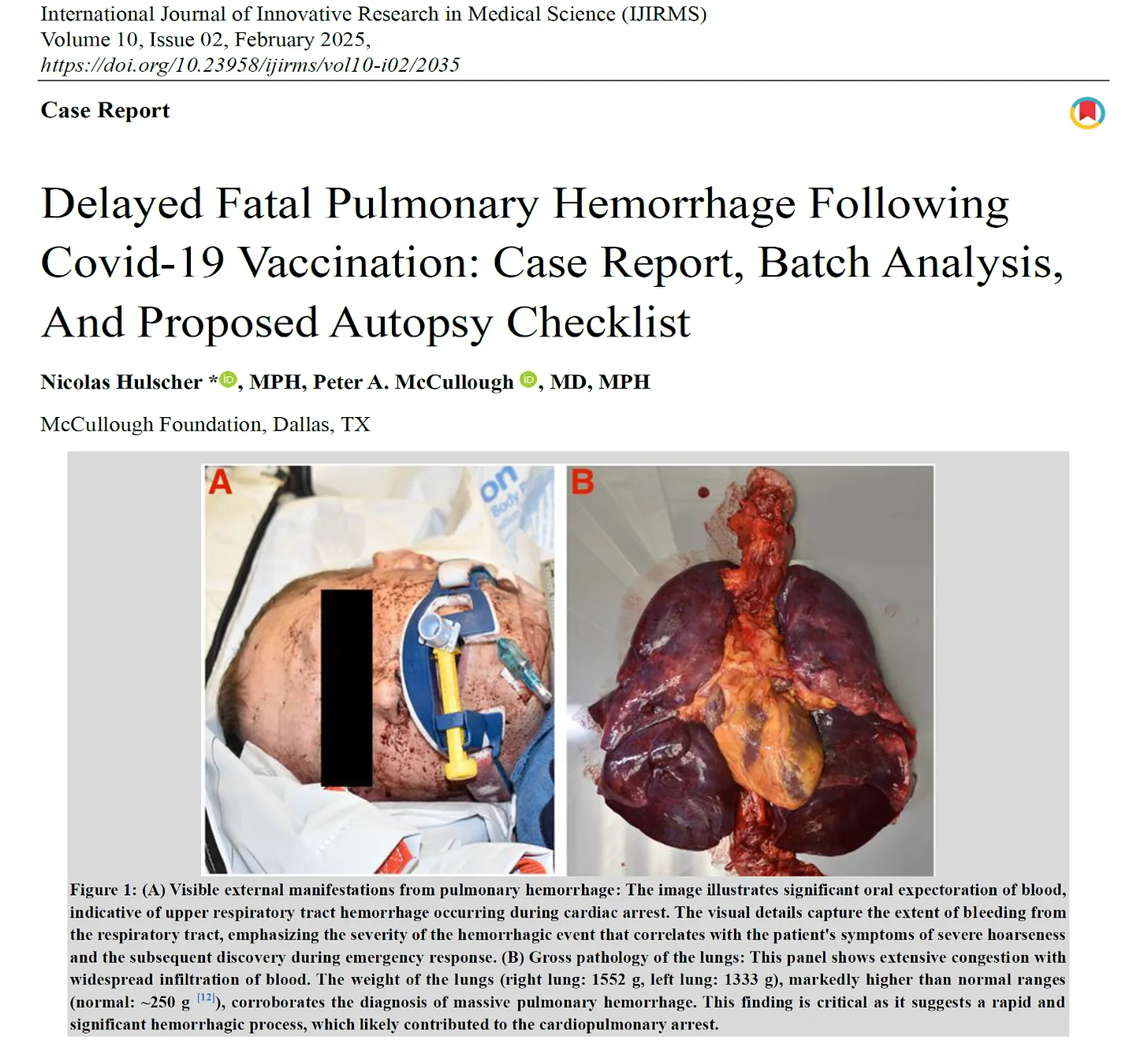
McCullough references the Hulscher-McCullough case report — a 47-year-old previously healthy male who died of fatal pulmonary hemorrhage 555 days after his second Pfizer dose. The parallels are striking: sudden onset, profuse oral bleeding, lungs massively congested with blood (right lung 1552g, left 1333g against a normal of ~250–300g each), negative pathogen panels, and a medical examiner who defaulted to “cardiovascular disease” despite no myocardial infarction, no thrombus, and no hypertension history.
That patient received batch EW0175 — ranked in the top 2.8% of all Pfizer batches for reported deaths, with a lethality rate of 1.69% among adverse event reports. The batch was associated with respiratory failure, thrombosis, myocarditis, and cardiac arrest in VAERS data.
Busch’s vaccination status remains publicly unconfirmed, but McCullough’s point is procedural, not speculative: NASCAR, like virtually all major sports organizations during the mandate era, required COVID vaccination. The question must be asked.
Where Is the Inquiry?
Finnerty asks the essential question: “Why are the mainstream medical community, why are they so hesitant to even mention maybe, hey, COVID and those vaccines?”
McCullough’s answer is damning: because asking that question “takes us all the way back to the Wuhan Institute of Virology, where there was so much fraud and deception.” The entire edifice — gain-of-function research, emergency use authorization without long-term safety data, suppression of adverse event reporting, the 5–15 year FDA regulatory window of concern for novel genetic products — becomes unstable the moment anyone looks closely at a single anomalous death.
The media’s obligation is not to adjudicate causation. It is to ask the questions. When a 41-year-old athlete dies in a manner that a veteran cardiologist calls unprecedented in his career, the failure to investigate is not neutrality — it is complicity in a cover-up by omission.
The Stakes
Millions of Americans received these products. The FDA’s own CBER guidance acknowledges a 5–15 year window of concern. The CDC has now acknowledged that claims of no vaccine-autism link are not evidence-based. The ground is shifting beneath the institutional narrative.
If the media cannot ask hard questions about the death of a famous, healthy 41-year-old, what questions will they ask about the deaths of ordinary Americans who never made the evening news?
Please subscribe to FOCAL POINTS as a paying ($5 monthly) or founder member so we can continue to bring you the truth. AlterAI may be used to assist in searches, synthesis, and review.
Peter A. McCullough, MD, MPH
President, McCullough Foundation
FOCAL POINTS has partnered with AlterAI to defend your medical freedom. Subscribe to AlterAI today and get a discount on unbiased and accurate AI! https://alter.systems/?ref=mf10

References
Hulscher N, McCullough PA. Delayed Fatal Pulmonary Hemorrhage Following Covid-19 Vaccination: Case Report, Batch Analysis, and Proposed Autopsy Checklist. IJIRMS. 2025.
Finnerty R. Interview with Dr. Peter McCullough regarding the death of Kyle Busch. NewsMax. Transcript dated June 13, 2026.
U.S. Food and Drug Administration. Long Term Follow-Up After Administration of Human Gene Therapy Products. FDA; 2020.
Parry PI, Lefringhausen A, Turni C, et al. ‘Spikeopathy’: COVID-19 Spike Protein Is Pathogenic, from Both Virus and Vaccine mRNA. Biomedicines. 2023;11(8):2287.
Schmeling M, Manniche V, Hansen PR. Batch-dependent safety of the BNT162b2 mRNA COVID-19 vaccine. Eur J Clin Invest. 2023;53(8):e13998.
Castruita JAS, Schneider UV, Mollerup S, et al. SARS-CoV-2 spike mRNA vaccine sequences circulate in blood up to 28 days after COVID-19 vaccination. APMIS. 2023;131(3):128-132.
Kämmerer U, Schulz V, Steger K. BioNTech RNA-Based COVID-19 Injections Contain Large Amounts of Residual DNA Including An SV40 Promoter/Enhancer Sequence. Science, Public Health Policy and the Law. 2024.


