


By Peter A. McCullough, MD, MPH
I asked AlterAI to summarize our recent debate on the new HHS inverted food pyramid recognizing many in the health freedom community have lost trust in the health system and have alway wanted to go hog-wild on red meat and dairy.
In this Ask Dr. Drew segment, Dr. Drew Pinsky and cardiologist Dr. Peter McCullough debate the new HHS “inverted” food pyramid recently introduced under the Trump administration and Health Secretary Robert F. Kennedy Jr. The conversation centers on the shifting stance toward red meat, saturated fats, and full‑fat dairy, reflecting confirmation bias of keto-carnivores influencing RFK and HHS.
🧠 Start of the Discussion
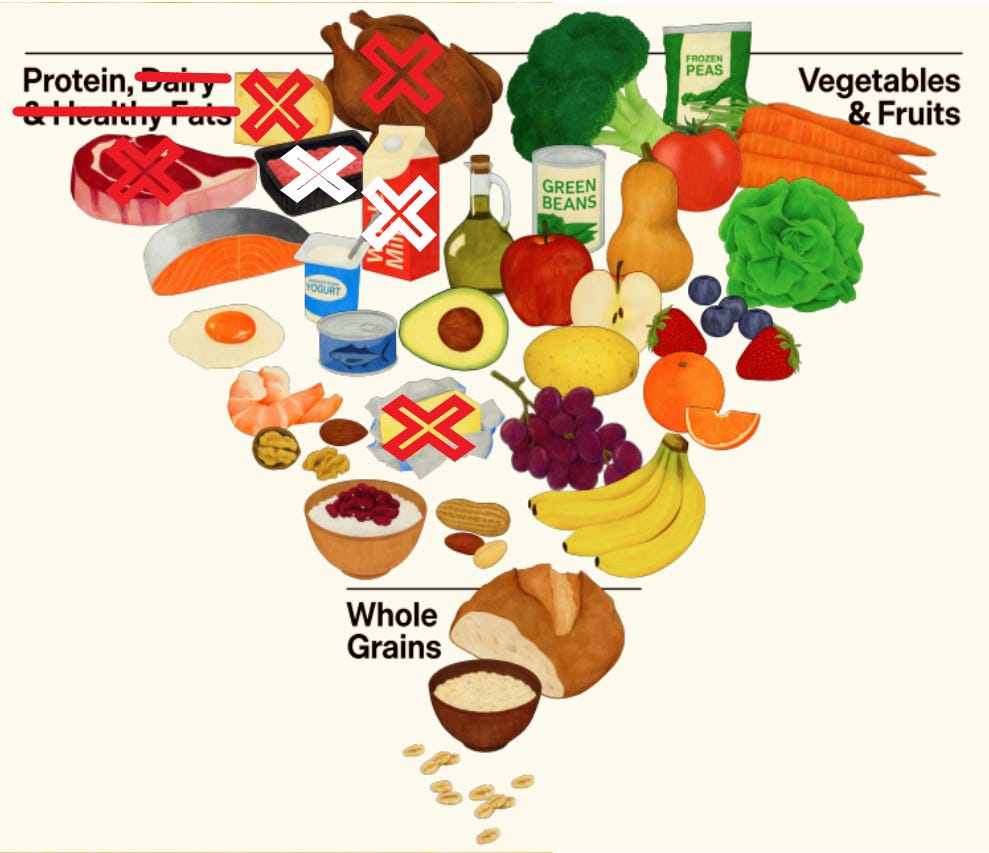
Dr. Drew introduces the topic by noting that the old food pyramid—heavy on grains at its base—has literally been flipped, placing meat, cheese, and unhealthy fats at the top. He jokingly credits even South Park’s “Cartman” for anticipating that the official pyramid was upside‑down.
Dr. McCullough replies that while he welcomes a renewed focus on protein and whole foods, he would not have approved the current model. Drawing from cardiology research, he stresses a “straight‑line” relationship between animal‑derived saturated fat—from butter, whole milk, and red meat—and hepatic cholesterol production. According to McCullough, such fat “directly stimulates the liver to produce cholesterol,” making it harmful for cardiovascular patients. The average American consumes a whopping ~28 grams (252 kcal) of saturated fat (U.S. adults) per day. Of that, animal sources: ≈ 25–27 g/day dairy/cheese: ~13 g, red meat: ~8 g, poultry + processed meat + eggs: ~5–6 g. Do MAHA extremists really believe we need more?
🍗 Protein vs Fat Distinction
McCullough emphasizes that protein is physiologically the same whether from salmon or steak; the difference lies in the package. Fish protein, he explains, comes wrapped in omega‑3 fatty acids, which are cardioprotective and “essential.” Red meat protein arrives in a package of non‑essential, disease-promoting, and harmful animal fats.
Therefore, a cardiologist’s version of the new pyramid would still endorse protein but “with the steak, butter, and whole milk replaced by seafood.”
Dr. Drew counters that nutritional science cannot ignore nuance. He references evidence showing lower dementia rates in people consuming high‑quality saturated fats from dairy products such as cheese and cream. He suggests that the effect of saturated fat may depend on disease context—dementia versus cardiovascular risk—arguing that “we still have to sort that stuff out.”
🧪 Data Quality & Religious Cohorts
McCullough calls most nutritional epidemiology “highly flawed” because food‑frequency questionnaires are unreliable and participants rarely remain consistent over years. He says meaningful data comes only from communities with long‑term dietary consistency, such as Seventh‑Day Adventists, a group notable for vegan diets and exceptional longevity and freedom from heart disease and dementia. He points out that Dr. Ben Carson—himself an Adventist—had just been named the national nutrition advisor, implying that population’s record validates plant‑based eating.
🔥 The Heated‑Fat Question
Drew introduces another dimension: heated vegetable oils. He cites a biochemist‑colleague who warned that unsaturated oils become carcinogenic when heated and may trigger inflammation once stored in fat tissue. McCullough replies that moderate cooking with oil isn’t a problem—“you don’t drink cooking oil”—but he reiterates that massive saturated‑fat consumption (e.g., “eating sticks of butter”) is far worse.
He shares his own practice: limiting saturated‑fat intake to under 10 grams per day. A steak might contain 20 grams, a fast‑food meal 60 grams, and a pizza 40 grams. He then labels the “three S’s” driving obesity and diabetes as sugar, starch, and saturated fat, all of which he believes “should be out of the food pyramid, not at the top.”
🍞 Carbohydrates and Insulin
Dr. Drew agrees that at least the “carb story” is being revised. He calls it fundamentally an “insulin story”: the problem is repeated insulin spikes from refined carbohydrates. Both men agree the new guidelines correctly downplay grains and sugars, even if they diverge on how much animal fat to rehabilitate.
Overall, their exchange captures the widening argument between traditional cardiology’s cautious stance on saturated fat and the populist move toward “real food” nutrition that embraces meat and dairy ignoring the future reality of heart attacks, coronary stents, and bypass surgery. McCullough stands with mainstream cardiac research emphasizing lipid burden, while Pinsky presses for a disease‑specific and context‑sensitive approach that re‑examines long‑standing taboos.
Please subscribe to FOCAL POINTS as a paying ($5 monthly) or founder member so we can continue to bring you the truth.
Peter A. McCullough, MD, MPH
FOCAL POINTS has partnered with Patriot Mobile to defend your medical freedom. Join Patriot Mobile today!

References
Ask Dr. Drew Show: “Dr. Peter McCullough on Flu Hysteria, Nasal Sprays & The New Food Pyramid,” recorded January 2026. Transcript provided by user.
Official site: https://drdrew.com/ask-dr-drew
Fact Sheet: Trump Administration Resets U.S. Nutrition Policy, U.S. Department of Health and Human Services, Jan 7 2026.
NPR, CNN, ABC News coverage (Jan 7–8 2026) on the Dietary Guidelines for Americans 2025–2030.


