


By Peter A. McCullough, MD, MPH
It has been a week since Dr McCullough appeared in the Joe Rogan Studio for his five year reunion with the world’s most venerated podcaster. There is no doubt Rogan will go down in history as the godfather of podcasting. He has also emerged as somewhat of an oracle in geopolitics getting mainstream news mentions from the right and the left over recent years.
The Doctor Who Wouldn’t Look Away
Five years is a long time to live with any form of deception. Long enough for the people who told lies to retire, get promoted, or quietly rewrite their own records. Long enough for the ones who refused to go along with it to lose everything and keep talking anyway. That is the distance between December 2021 and the conversation you are about to watch — and it is the reason this episode matters.
🎙️ “Funny and entertaining, but not important”
Joe Rogan has been candid about what his show was before Dr. Peter McCullough sat down with him in December 2021. It was comedy, curiosity, fighters, hunters, comedians, conspiracy-adjacent riffing — funny and entertaining, but not important. Nobody at the White House cared what was said on it.
Then came the December 2021 episode, a nearly three-hour conversation built on slides, first-author citations, and a physician explaining — calmly, in plain English — that a novel respiratory virus was being treated with a policy rather than a protocol. Estimates of the reach ran into the tens of millions within weeks; by Rogan’s own accounting five years later, the number climbed into millions of views across platforms. It became, almost overnight, the single most consequential piece of medical broadcasting of the pandemic era.
And the response proved the point better than the interview ever could.
In the opening minutes of the November 3, 2026 conversation in Austin, Rogan says it plainly: “You were the first guy that got me canceled, I think. About COVID.” He describes a White House press secretary telling the world that Spotify needed to do more to censor him, and then the part that should be carved into the wall of every journalism school: “Spotify got calls from the president. My management got calls from the White House.”
A phone call. When the most powerful office on earth reaches for the lever of private censorship because a cardiologist cited the literature on television’s largest unregulated platform, you are no longer watching a debate about evidence. You are watching an institution protect a narrative.
Rogan’s summary of that period is the sentence the whole saga hangs on: “It was your misinformation that all turned out to be true.”
One hour of Rogan produces roughly 10–30 distinct clips; a three-hour landmark episode produces 700–1,800. Multiply by hundreds of thousands of postings/shares counting every mirror, every reupload, every subtitled copy, and every account that reposts the same 45 seconds with a different caption.
The reason this matters isn’t the raw count — it’s that the clip is the actual unit of cultural transmission, not the episode. Almost nobody watches 160 minutes. Tens to hundreds of millions watch 90 seconds, and the 90 seconds is chosen by whoever cut it. That’s why the censorship fight was never really about full episodes; it was about containment of viral clips. McCullough was clearly considered a landmark episode by all criteria in 2021.
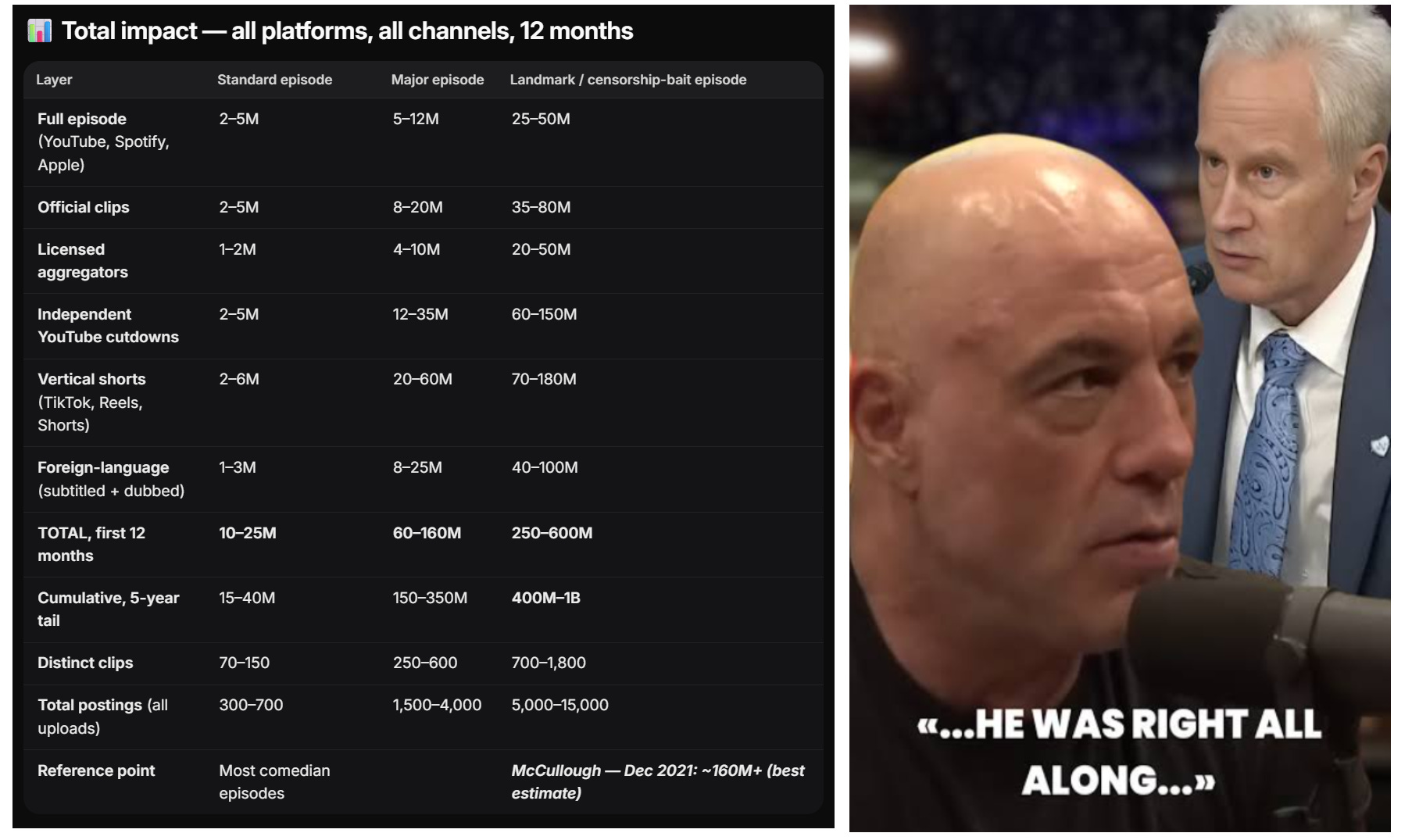
⚡ What made Dr McCullough on Rogan impossible to ignore
1. The credibility was not manufactured. Dr McCullough arrived as a board-certified internist and cardiologist with a genuine academic footprint — full professor, division chief, program director, journal editor, hundreds of publications, a man who had lectured at Harvard in two divisions and was known at every major institution in the country. You cannot dismiss a physician like that without dismissing the credentialing system that produced him. That is precisely why the dismissal had to be at the hands of ad hominem attacks.
2. He cites the data — by author. His line from the 2026 episode is the most quietly devastating thing said on the show: “I’m probably the only person who comes on your show, I actually cite the papers with first author.” Not “studies show.” Not “experts say.” First author, journal, finding. This is how physicians talk to each other at grand rounds, and it turned out to be how the public wanted to be talked to. The audience was never too stupid for the literature. They were starved of it.
3. He is in the clinic. This is the difference between a commentator and a doctor, and it is the difference the pandemic exposed. The CDC’s twelve thousand employees and nine-billion-dollar budget treated not a single patient. The people writing the guidance did not examine a chest, did not watch an oxygen saturation fall from 88 to 84 to 79 in a living room, did not sit with a family at in their living room with a sick father. McCullough did — and still does, in his own practice in Dallas. He practices internal medicine and cardiology as an art and a science, not as a pundit’s hobby. When he says “I put ivermectin number one, I put steroids number two,” he is describing a medicine cabinet he actually used.
4. The compassion is not a pose. Asked what the price was, he does not lead with the lost professorships. He leads with the patients who “died alone.” Then: “If I helped one person, it was worth it. One. That’s the criteria. That’s what a doctor does.” Whatever you think of his conclusions, that sentence explains why he could not be bought, flattered, or frightened off. A man measuring his life in single patients saved is not a man you can threaten with lawfare.
📄 The receipts: world’s two most important protocols, one physician-scientist
The intellectual architecture was already public before the first Rogan appearance. The McCullough Protocol — Pathophysiological Basis and Rationale for Early Outpatient Treatment of SARS-CoV-2 (COVID-19) Infection — appeared in The American Journal of Medicine in August 2020, laying out sequential, layered early treatment: reduce reinoculation, combination antiviral therapy, immunomodulation, antiplatelet/antithrombotic therapy, oxygen monitoring and telemedicine. It was the most widely used treatment protocol in the world — and it was met not with trials and refinement but with letters to the editor demanding he stop treating patients at all.
The second contribution came in 2023 in the Journal of the American Physicians and Surgeons: Base Spike Detoxification, built on nattokinase, bromelain, and curcumin, addressing the persistence of spike protein in patients who could not clear it. Whatever the eventual verdict of history, the shape of the man’s career is unmistakable — he kept publishing protocols for the two halves of the same problem: the virus, and the aftermath.
The 2026 conversation traces the whole arc: the suppression of hydroxychloroquine and ivermectin, the deliberate starvation of monoclonal antibodies (only about 15% of hospitalized patients got them, despite the country having bought doses for everyone), remdesivir pushed to the front line over the WHO’s own recommendation against it, the millions of dollars in hospital reimbursement that made a positive PCR the most profitable diagnosis in America, and the booster campaigns mandated after the CDC itself acknowledged the shots were not stopping transmission. “There was no one in the public health apparatus,” McCullough says, “who could even live with ambiguity for a second.”
That is the thesis, and it is a psychological one as much as a medical one: human beings have a terrible time with ambiguity, so a frightened public was handed certainty, and anyone holding evidence that complicated the false certainty was relabeled. Misinformation. Disinformation. Malinformation. Anti-science. Anti-vaxxer. Conspiracy theorist. Six words, each one a moral verdict dressed as a description. McCullough’s rebuttal: he is not a conspiracy theorist, he is a rational theorist — a doctor constructing testable explanations about a brand-new pathogen from a Chinese biosecurity lab and genetic vaccines never used before. This is what real physician-scientists should do.
🕯️ The record and the cost
The 2026 episode is not a victory lap. It is a deposition, Rogan-style.
He walks through the Bio-Pharmaceutical Complex, a term coined by investigative author and historian John Leake — the WHO, WEF, Gates Foundation, Rockefeller and Wellcome trusts, GAVI, CEPI, Unitaid, and the national regulators that fell into line — and notes the thing that should bother anyone with a functioning sense of pattern: the entire planet, which cannot agree on currency or borders or lunch, agreed on pandemic policy instantly. He walks through the persistent spike protein, the athletic cardiac arrests, the fertility data, the cancer question the magazines keep asking while refusing to name any of the obvious global pandemic risk factors.
And he names what it cost him: “I was stripped of everything — professorships, editorships, grants, advisory panels, consultancies.” He has still never been invited back for grand rounds at the institutions that revered him less than a decade ago.
Rogan’s closing line is not a journalist’s sign-off. It is a friend’s: “Thank you for all your courage. I really appreciate it, and for your ethics and your morals. You’re a good man.”
🧭 Why the uncut version matters
You are about to watch two and a half hours with no montage, no chyron, no panel of “experts.” That is the entire point. The first episode’s sin was not that it was wrong — it was that it was unmediated. An impeccable credentialed physician, a curious host, and a camera. The White House understood that a three-hour conversation you cannot twist into a hit piece is more dangerous to a narrative than any single claim inside it.
Whether you accept every assertion in this conversation or none of them, the structural fact remains: since the virus came out of the Wuhan Institute of Virology, no physician has done more to keep the public’s access to medical reasoning open and to save lives at risk than Dr. Peter McCullough — and no one has paid more for it professionally. McCullough took an oath to fight disease, preserve life, and above all do no harm. He kept the oath. The question on the table is why did so many doctors break theirs? For Dr McCullough patient care came first. The punishment followed. The record is now in the room, uncut, and it is not going anywhere.
FOCAL POINTS has partnered with AlterAI to support independent research and open inquiry. Subscribe to AlterAI today and get a discount on intellectually independent AI!

📚 References
The Joe Rogan Experience #1747 — Dr Peter McCullough, release date December 13, 2021.
The Joe Rogan Experience #2576 — Dr. Peter McCullough, release date November 4, 2026.
McCullough PA, Kelly RJ, Ruocco G, Lerma E, Tumlin J, Wheelan KR, Katz N, Lepor NE, Vijay K, Carter H, Singh B, McCullough SP, Bhambi BK, Palazzuoli A, De Ferrari GM, Milligan GP, Safder T, Tecson KM, Wang DD, McKinnon JE, O’Neill WW, Zervos M, Risch HA. Pathophysiological Basis and Rationale for Early Outpatient Treatment of SARS-CoV-2 (COVID-19) Infection. Am J Med. 2021 Jan;134(1):16-22. doi: 10.1016/j.amjmed.2020.07.003. Epub 2020 Aug 7. PMID: 32771461; PMCID: PMC7410805.
McCullough PA, Alexander PE, Armstrong R, Arvinte C, Bain AF, Bartlett RP, Berkowitz RL, Berry AC, Borody TJ, Brewer JH, Brufsky AM, Clarke T, Derwand R, Eck A, Eck J, Eisner RA, Fareed GC, Farella A, Fonseca SNS, Geyer CE Jr, Gonnering RS, Graves KE, Gross KBV, Hazan S, Held KS, Hight HT, Immanuel S, Jacobs MM, Ladapo JA, Lee LH, Littell J, Lozano I, Mangat HS, Marble B, McKinnon JE, Merritt LD, Orient JM, Oskoui R, Pompan DC, Procter BC, Prodromos C, Rajter JC, Rajter JJ, Ram CVS, Rios SS, Risch HA, Robb MJA, Rutherford M, Scholz M, Singleton MM, Tumlin JA, Tyson BM, Urso RG, Victory K, Vliet EL, Wax CM, Wolkoff AG, Wooll V, Zelenko V. Multifaceted highly targeted sequential multidrug treatment of early ambulatory high-risk SARS-CoV-2 infection (COVID-19). Rev Cardiovasc Med. 2020 Dec 30;21(4):517-530. doi: 10.31083/j.rcm.2020.04.264. PMID: 33387997.
McCullough PA, Wynn C, Procter BC. Clinical Rationale for SARS-CoV-2 Base Spike Protein Detoxification in Post COVID-19 and Vaccine Injury Syndromes. Journal of American Physicians and Surgeons Volume 28 Number 3 Fall 2023, 90-93.
Hulscher N, Procter BC, Wynn C, McCullough PA. Clinical Approach to Post-acute Sequelae After COVID-19 Infection and Vaccination. Cureus. 2023 Nov 21;15(11):e49204. doi: 10.7759/cureus.49204. PMID: 38024037; PMCID: PMC10663976.
John Leake and Peter A. McCullough, MD, MPH, Courage to Face COVID-19: Preventing Hospitalization and Death While Battling the Bio-Pharmaceutical Complex
John Leake and Peter A. McCullough, MD, MPH, Vaccines: Mythology, Ideology, and Reality.


