


By Peter A. McCullough, MD, MPH
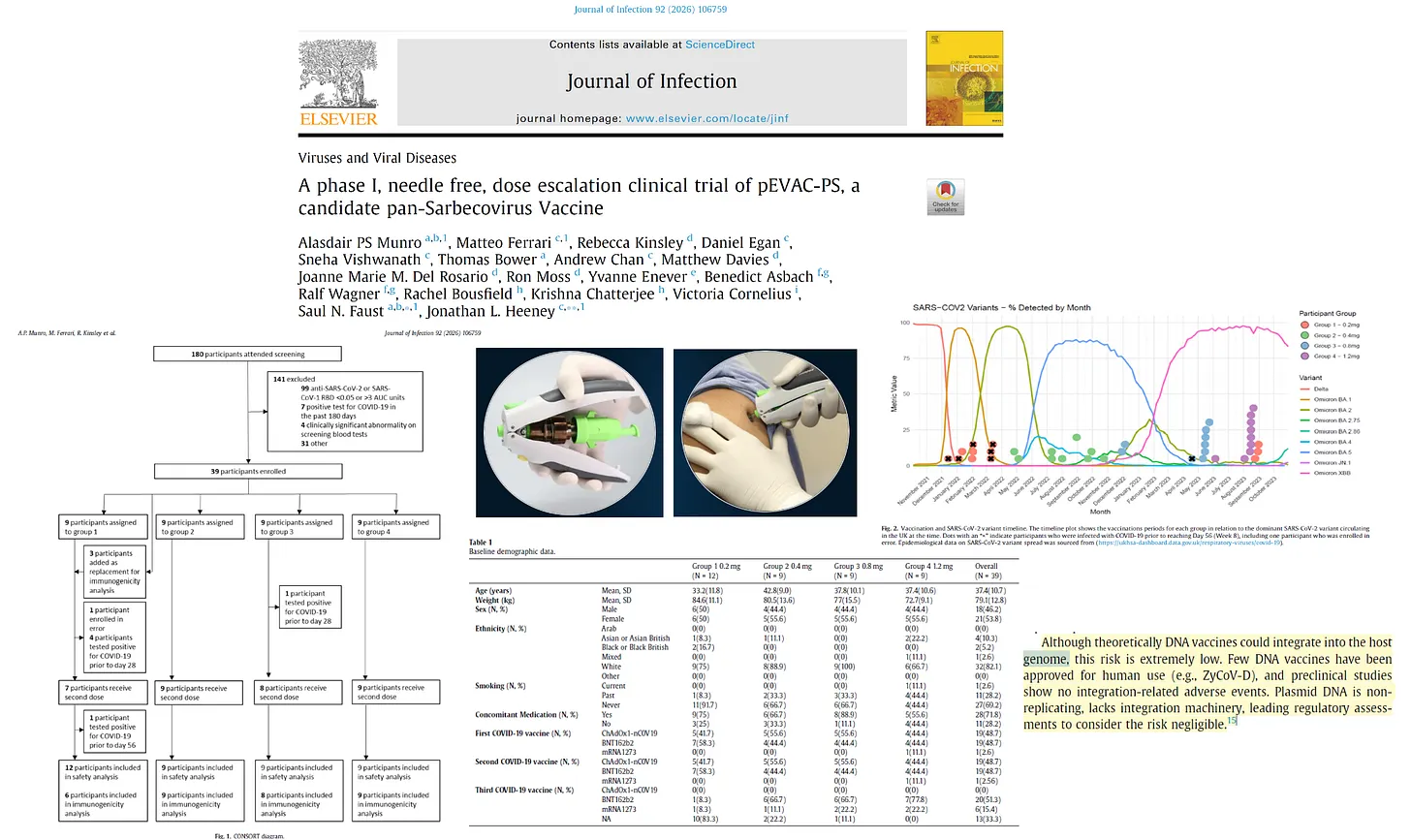
Recently I joined Natalie and Clayton Morris on Redacted for a review of Munro et al describing a phase I trial of plasmid DNA encoded for the common conserved region of the coronavirus Spike protein. The product was tested in high doses using a external gun shooting the vaccine into the arm. You may be thinking, what could go wrong?

AI-Designed DNA Vaccine: Dr. McCullough on the Munro et al. pEVAC-PS Trial
Dr. Peter McCullough sat down with Natalie and Clayton Morris to dissect the Munro et al. phase I trial of pEVAC-PS — a computationally designed, needle-free DNA plasmid vaccine targeting pan-sarbecoviruses. The conversation zeroed in on what the paper doesn’t say.
The Technology
The vaccine uses circular DNA plasmids encoding a 200-amino-acid conserved region of the spike protein’s receptor-binding domain, selected by AI (DIOSynVax platform) for cross-sarbecovirus reactivity. Delivery bypasses needles entirely — the PharmaJet Tropis device shoots liquid intradermally at high pressure. McCullough noted this is not a needle but a gun, raising the spectre of surreptitious vaccination: “If I snuck up behind you and just brushed by you, I could pop that, and then you’re vaccinated with DNA plasmids.”
The Missing Preclinical Data
McCullough’s central critique: no genotoxicity, teratogenicity, or oncogenicity studies were performed before injecting humans. The paper states integration risk is “extremely low” because plasmids lack integrase enzymes, then concedes in the same breath that human cells possess endogenous mechanisms for incorporating foreign DNA into the genome. McCullough: “They state that there’s no integrase enzyme with it. So you don’t have to provide an integrase. Human cells have ways of taking DNA and putting it into the genome.”
The authors claim the risk is negligible. McCullough’s response: “But they did not test that. That’s not listed. So we’re just supposed to take their word for it?”
The Adverse Events Shell Game
The paper reports no serious adverse events, but as the Morrises highlighted, there is no tabulated list of adverse events — just a summary statement. McCullough called this unacceptable for a phase I trial whose entire purpose is safety assessment. The paper reports 121 unsolicited AEs, 23 deemed vaccine-related, and 12 clinically significant laboratory abnormalities — all dismissed as grade 1–2 and “self-resolved.”
The Efficacy Smoke Screen
Despite being a safety trial, the paper leans heavily on antibody data. McCullough noted that one participant contracted COVID during the trial and was pulled from analysis. The modest binding antibody responses — statistically significant only in the highest dose group and only against the vaccine construct itself — don’t support meaningful protection. The paper admits immunogenicity was “modest” and “did not increase predictably with higher doses.”
The Lab-Leak Vaccine Hypothesis
McCullough drew a direct line to Peter Daszak and the Wuhan Institute of Virology: “This seems like a vaccine to cover more lab accidents and lab leaks.” The broad-spectrum design targeting “potential zoonotic spillovers” reads, in his view, as preparation for whatever escapes the lab next — not natural emergence.
What Could Go Wrong: A Development Checklist
Systemic distribution — The PharmaJet device targets the dermis, but nothing guarantees plasmid DNA stays local. McCullough warned it could enter circulation, distributing genetic code to vital organs.
Incomplete enzymatic degradation — Human DNAses may fragment plasmids rather than fully destroy them. Partial sequences could remain functional.
Cellular spike protein loading — Transfected cells become spike protein factories. The paper’s own peptide microarray data show antibodies targeting the S309 epitope — a conserved region with homology concerns (McCullough referenced the 2021 Australian vaccine where subjects turned HIV-positive due to spike-HIV homology).
Genomic integration — Human cells possess LINE-1 retrotransposon machinery and non-homologous end-joining pathways capable of inserting foreign DNA into chromosomes. Without integration studies, this risk is unknown, not low.
Transgenerational transfer — If germline cells take up plasmids, integrated sequences could pass to offspring. No reproductive toxicology was performed.
Oncogenic transformation — Random genomic integration can disrupt tumor suppressor genes or activate oncogenes. Zero carcinogenicity data exist.
Immune dysregulation — Chronic spike protein expression from integrated DNA could drive autoimmunity or antibody-dependent enhancement upon wild-type virus exposure.
Needle-free delivery risks — High-pressure injection may aerosolize vaccine, create unpredictable tissue distribution, and enable non-consensual administration.
For many of you the genetic plasmid DNA shot is a “hard-pass.” Sadly, the vaccine development world has apparently lost its moorings and is bounding ahead with no concerns for safety whatsoever.
Please subscribe to FOCAL POINTS as a paying ($5 monthly) or founder member so we can continue to bring you the truth. AlterAI may be used to assist in searches, synthesis, and review.
Peter A. McCullough, MD, MPH
President, McCullough Foundation
FOCAL POINTS has partnered with AlterAI to defend your medical freedom. Subscribe to AlterAI today and get a discount on unbiased and accurate AI! https://alter.systems/?ref=mf10

References
Munro APS, Ferrari M, Kinsley R, et al. A phase I, needle free, dose escalation clinical trial of pEVAC-PS, a candidate pan-Sarbecovirus Vaccine. J Infect. 2026;92:106759. doi:10.1016/j.jinf.2026.106759
Morris N, Morris C. Interview with Dr. Peter McCullough: AI COVID DNA vaccine tested on humans. June 12, 2026. Transcript provided.


