


By Peter A. McCullough, MD, MPH
The recent FDA panel on peptides has created great enthusiasm in the health freedom and biohacking space, however, without large NIH trials or safety registries, the field will be left without the foundations of clinical evidence. I touched on this recently with Dr Gina Loudon.
🧪 FDA Peptide Deliberations: Importance of Route-of-Administration
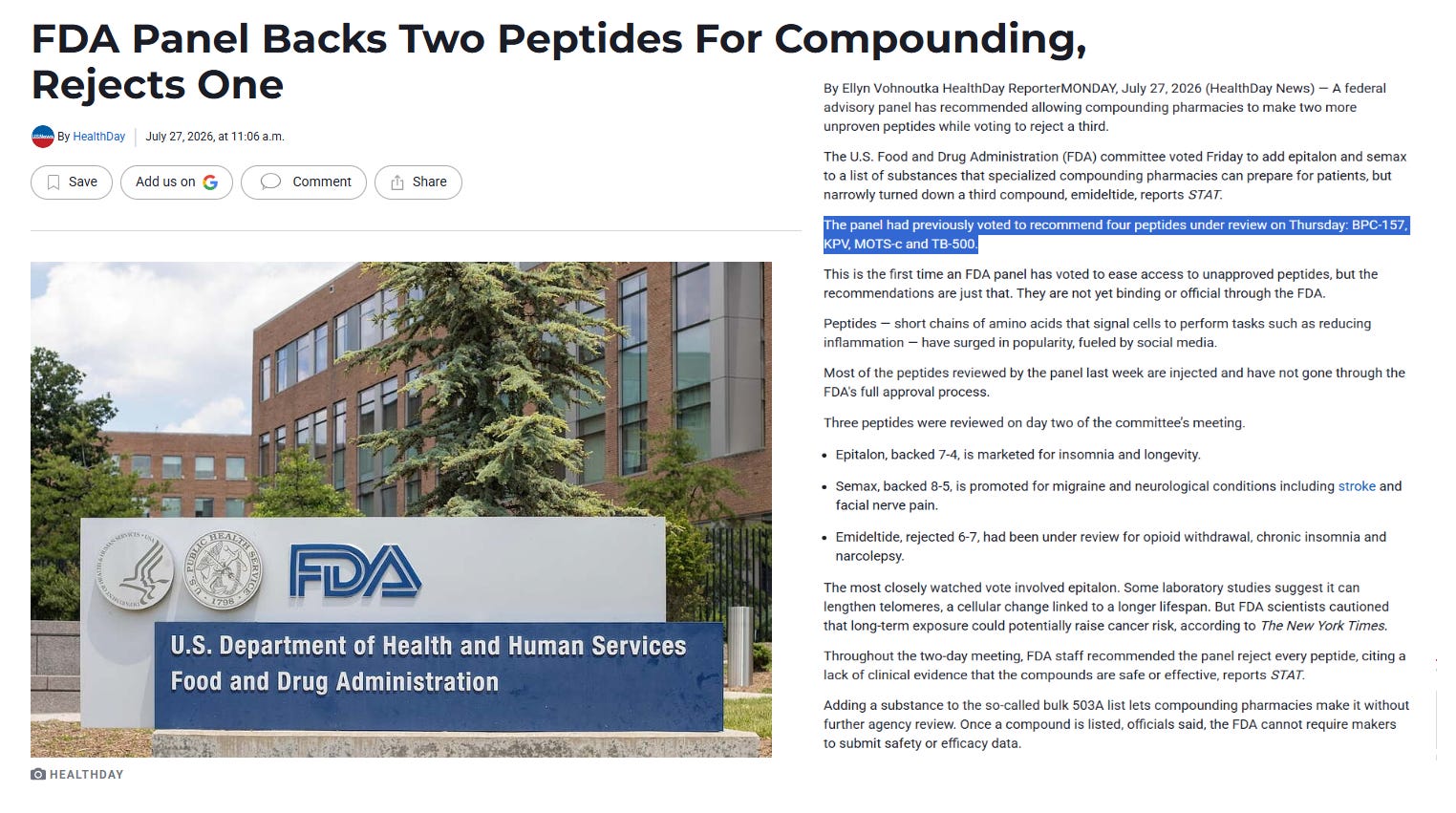
The FDA’s Pharmacy Compounding Advisory Committee (PCAC) just held its most consequential peptide meeting in years — July 23–24, 2026 — and voted to recommend BPC-157, KPV, TB-500, and MOTS-c for the 503A bulks list, with favorable votes on Epitalon (7-4), Semax (8-5), but rejected Emideltide (DSIP) (6-7), following on Day 2. The margins were tight: 8–6 with one abstention across the board, with MOTS-c squeaking through at 7–5–2.
But buried in the procedural drama is a question the FDA itself keeps circling without landing on: route of administration.
💉 Injectable Is the Default
Every single one of these seven peptides under review is primarily used as an injectable in practice. BPC-157, TB-500, MOTS-c, KPV — these are administered via subcutaneous or intramuscular injection, with some intranasal and oral formulations.
The FDA’s own briefing documents, released June 29–30, flagged this explicitly. Their four recurring concerns across all seven substances:
Inadequate human safety data
Characterization and impurity concerns
Immunogenicity risk — this one is directly tied to parenteral administration
Insufficient historical 503A compounding-pharmacy use
That third point — immunogenicity — is where route of administration becomes the unspoken center of gravity. Injecting peptides bypasses the gut’s immune-surveillance machinery and delivers foreign amino acid sequences directly into circulation. The FDA’s career staff hammered this: peptide impurities and sequence variations can trigger immune responses when injected that would be neutralized or simply not occur with topical or oral routes. The most expedient way of clarifying these concerns is for the National Institutes of Health to fund and conduct large prospective, double-blind, placebo-controlled, randomized trials in specific disease categories with adjudicated and objective outcomes. Intravenous therapies are very amenable to this approach.
🔬 The BPC-157 Paradox
BPC-157 is the poster child for this tension. It’s a pentadecapeptide fragment of BPC, a protein found in human gastric juice. Nature designed it to function in the gut. The original preclinical work — and there’s a substantial body of it, mostly out of Croatian labs — focused on oral administration for GI indications like ulcerative colitis and NSAID-induced lesions.
Yet the biohacking and wellness communities have almost entirely converged on subcutaneous injection as the standard route, even for systemic healing. The “Wolverine stack” — BPC-157 + TB-500 injected together — is practically folk medicine at this point.
The FDA’s Russell Wesdyk flagged what he called a “foundational challenge”: the agency cannot actually define what these substances are. Different vendors selling “BPC-157” are providing peptides with variations in sequence, purity, and salt form (free base vs. acetate). When you inject a poorly characterized peptide mixture, the immunogenicity risk isn’t theoretical — it’s a direct function of the route. All of this could be clarified with product manufacture and provision in a randomized trials. Compounding pharmacies are not in a position to fund these trials, that’s the role of the NIH.
🧬 MOTS-c and the Mitochondrial Injection Question
MOTS-c is particularly interesting here. It’s a mitochondrial-derived peptide — 16 amino acids encoded in the mitochondrial genome — that regulates metabolic homeostasis. The academic work on it (mostly from the Pinchas Cohen lab at USC) has focused on metabolic disorders and aging.
The route-of-administration question for MOTS-c is even sharper than for BPC-157. Mitochondrial peptides aren’t supposed to be floating around in extracellular space at pharmacological concentrations. Injecting them subcutaneously creates a pharmacokinetic profile that bears zero resemblance to their endogenous signaling patterns. The PCAC voted to recommend it anyway, but the 7–5–2 split suggests real discomfort with what amounts to an uncontrolled human experiment via injection.
🏭 The Compounding Angle: Why Route Matters for 503A
Here’s where the regulatory mechanics intersect with the science. Section 503A compounding is for individualized patient prescriptions prepared by licensed pharmacies. The whole framework assumes a physician has weighed risks and benefits for a specific patient.
But if these peptides land on the 503A bulks list, the actual landscape will be:
Telehealth platforms prescribing injectable peptides at scale
Compounding pharmacies shipping pre-loaded syringes or multi-dose vials nationwide
No requirement for large, prospective clinical trials or adverse event reporting — this is the crucial gap. FDA-approved injectable drugs have mandatory MedWatch reporting. Compounded injectables under 503A do not.
The Partnership for Safe Medicines and Public Citizen both raised this exact point during the meeting, framing bulks-list inclusion as a de facto “uncontrolled human trial without necessary adverse event reporting.” They’re not wrong about the mechanics, even if their motives are gatekeeping.
🧪 Oral, Intranasal, Topical: The Routes Considered Safe
The FDA deliberations paid little attention is paid to non-injectable routes. BPC-157 has oral and buccal bioavailability data from animal models. Semax is used intranasally in Russia with decades of clinical experience. KPV has been studied in topical formulations for wound healing. The Wellness Company’s REGENERATE combines BPC-157, KPV, and TB-500.

The FDA’s framework has evaluated narrowly specified indications (ulcerative colitis for BPC-157, wound healing for KPV), however, large NIH clinical trials are needed for broad applications. The FDA has not said: “This peptide probably has a better safety profile orally — let’s evaluate that route separately.” At TWC we believe REGENERATE is responsibly presented and administered allowing for topical absorption allowing its impact in the body to help heal tissues, particularly for musculoskeletal problems.
🔮 Where This Is Headed
The PCAC vote is advisory. The FDA’s career staff recommended against every single one of these peptides. Historically, the agency follows staff recommendations about two-thirds of the time — but the current panel was stacked with eight new members, several with peptide industry ties, which is exactly why the votes broke the way they did.
RFK Jr. at HHS has publicly endorsed easing restrictions and he oversees both the FDA and the NIH. If there is no trial or registry infrastructure, once these peptides are being compounded and injected at scale by a population that learned about them on podcasts, the first case of injection-site abscess, anaphylaxis, immune-mediated cross-reactivity, or death after infusion is going to test whether the FDA’s enforcement discretion was wise.
Large, prospective, double-blind placebo-controlled trials are warranted for the higher risk products to fully understand potential clinical indications and safety of the parenteral products.
Please subscribe to FOCAL POINTS as a paying ($5 monthly) or founder member so we can continue to bring you the truth. AlterAI may be used to assist in searches, synthesis, and review.
Peter A. McCullough, MD, MPH
Chief Scientific Officer, The Wellness Company
FDA Pharmacy Compounding Advisory Committee (PCAC), Meeting Briefing Documents, June 29–30, 2026. Federal Docket FDA-2025-N-6895.
FDA, “Interim Policy on Bulk Drug Substances Used in Compounding Under Section 503A,” revised April 15, 2026.
Associated Press, “FDA reviews BPC-157, TB-500 and other peptides favored by RFK Jr.,” July 23, 2026.
FDA Law Blog (Hyman, Phelps & McNamara), “PEPTIDE-L WAVE! PCAC Approves Four Bulk Drug Substances for the 503A List,” July 24, 2026.
NPR, “FDA panel supports broadening access to peptides popular with wellness influencers,” Will Stone, July 23, 2026.
BBC News, “US health panel loosens restrictions for controversial peptides popular online,” July 23, 2026.
Bloomberg Law, “FDA Panel to Revisit Biden Peptide Ban as It Weighs Looser Rules,” July 21, 2026.
ArentFox Schiff LLP, “50 Shades of Legally Gray: FDA’s Juicy Peptide Cliffhanger,” July 17, 2026.
Goodwin Law, “FDA Signals Potentially Evolving Stance Toward Compounding of Certain Peptides,” May 2026.
Peptide News Digest, “What the FDA’s Briefing Documents Actually Say About Each of the Seven Peptides Going to PCAC,” June 30, 2026.
Clinical Peptide Society, testimony submitted to PCAC, public docket FDA-2025-N-6895.
Partnership for Safe Medicines, Public Citizen, and Collaborative for Evidence-Based Medicine, oral testimony before PCAC, July 23, 2026.


