


By Peter A. McCullough, MD, MPH
Summarized by Alter AI, Dr. Peter A. McCullough, appearing on The Lila Rose Show in January 2026, laid out a comprehensive and withering critique of how the COVID-19 vaccine crisis upended not only medicine’s credibility but also destroyed public confidence in the broader childhood vaccine schedule.

🩺 Collapse of Public Trust in the Vaccine Establishment
McCullough’s argument is rooted in the idea that institutionalized medicine—long perceived as synonymous with scientific authority—has become captured by ideology, profit incentives, and bureaucratic inertia, leaving millions of Americans disillusioned and distrustful of official “public health.”
1. The Silence and Corruption of Medical Orthodoxy
Dr. McCullough begins by emphasizing that he was the establishment—an accomplished internist, cardiologist and professor of medicine with decades in academic medicine—and yet when he advocated early outpatient treatment for COVID-19 to prevent hospitalization and death, the medical hierarchy went silent. He recounts that no major institution—Harvard, Yale, Mayo, or the NIH—offered support or even dialogue. The “medical orthodoxy” preferred censorship and omission to open scientific debate.
This silence, McCullough argues, revealed the deeper corruption of the medical field—its alignment with a “Biopharmaceutical Complex” made up of multinational corporations, NGOs (like the Gates Foundation and CEPI), and government agencies. These entities, he says, have weaponized pandemics as business opportunities, manufacturing both the disease narrative and the “countermeasures” for profit.

Citing his book The Courage to Face COVID-19, McCullough identifies how bureaucracies, from the World Health Organization to American regulatory agencies, colluded to suppress early therapeutics while pushing mass vaccination as the only permissible solution. The pattern, he claims, has destroyed scientific independence and replaced medical judgment with obedience to centralized directives.
2. The Fraud of Emergency Vaccinology
McCullough asserts that the core myth of COVID-era policymaking was that vaccination could “end the pandemic.” In reality, the shots neither prevented infection, transmission nor significantly reduced death or hospitalization, yet the claim was continuously modified—first “it stops infection,” then “it reduces spread,” and finally “it makes infection milder.”
He argues this rhetorical shifting was deliberate damage control. The regulatory trials, he notes, did not demonstrate mortality reduction—a fact absent from public consent forms. Combined with VAERS data showing tens of thousands of vaccine-related deaths (and likely hundreds of thousands underreported), McCullough concludes the campaign represented “the largest iatrogenic disaster in modern history.”
As vaccine injuries mounted, government and medical journals doubled down on censorship rather than introspection. That, McCullough warns, solidified a psychological schism in the population: many vaccinated individuals refuse to engage the conversation at all because doing so would mean confronting the possibility of personal harm and institutional betrayal.
3. The Ideology Behind Vaccine Dogma
A major theme in the interview is what McCullough calls “vaccine ideology”—the centuries‑old belief that humanity’s salvation lies in universal immunization. Three centuries of the rise in vaccine zealotry is depicted in McCullough’s NY Times bestseller, Vaccines: Mythology, Ideology, and Reality. This ideology, he says, is built on the hubris that man can improve upon God’s creation by chemically “enhancing” the human body.

Such ideology rationalizes collateral damage: injuries and deaths are reframed as acceptable for the greater good. This religious‑like thinking, according to McCullough, converts a once rational medical tool into a moral imperative—“you must take it, for the team.” It suppresses dissent by recasting hesitation as heresy.
The COVID crisis, therefore, exposed a larger pattern—how vaccine ideology became a global dogma enforced through social stigma, employment mandates, and censorship. Its collapse was not limited to COVID but has now contaminated public trust in all vaccines.
4. The Erosion of the Childhood Vaccine Schedule
The interview transitions from the COVID crisis to a reevaluation of the entire childhood immunization program, which McCullough argues rests on the same flawed assumptions. He references the 2025 McCullough Foundation report submitted to HHS and the White House, which identified combination vaccines as a significant risk factor for autism, alongside parental age, premature birth, and perinatal drug exposures.
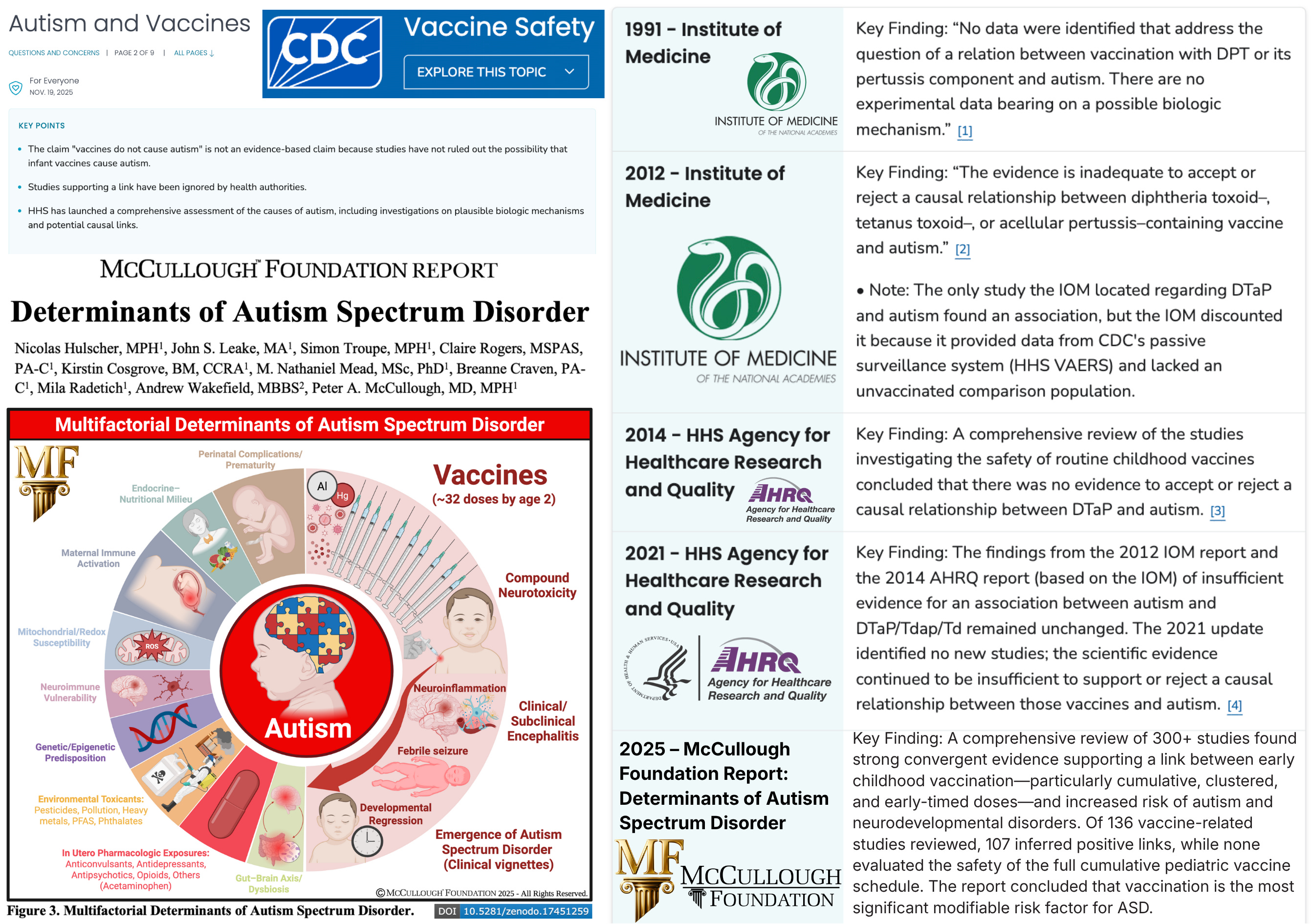
He notes that within 19 days of releasing this report, the CDC quietly altered its website to acknowledge that studies “have not ruled out” a link between vaccination and autism—a radical policy reversal following decades of categorical denial. Soon after, the Trump administration trimmed the national vaccine schedule from 17 to 11 recommended diseases (dropping 55 doses), echoing McCullough’s findings and European models like Denmark’s.
This shift signaled an institutional acknowledgment that something fundamental had broken. The once‑sacred vaccine calendar—thought untouchable—is now under public review. Americans no longer automatically conflate “public health” with trustworthiness.
5. From a Pandemic to a Movement for Medical Freedom
McCullough’s prescription is blunt: “Unschedule the vaccines.” He calls for abolition of all mandates, reinstatement of physician‑patient autonomy, and the repeal of the 1986 Vaccine Injury Compensation Act that shields manufacturers from liability. He warns that as long as regulatory immunity persists, profit will supersede safety, and science will remain subservient to commerce.
To restore legitimacy, he urges public release of all federal vaccination and mortality data for independent correlation analysis—something the CDC has avoided. The current refusal, he contends, proves systemic concealment of harm.
Ultimately, McCullough frames the crisis as a spiritual as well as medical reckoning. COVID-19 revealed not a failure of medicine alone but of integrity and humility in science itself. Americans, once trusting “the doctor knows best,” now recognize the need for critical self‑education and medical sovereignty.
Please subscribe to FOCAL POINTS as a paying ($5 monthly) or founder member so we can continue to bring you the truth.
Peter A. McCullough, MD, MPH
President, McCullough Foundation
📚 References
McCullough, Peter A., MD, MPH. The Lila Rose Show Interview Transcript, Recorded January 2026, Los Angeles, CA.
McCullough, Peter A. (2026). Unschedule the Vaccines! Let Doctors and Patients Decide, Focal Points (Courageous Discourse), Jan. 19, 2026.
Leake, John, McCullough, Peter A. (2025). Vaccines: Mythology, Ideology, and Reality. Skyhorse Publishing.
Nicolas Hulscher, MPH, John S. Leake, MA, Simon Troupe, MPH, Claire Rogers, MSPAS, PA-C, Kirstin Cosgrove, BM, CCRA, M. Nathaniel Mead, MSc, PhD, Breanne Craven, PA-C, Mila Radetich, Andrew Wakefield, MBBS, & Peter A. McCullough, MD, MPH. (2025). McCullough Foundation Report: Determinants of Autism Spectrum Disorder. Zenodo. https://doi.org/10.5281/zenodo.17451259
Centers for Disease Control and Prevention. Autism and Vaccines (Updated Oct. 2025).


