


By Peter A. McCullough, MD, MPH
It seems like everyone I know over age 65 is running into a problem in one or more of the large joints: shoulders, hips, or knees. So I decide to reach out to an expert.
📋 Focal Points Interview Summary: Dr. Peter McCullough × Dr. Erica Rowe Urquhart
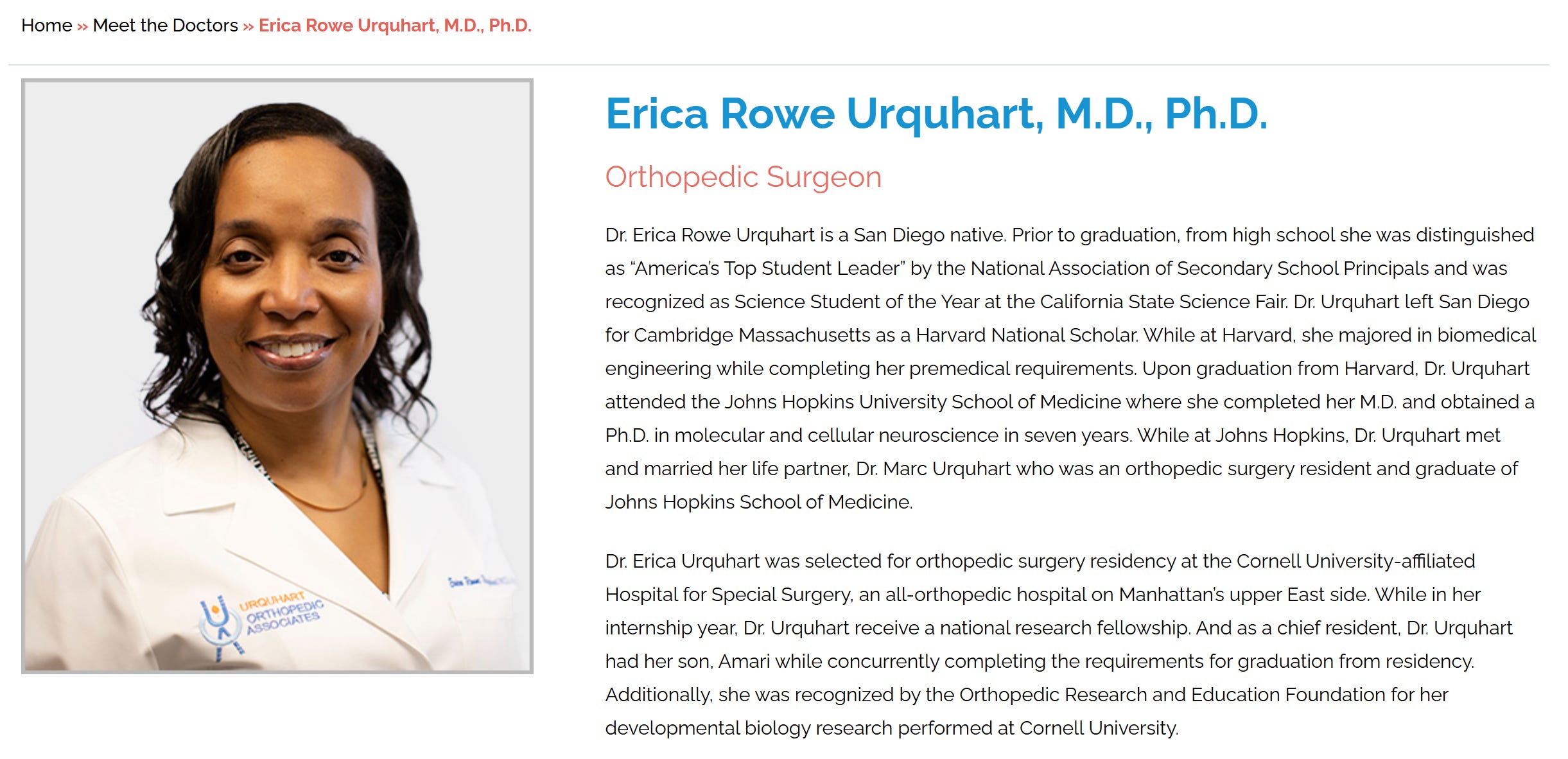
🧬 Background: Dr. Erica Rowe Urquhart, M.D., Ph.D., MBA
San Diego native — named “America’s Top Student Leader” by the NASSP and Science Student of the Year at the California State Science Fair before leaving for college
Harvard National Scholar — B.S. in Biomedical Engineering, Harvard College
Johns Hopkins University School of Medicine — completed both M.D. and Ph.D. in molecular and cellular neuroscience in seven years. Met her future husband, Dr. Marc Urquhart (then an orthopedic surgery resident), at a brunch hosted by Dr. Benjamin Carson for newly admitted medical students
Hospital for Special Surgery (Cornell-affiliated, Upper East Side NYC) — orthopedic surgery residency; national research fellowship during internship; OREF recognition for developmental biology research; completed residency as chief resident while having her son, Amari
Private practice — joined her husband at Urquhart Orthopedic Associates in northern New Jersey for ~20 years of general orthopedic surgery and sports medicine. Daughter Alexis born 2006
Oxford Said Business School MBA — earned after 15 years in practice to combat the insurance/billing bureaucracy
Author — The Invisible Hand Wielding the Scalpel: The Hidden Cause of America’s Healthcare Crisis (private equity, consolidation, and the erosion of independent practice)
🎙️ Interview Summary
The Structural Problem in Orthopedics
Epidemiology of chronic joint disease: The two dominant age-related shoulder conditions are osteoarthritis/arthropathy and rotator cuff tendinopathy or tears. Hips and knees are dominated by arthritis (osteo-, post-traumatic, or inflammatory).
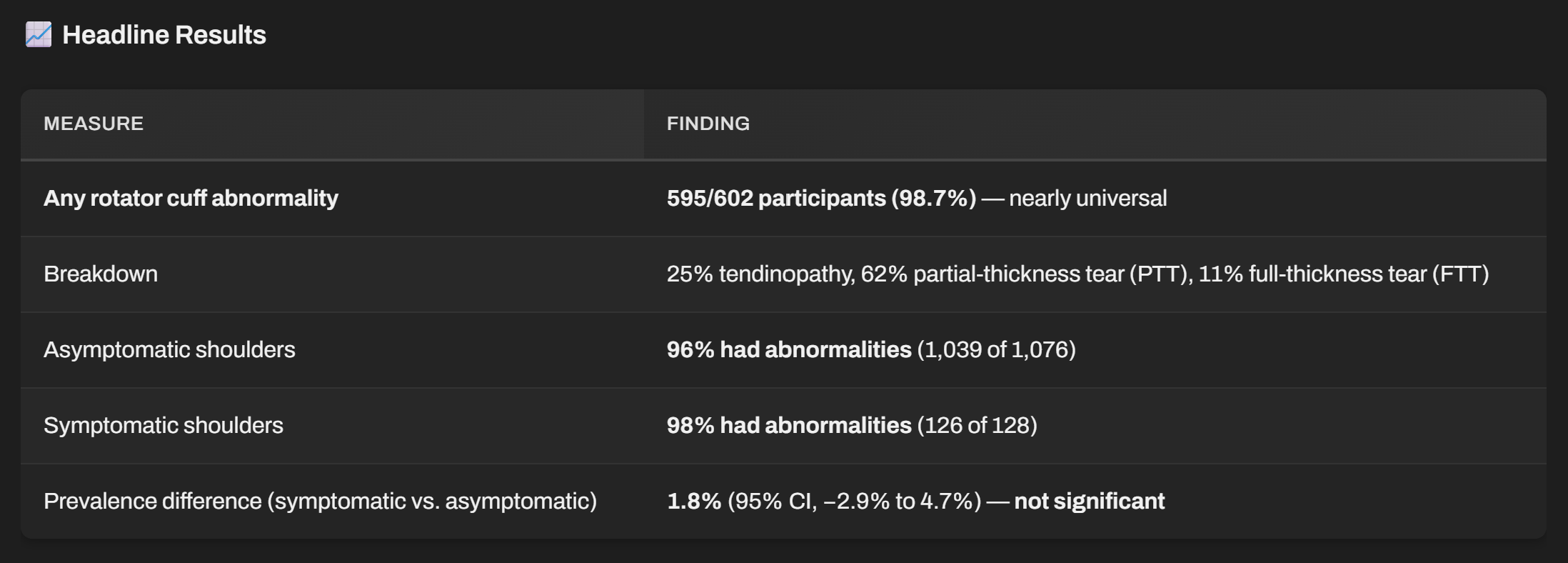
“We treat symptoms, not MRIs”: Urquhart’s most important clinical maxim — studies show huge proportions (over 90%) of asymptomatic adults have rotator cuff abnormalities on MRI. “We don’t treat MRI findings.” Treatment targets pain, limited motion, and lost function — not imaging pathology. Orthopedic conditions are rarely life-threatening, but the surgeries carry real complications (typically <1–2%, but “if it happens to you, that’s 100%”). Surgery demands corroboration between the diagnosis, functional limitation, and significant pain.
The physical exam trumps imaging: Urquhart watches patients the moment they walk in — gait, posture, how they move. The exam is more important than the studies. But third-party payers force diagnostic confirmation (MRI) before approving treatment, which is why imaging gets ordered even when the clinical picture is clear.
AI in the clinic: Her practice uses HIPAA-compliant AI ambient transcription for notes, freeing physicians to return to face-to-face patient interaction (versus keyboard-and-monitor charting). She draws a sharp distinction between machine learning (task-execution, transcription without improvisation) and AI (which is “taught to improvise” — hence hallucination, filling gaps with what it thinks happened).
On Media Bias & AI Integrity
McCullough cites the Wikipedia analysis showing ~97% left-leaning editorial bias despite a 50-50 country, and warns about factcheck.org and similar “fact-checking” outfits entering language models. He uses Alter AI as the McCullough Foundation’s aligned AI because it vows not to inject bias — demonstrated by whether an AI answers the question posed or instead front-loads “safe and effective” promotion unprompted.
Elon Musk: Robots Replacing Surgeons in 5 Years?
Musk claims robots will replace the best surgeons within five years. Urquhart’s verdict: fascinating but the timeline is contracted — she’d say 20–25 years for truly independent robotic surgery. Robots already assist in total joints and spine (precise placement), and humanoid robotics (she cites Unitree in China, which she visited on a study tour — IPO ~$250B) are advancing exponentially. But robots cannot yet handle:
Surgical judgment — knowing when not to operate (McCullough: Parkland’s 5-year general surgery maxim)
Real-time complication management — bleeding, unexpected pathology, adhesions, sutures that don’t hold, an assistant handing the wrong suture, a patient crashing in another organ system mid-case
“Could a robot perform surgery independently without the supervision of a surgeon? At this point, no.”
🔴 THE CORE SECTION: Chronic Nontraumatic Problems (Shoulders, Hips, Knees)
🦴 Shoulder
Two dominant age-related conditions:
Osteoarthropathy (arthritis) of the glenohumeral joint
Rotator cuff tendinopathy / tears
Treatment spectrum:
Rotator cuff issues → arthroscopic (camera) debridement/repair — same-day, less soft-tissue trauma, less pain
Degenerative arthropathy → shoulder replacement. If the rotator cuff is also torn, a reverse shoulder replacement is needed, which requires opening the soft-tissue plane — a longer recovery with more involved pain management, though still possible in an ambulatory setting
Why the rotator cuff is so vulnerable:
Vascularity — the tendons depend on blood supply for healing after overuse/inflammation. As we age, that healing capacity declines, so what might have been a minor reversible injury becomes a permanent one
The musculotendinous junction — the margin between muscle and tendon is where the vulnerability lies
Overuse is the #1 cause, though falls become more prevalent in older, higher-fall-risk patients
Anatomy mismatch: the big muscles (deltoid, pectoralis) do the coarse, powerful work — pressing, overhead, abduction. The rotator cuff handles finer movements (internal/external rotation). Big lifts strengthen the big muscles; you don’t meaningfully “strengthen the tendons” — you strengthen the muscles. That’s why recovery from a supraspinatus tear (as McCullough’s wife is experiencing, and he has a marathon history) is so slow
Frozen shoulder (adhesive capsulitis):
Comes up as a secondary problem after pain/injury — or seemingly out of nowhere in people in their 40s–50s (McCullough notes it’s well documented in diabetics)
🦵 Hip
Etiology of hip arthritis is multifactorial, not just “wear and tear”:
Genetic predisposition, anatomy (ball-and-socket articulation problems — a patient “born with anatomy that doesn’t facilitate normal articulation”) other conditions that lead to life long poor biomechanics — leg length discrepancy, varus/valgus alignment, bow-legged/knock-kneed patterns; add excess loading with obesity and the result is a total hip replacement
Post-traumatic — a fall years ago that injured cartilage, never treated, surfacing a decade later after pounds of weight gain over life.
Obesity’s dose-response effect on joint replacement:Journal: American Journal of Epidemiology / Public Health literature — PubMed 14580629 Design: Frequency-matched case-control, Utah, 1992–2000, 840 hip and 911 knee replacement patients (ages 55–74) vs. 5,578 matched controls

That’s a 16-to-19-fold increased odds of knee replacement in the severely obese. The knee effect dwarfs the hip effect — matching exactly what both Urquhart and McCullough said on air about the knee seeing a higher multiple of body weight.
The “is walking bad for your hips?” question:
Activity is not the driver. People who run/walk their whole lives (McCullough’s 30-marathon history; his 93-year-old mother-in-law, a lifelong walker with zero hip pain) don’t automatically wear out their joints. There’s an inverse relationship in the literature — lifelong runners don’t line up for hip replacements.
Williams’ National Runners’ Health Study at Berkeley Lab (“Effects of Running and Walking on Osteoarthritis and Hip Replacement Risk” Paul T. Williams, PhD — Life Sciences Division, Lawrence Berkeley National Laboratory Journal: Medicine & Science in Sports & Exercise (2013) DOI link: PMC3756679 cited by Dr McCullough:
Running reduces OA and hip replacement risk by roughly 15–50%, with the benefit mostly achieved at modest volumes and persisting even at extreme mileage
Running is not riskier than walking for joint health — the high-impact concern is largely myth
The protective effect is driven substantially by lower BMI (tying directly back to the obesity discussion) — but the mechanical/hormonal benefit of exercise appears genuine
Hip replacement — where it is now:
Materials: no huge changes in ~15 years
The real advance: robotic software/instrumentation for more precise, accurate prosthesis placement
Ambulatory/outpatient surgery: the fastest-growing shift — roughly 30% outpatient/70% in patient. Enabled by:
Regional nerve blocks — more specific anesthesia
Local pain medication layered in at the surgical site by the surgeon
Patients bear weight and walk the same day (they have to, to get home)
Pain is remarkably well controlled for the first days post-op as the body heals
🦶 Knee
Same principles as the hip — but amplified:
Obesity plays an even bigger role in the knee because of mechanics — the knee sees a higher multiple of body weight with ambulation, stairs, etc.
Outpatient split: roughly 60% inpatient / 40% outpatient (more knees done same-day than hips)
Knee patients often present with a higher baseline level of functionality than hip patients
Robotic assistance applies to knee instrumentation placement as well
Materials last longer — patients live with their first knee replacement far longer than 20–30 years ago
Age limits:
Urquhart’s practice hasn’t done elective arthroplasty in anyone over ~88 (speaking of elective joint replacement, not emergency hip fracture surgery). McCullough recounts his wife’s father living to 98 with bone-on-bone knees, lamenting that by the time knee replacement went “prime time,” he was simply too old — and trapped in the resource-constrained Canadian system
The flexion contracture problem:
If patients don’t maintain their rehab range of motion, knees can develop a chronic flexion contracture — the patient can no longer stand erect. McCullough’s elderly mother, after two knee replacements, has exactly this: her knees are stuck in chronic flexion from years of not getting full extension
Urquhart’s nuance: some older patients develop joint contractures regardless of surgery (natural aging), and those with memory issues/dementia are especially prone — elbow and wrist contractures happen too
🩸 Blood Clots & the Pandemic
McCullough pivots to DVT/PE risk, a topic central to his post-pandemic work:
Urquhart’s experience: She has not seen increased clot rates in her practice — because prophylaxis is much broader now (more anticoagulants approved for prevention).
McCullough’s counter: The secular use of novel anticoagulants (Eliquis, Xarelto, Pradaxa) has skyrocketed since the pandemic — due to broad exposure to the thrombogenic spike protein with SARS-CoV-2 infection and COVID-19 vaccination.
Kurdi et al “Impact of COVID-19 pandemic on the prescribing pattern of oral anticoagulants in the English primary care setting: a population-based segmented interrupted time series analysis of over 53 million individuals” Journal: Expert Review of Pharmacoeconomics & Outcomes Research (2025) — DOI 10.1080/17512433.2025.2473613 Date window: March 2018 – March 2024 (covers pre-, during-, and post-pandemic rates of anticoagulation use rose > 100%)

~97% of the population has had COVID; ~81% took a COVID vaccine that actively produced spike protein in the body long-term
One patient has had circulating Pfizer vaccine in his bloodstream for 3.5 years, producing spike protein — and has suffered multiple DVTs, PE, and myocarditis
Example: Jalen Hurts — had ankle surgery in 2018 with no thrombosis, then after 2021 vaccines developed superficial thrombosis, DVT, and PE
Spike detoxification: natural fibrinolytic/anticoagulant products — nattokinase (oral thrombolytic) and bromelain (natural oral anticoagulant, also a prescription eschar-removal ointment) — 30+ product rows on Amazon for “spike detoxification”
🏁 Closing
Urquhart emphasizes treatment doesn’t always have to be surgery, but as a surgeon she’s “biased toward clearly explaining to patients what surgical treatment would involve”
Contact: DrUrquhart.com (personal) and UrquhartOrthopedicAssociates.com (practice), northern New Jersey
📝Please subscribe to FOCAL POINTS as a paying ($5 monthly) or founder member so we can continue to bring you the truth. AlterAI may be used to assist in searches, synthesis, and review.
Peter A. McCullough, MD, MPH
President, McCullough Foundation
FOCAL POINTS has partnered with AlterAI to support independent research and open inquiry. Subscribe to AlterAI today and get a discount on unbiased and accurate AI!


