


By Peter A. McCullough, MD, MPH
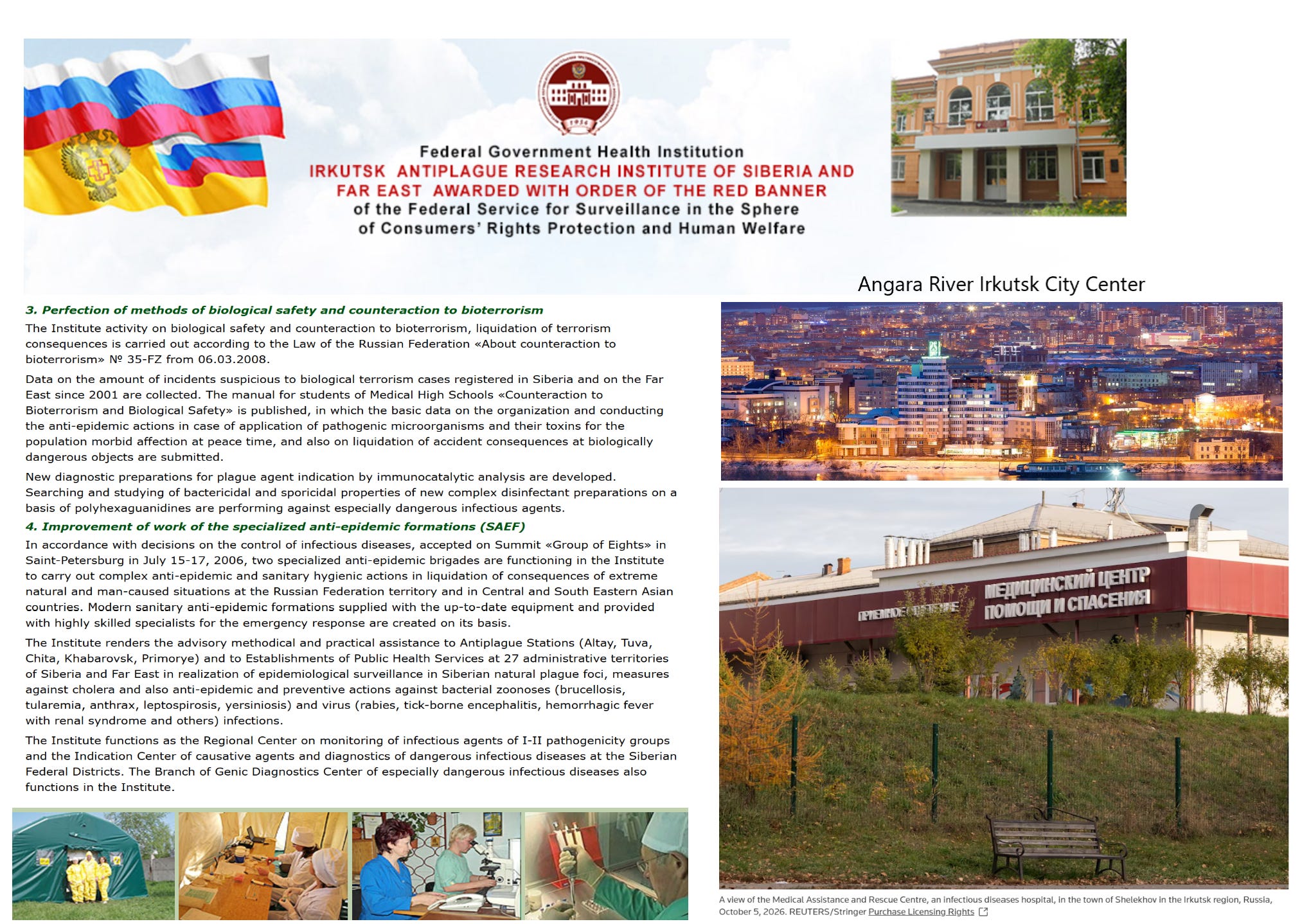
McCullough Foundation and The Wellness Company are following the breaking developments surrounding the death of a young woman who worked in the Anti-Plague Biolab in Siberia. The Institute was founded by the order of the Authorized Advice of Labour and Defense of the USSR № 1 from June 5, 1934 as a scientific operative body for plague control. Over the years the Institute began to work with other especially dangerous diseases: cholera, brucellosis, tularemia, anthrax, arbovirus infections. The City of Irkutsk: The metropolitan area of Irkutsk (where the Anti-Plague Institute sits) has an estimated 605,000 to 649,000 residents.
The Town of Shelekhov: The immediate town center where the Medical Assistance and Rescue Centre where she died on the ventilator has a population of approximately 42,000 to 55,000 people. I appeared on Just the News and made an important distinction about plague.
🦠 Two Plagues, One Bacterium
Yersinia pestis is the same organism either way. What changes is the route of entry, the dose, and the delivery mechanism—and those three variables decide whether you’re looking at a rat-borne outbreak that smolders for months or a respiratory pathogen that kills in days.
🐀 The Natural Form
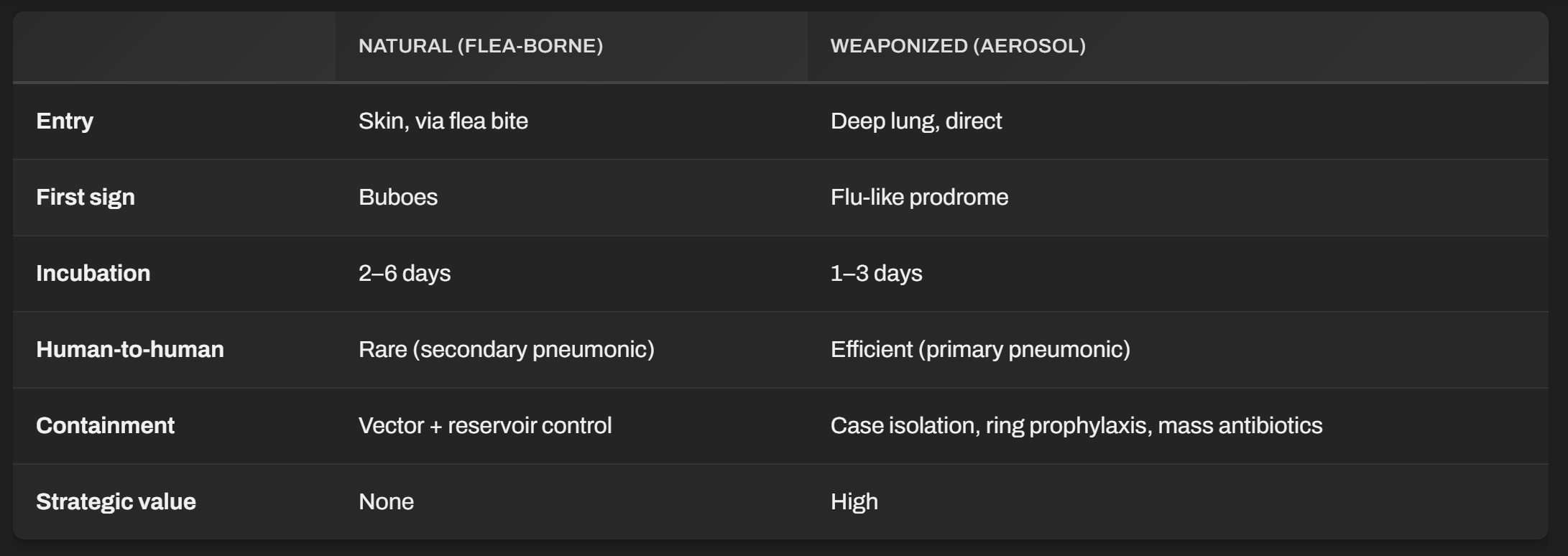
Bubonic plague is a zoonosis with a flea as the middleman. The flea takes a blood meal from an infected rodent, the bacteria multiply and block its gut, and the next bite regurgitates Y. pestis into the human bloodstream.
Route: subcutaneous, via flea bite
Dose: small, incidental
Onset: swollen, painful lymph nodes (buboes) after 2–6 days
Spread: requires a flea population and a rodent reservoir to sustain itself
Untreated mortality: historically 30–60%
This is a vector-dependent disease. Kill the fleas, control the rodents, and the outbreak dies. That’s why natural plague is a public-health problem—not a strategic one.
Pneumonic plague can arise naturally too, when bubonic infection seeds the lungs and the patient coughs bacteria into someone else’s face. But it’s a dead end in nature: secondary pneumonic cases burn hot and kill their host fast, often before they can infect many others.
🧪 The Weaponized Form
Bio-weaponization changes the physics of the encounter entirely.
Route: direct inhalation of aerosolized particles into the deep lung which can be sprayed by drone-fired cannisters
Dose: engineered for high concentration, uniform particle size (1–5 µm—the sweet spot that bypasses upper-airway filtering and lodges in the alveoli)
Onset: 1–3 days, sometimes faster
Symptoms: flu-like prodrome—fever, cough, bloody sputum—then fulminant pneumonia, sepsis, and respiratory collapse
Untreated mortality: approaching 100% for inhalational exposure
The critical difference is that inhalational plague skips the flea, skips the bubo, and skips the incubation window you’d use to identify and isolate cases. A person exposed to an aerosol is infectious and deteriorating within a day or two. There is no lymph-node warning sign. There is no rodent reservoir to trace. The infection curve is a vertical line.
This is why every biological weapons program that took plague seriously—the Soviet one above all—focused on aerosol delivery. The bacterium doesn’t need to be genetically modified to be devastating by inhalation; it just needs to be delivered to the right tissue in the right particle size.
⚖️ Why the Distinction Matters
A natural outbreak gives you time. An aerosol release does not. That asymmetry is the entire point of weaponization.
🏥 The Irkutsk Case
The death of 28-year-old Darya Shipilova, a laboratory technician at the Irkutsk Anti-Plague Institute of Siberia and the Far East, has produced a textbook case of institutional non-answers. She died on October 2, 2026, of what Rospotrebnadzor calls “pneumonia of unknown etiology.”
But look at how the authorities have behaved—not what they’ve said:
~200 contacts quarantined, with FSB escorts reportedly accompanying ambulances for testing
A regional governor initially said “plague,” then quietly edited in the word “possibly”
A state television channel reportedly deleted five articles about the incident
The institute’s biosafety committee declared “no emergency situations involving pathogenic microorganisms”—the same boilerplate you’d expect whether or not one occurred
The WHO has asked Russia what pathogen actually killed her. It’s still waiting
Shipilova is listed as a co-author on Yersinia pestis research published earlier this year
No one has confirmed pneumonic plague. But the containment posture—quarantining 200 people for a “pneumonia of unknown cause”—is not the response you mount for a routine respiratory infection. That is the response you mount when you suspect bioweapon-grade, primary inhalational plague, the kind that comes from a broken tube in a BSL-3 facility rather than a flea on a rat. While unconfirmed, the Russian public authorities are behaving exactly as they would if the 28-year-old died of aerosolized Yersinia pestis—and the gap between their words and their actions is the story.
📝Please subscribe to FOCAL POINTS as a paying ($5 monthly) or founder member so we can continue to bring you the truth. AlterAI may be used to assist in searches, synthesis, and review.
Peter A. McCullough, MD, MPH
Chief Scientific Officer, The Wellness Company


